THERMODYNAMICS
Chapter 5: Entropy & the Second Law of Thermodynamics
Practice Questions & Full Solutions
10 Questions | Easy · Medium · Hard | Full Worked Solutions
Topics Covered
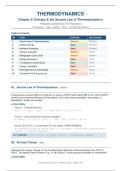
Q# Topic Difficulty Key Concept
1 Second Law of Thermodynamics Medium Efficiency
2 Entropy Change Easy Efficiency
3 Isentropic Processes Hard Efficiency
4 Clausius Inequality Medium Entropy
5 Refrigeration Cycle (COP) Medium Entropy
6 Entropy Generation Hard Cycles
7 T-s Diagram & Carnot Cycle Easy Cycles
8 Exergy / Availability Hard Exergy
9 Reversible Work & Irreversibility Medium Exergy
10 Combined First & Second Law Hard Exergy
Q1. Second Law of Thermodynamics Medium
A heat engine receives 800 kJ of heat from a source at 900 K and rejects 500 kJ to a sink at 300 K.
(a) What is the thermal efficiency of this engine? (b) Is this engine reversible, irreversible, or
impossible? Justify your answer.
✔ SOLUTION
Part (a) – Thermal Efficiency:
η_th = 1 - Q_L / Q_H = 1 - = 0.375 = 37.5%
Part (b) – Carnot Efficiency (maximum possible):
η_Carnot = 1 - T_L / T_H = 1 - = 0.667 = 66.7%
Since η_th (37.5%) < η_Carnot (66.7%), the engine is IRREVERSIBLE.
An impossible engine would have η > η_Carnot. A reversible engine would
have η = η_Carnot exactly.
KEY ANSWER: η_th = 37.5% < η_Carnot = 66.7% → Irreversible engine
Q2. Entropy Change Easy
Calculate the entropy change of 2 kg of water being heated at constant pressure from 20°C to
100°C. The specific heat of water is cp = 4.18 kJ/(kg·K). Is this process reversible or irreversible?
✔ SOLUTION
Thermodynamics Ch.5 — Practice Q&A | Page 1 of 6
, Convert temperatures to Kelvin:
T₁ = 20 + 273.15 = 293.15 K
T₂ = 100 + 273.15 = 373.15 K
Entropy change for constant-pressure heating:
ΔS = m × cp × ln(T₂ /T₁ )
ΔS = 2 × 4.18 × ln(373..15)
ΔS = 8.36 × ln(1.2729)
ΔS = 8.36 × 0.2408
ΔS ≈ 2.013 kJ/K
Since ΔS > 0, entropy increases. Heating over a finite temperature difference is an IRREVERSIBLE
process.
KEY ANSWER: ΔS ≈ 2.013 kJ/K (positive → irreversible process)
Q3. Isentropic Processes Hard
Air (ideal gas, γ = 1.4, cp = 1.005 kJ/kg·K) undergoes an isentropic compression from state 1 (P₁ =
100 kPa, T₁ = 300 K) to state 2 (P₂ = 800 kPa). Find: (a) T₂ , (b) specific work input, and (c)
change in entropy.
✔ SOLUTION
Part (a) – Temperature at state 2 (isentropic relation):
T₂ /T₁ = (P₂ /P₁ )^((γ-1)/γ)
T₂ = 300 × (800/100)^((1.4-1)/1.4)
T₂ = 300 × (8)^(0.2857)
T₂ = 300 × 1.811 = 543.4 K
Part (b) – Specific work input (isentropic compressor):
w_in = cp × (T₂ - T₁ ) = 1.005 × (543.4 - 300)
w_in = 1.005 × 243.4 = 244.6 kJ/kg
Part (c) – Entropy change:
By definition of an isentropic process: ΔS = 0 kJ/K
An isentropic process is both adiabatic (q = 0) and reversible.
KEY ANSWER: T₂ = 543.4 K | w_in = 244.6 kJ/kg | ΔS = 0 (isentropic)
Q4. Clausius Inequality Medium
A system undergoes a cycle consisting of three processes: Process 1→2: Q₁ ₂ = +500 kJ at T =
1000 K; Process 2→3: Q₂ ₃ = -200 kJ at T = 500 K; Process 3→1: Q₃ ₁ = -100 kJ at T = 300 K.
Apply the Clausius inequality to determine if this cycle is possible.
✔ SOLUTION
Apply the Clausius inequality: ∮ δQ/T ≤ 0
Sum of δQ/T around the cycle:
∮ δQ/T = Q₁ ₂ /T₁ ₂ + Q₂ ₃ /T₂ ₃ + Q₃ ₁ /T₃ ₁
∮ δQ/T = 500/1000 + (-200)/500 + (-100)/300
Thermodynamics Ch.5 — Practice Q&A | Page 2 of 6