
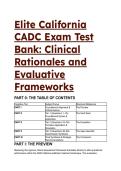
Elite California
CADC Exam Test
Bank: Clinical
Rationales and
Evaluative
Frameworks
PART 0: THE TABLE OF CONTENTS
Cognitive Tier Subject Focus Structural Reference
PART I Foundational Alignment & The Preview
Critical Axioms
PART II Tier 1 (Questions 1–15): The Hard Deck
Foundational Syntax &
Application
PART II Tier 2 (Questions 16–35): The Escalation
Complex Application &
Simulation
PART II Tier 3 (Questions 36–60): The Apex Gauntlet
Grandmaster Synthesis
PART III Final Synthesis & Strategic The Conclusion
Recommendations
PART I: THE PREVIEW
Mastering this rigorous clinical assessment framework translates directly to elite operational
performance within the 2026 California addiction treatment landscape. This evaluative
,document replaces rote memorization with a profound, simplified command of the highly
complex clinical, ethical, and legal frameworks required of a modern Certified Alcohol and Drug
Counselor (CADC). The analysis demonstrates how advanced academic theory is seamlessly
synthesized into high-stakes clinical application, prioritizing patient safety, legal compliance, and
evidence-based methodologies.
The "Critical Axioms" Data Architecture: 2026 Standards
Regulatory/Clinical Framework 2026 Evaluative Mandate Operational Clinical Impact
ASAM Criteria 4th Edition Treatment is structured via six Withdrawal management is
Paradigm dimensions. "Readiness to integrated into standard care
Change" is integrated across all levels (e.g., Level 3.5 manages
areas and replaced by clinically managed withdrawal,
Dimension 6: Person-Centered eliminating Level 3.2).
Considerations.
California Minor Consent Minors exactly 12 years or Replacement narcotic therapy
(Family Code 6929) older possess the legal strictly requires parental
authority to independently consent unless the minor is 16
consent to SUD counseling. or older and federally permitted.
CCAPP Ethical Boundary A mandatory two-year embargo Any violation of these
Standard exists for sexual/social chronological boundaries
relationships post-termination; constitutes a catastrophic
a one-year embargo exists for breach of the professional
business relationships. power dynamic and state law.
IC&RC ADC Domain Domain III (Evidence-Based The examination structure
Distribution Treatment) carries the highest heavily prioritizes the applied
weight at 30%, followed by execution of therapeutic
Domains I and IV (25% each), interventions and ethical
and Domain II (20%). compliance over pure
screening metrics.
CCAPP Continuing Credential renewal demands 50 Cultural competency and strict
Education (CE) Mandate total CE hours biennially. ethical adherence are
Exactly 9 hours must be Ethics, non-negotiable, mathematically
with a minimum of 3 addressing enforced requirements for
diversity/inclusion. maintaining clinical licensure.
PART II: THE ELITE TEST BANK
Tier 1: Foundational Syntax & Application (Questions 1–15)
Q1: A credentialed counselor is conducting an intake assessment utilizing the ASAM Criteria,
4th Edition. The patient demonstrates high clinical severity but faces severe transportation
deficits and housing instability. Based on the 2026 updates, within which structural dimension
must the clinician document these specific barriers to care? A) Dimension 4: Substance
Use-Related Risks B) Dimension 6: Person-Centered Considerations C) Dimension 5: Recovery
Environment Interactions D) Dimension 4: Readiness to Change
● The Answer: B (Dimension 6: Person-Centered Considerations)
● Distractor Analysis:
○ A is incorrect: Dimension 4 calculates the behavioral probability of future relapse or
risky substance use, rather than logistical barriers.
, ○ C is incorrect: Dimension 5 specifically maps the external recovery environment,
but the 4th Edition explicitly re-categorized personal treatment barriers and
preferences into the newly established Dimension 6.
○ D is incorrect: "Readiness to Change" was entirely dismantled as an independent
dimension in the 4th Edition and structurally integrated across all other dimensions.
The Mentor's Analysis: The ASAM 4th Edition introduces a paradigm shift regarding health
equity. By formalizing Dimension 6: Person-Centered Considerations, the framework legally and
clinically codifies the social determinants of health as primary diagnostic criteria that modify the
treatment plan. Professional/Academic Intuition: Social determinants of health dictate the
treatment trajectory; Dimension 6 isolates and formalizes the operational barriers to care.
Q2: Under the California Consortium of Addiction Programs and Professionals (CCAPP) Code
of Conduct, what is the EXACT time restriction regarding a practitioner entering into a business
relationship with a former client? A) Six months from the termination of the counseling
relationship. B) One year from the termination of the counseling relationship. C) Two years from
the termination of the counseling relationship. D) Business relationships with former clients are
permanently prohibited.
● The Answer: B (One year from the termination of the counseling relationship.)
● Distractor Analysis:
○ A is incorrect: Six months is an arbitrary timeframe not recognized by CCAPP
professional standards.
○ C is incorrect: Two years is the mandatory embargo specifically reserved for sexual
or social relationships, not commerce.
○ D is incorrect: While highly discouraged ethically, it is not permanently prohibited by
the literal text of the CCAPP code.
The Mentor's Analysis: Ethical boundary management requires precise adherence to
chronological mandates. The CCAPP Code bifurcates its timeline to address different tiers of
exploitation: one year for financial/business boundaries, and two years for sexual/social
boundaries. Professional/Academic Intuition: Dual relationships carry mathematical
expiration dates under CCAPP: 1 year for commerce, 2 years for intimacy.
Q3: A 14-year-old student presents to a state-funded outpatient clinic in California requesting
treatment for severe alcohol use disorder. The student explicitly refuses to allow the facility to
contact their parents. According to California Family Code Section 6929, which operational
action is the MOST APPROPRIATE? A) Refuse services, as minors under 16 cannot consent to
medical care. B) Admit the student, as minors 12 years of age or older may independently
consent to drug or alcohol-related counseling. C) Contact the parents immediately, as outpatient
clinics are exempt from minor consent laws. D) Admit the student but strictly mandate parental
involvement within 48 hours.
● The Answer: B (Admit the student, as minors 12 years of age or older may independently
consent to drug or alcohol-related counseling.)
● Distractor Analysis:
○ A is incorrect: The statutory age for SUD behavioral treatment consent in California
is exactly 12, not 16.
○ C is incorrect: Breaching confidentiality without the minor's consent violates both
State law and federal 42 CFR Part 2 privacy statutes.
○ D is incorrect: While Family Code 6929 states the treatment plan "shall include the
involvement of the minor's parent... if appropriate," the professional determines
appropriateness. It is not an automatic 48-hour requirement that supersedes
consent.

