

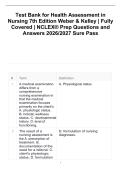
Test Bank for Health Assessment in
Nursing 7th Edition Weber & Kelley | Fully
Covered | NCLEX® Prep Questions and
Answers 2026/2027 Sure Pass
# Term Definition
1 A medical examination A. Physiological status
differs from a
comprehensive
nursing examination in
that the medical
examination focuses
primarily on the client's
A. physiologic status.
B. holistic wellness
status. C. developmental
history. D. level of
functioning.
2 The result of a D. formulation of nursing
nursing assessment is diagnoses.
the A. prescription of
treatment. B.
documentation of the
need for a referral. C.
client's physiologic
status. D. formulation
1
, of nursing diagnoses.
3 Although the A. continuous.
assessment phase of
the nursing process
precedes the other
phases, the
assessment phase is
A. continuous. B.
compieted on
admission. C. linear. D.
performed only by
nurses.
4 When a client first D. comprehensive.
entres the hospital for
an elective surgical
procedure, the nurse
should perform an
assessment termed
A. entry. B.
exploratory. C.
focused. D.
comprehensive.
5 An ongoing or partial D. includes a brief reassessment
assessment of a client of the client's normal body system.
A. focuses on a
specific problem of the
client. B. includes a
comprehensive
overview of all body
systems. C. is usually
performed by another
health care worker. D.
includes a brief
reassessment of the
2
,client's normal body
system.
3
, HEALTH ASSESSMENT
# Term Definition
6 To prepare for the C. review the client's health care
assessment of a client record.
visiting a
neighborhood health
care clinic, the nurse
should first A. discuss
the client's symptoms
with other team
members. B. plan for
potential laboratory
procedures. C. review
the client's health care
record. D. determine
potential health care
resources.
7 The nurse is preparing C. avoid premature judgments
to meet a client in the about the client.
clinic for the first time.
After reviewing the
client's record, the
nurse should A.
analyze data that
have already been
collected. B. review
any past collaborative
problems. C. avoid
premature judgments
about the client. D.
consult with the
client's family
members.
4
Nursing 7th Edition Weber & Kelley | Fully
Covered | NCLEX® Prep Questions and
Answers 2026/2027 Sure Pass
# Term Definition
1 A medical examination A. Physiological status
differs from a
comprehensive
nursing examination in
that the medical
examination focuses
primarily on the client's
A. physiologic status.
B. holistic wellness
status. C. developmental
history. D. level of
functioning.
2 The result of a D. formulation of nursing
nursing assessment is diagnoses.
the A. prescription of
treatment. B.
documentation of the
need for a referral. C.
client's physiologic
status. D. formulation
1
, of nursing diagnoses.
3 Although the A. continuous.
assessment phase of
the nursing process
precedes the other
phases, the
assessment phase is
A. continuous. B.
compieted on
admission. C. linear. D.
performed only by
nurses.
4 When a client first D. comprehensive.
entres the hospital for
an elective surgical
procedure, the nurse
should perform an
assessment termed
A. entry. B.
exploratory. C.
focused. D.
comprehensive.
5 An ongoing or partial D. includes a brief reassessment
assessment of a client of the client's normal body system.
A. focuses on a
specific problem of the
client. B. includes a
comprehensive
overview of all body
systems. C. is usually
performed by another
health care worker. D.
includes a brief
reassessment of the
2
,client's normal body
system.
3
, HEALTH ASSESSMENT
# Term Definition
6 To prepare for the C. review the client's health care
assessment of a client record.
visiting a
neighborhood health
care clinic, the nurse
should first A. discuss
the client's symptoms
with other team
members. B. plan for
potential laboratory
procedures. C. review
the client's health care
record. D. determine
potential health care
resources.
7 The nurse is preparing C. avoid premature judgments
to meet a client in the about the client.
clinic for the first time.
After reviewing the
client's record, the
nurse should A.
analyze data that
have already been
collected. B. review
any past collaborative
problems. C. avoid
premature judgments
about the client. D.
consult with the
client's family
members.
4

