
Penn State University
WEIVER • 1 MAXE
PSU
NURS College of Nursing — NURS 251 Exam 1 Review
W E A R E · P E N N S TAT E
251
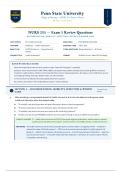
NURS 251 — Exam 1 Review Questions
D O CU M E N TAT I O N , M O B I L I TY, I N F E C T I O N CO N T R O L & W O U N D C A R E
INSTITUTION Penn State University EXAM CODE PSU-NURS251-EX1-2026
PROGRAM NURS 251 — Health Assessment ACADEMIC YEAR
EXAM TITLE NURS 251 Exam 1 — Comprehensive TOTAL QUESTIONS Review Questions — All Topics
Review
COURSE TITLE Health Assessment FORMAT Multiple Choice / Select All That Apply
REVIEW INSTRUCTIONS
▸ Select the single best answer for each question unless "Select All That Apply" is specified.
▸ Questions cover documentation (EHR, HIPAA, ISBAR, charting formats), patient mobility and positioning (ROM, contracture
prevention, safe transfers), infection control (standard/transmission-based precautions, HAI, sepsis, chain of infection), wound
care (staging, healing, dressings, Braden Scale), and self-care/ADLs.
▸ Correct answers and detailed rationales appear below each question.
▸ All content is derived from Penn State NURS 251 Exam 1 review materials.
SECTION I — DOCUMENTATION, MOBILITY, INFECTION & WOUND Comprehensive
CARE Review
1. After educating nursing students about the health care record, the instructor determines the group needs
additional instruction when the students state:
A. "The health care record provides valuable information about a client's assessment."
B. "The record provides a means for decisions about reimbursement for care."
C. "The health care record can serve as a resource for conducting research."
D. "Health care records are PRIMARILY used for communication among nurses and health care providers."
CORRECT ANSWER D — Health care records serve MULTIPLE purposes: legal documentation, reimbursement, research,
quality assurance, AND communication. Communication is only ONE purpose, not the primary one.
RATIONALE The health care record serves many purposes beyond communication: (1) Legal document — evidence in
malpractice cases; (2) Reimbursement — CMS/insurance requires documentation to justify payment; (3)
Research — data for clinical studies; (4) Quality assurance — monitoring outcomes; (5) Education — teaching
tool; (6) Communication — among the healthcare team. Stating it is "primarily" for communication reflects
incomplete understanding.
, 2. The nurse documents a progress note differentiating between assessment findings the nurse obtained directly
and data the client describes. This is what form of documentation?
A. PIE note
B. SOAP note — Subjective (what client says), Objective (what nurse observes), Assessment, Plan
C. Flow Sheet
D. Narrative note
CORRECT ANSWER B — SOAP notes separate Subjective data (client's description/symptoms) from Objective data (nurse's
direct observations/measurements).
RATIONALE SOAP format: S (Subjective) — what the client reports ("I have pain"); O (Objective) — what the nurse
observes/measures (vital signs, wound appearance, lung sounds); A (Assessment) — nurse's clinical
judgment/analysis; P (Plan) — interventions and goals. PIE (Problem-Intervention-Evaluation) organizes by
problem. DAR (Data-Action-Response) is a focus charting format. Flow sheets track routine data.
3. Which information would the nurse be unable to locate in the client care summary (Kardex)?
A. IV therapy
B. Code Status
C. Activity Status
D. Bowel Assessment — this is detailed clinical data found in progress notes, not the Kardex summary
CORRECT ANSWER D — Bowel assessment is detailed clinical information documented in progress notes. The Kardex/care
summary contains concise reference information: IV therapy, code status, activity level, diet, allergies,
and daily labs.
RATIONALE The Kardex (client care summary) is a quick-reference tool containing: patient demographics, medical
diagnoses, code status (DNR/full code), allergies, activity orders, diet, IV therapy, scheduled tests/procedures,
and special equipment needs. It does NOT contain detailed assessment data (bowel sounds, lung sounds,
wound descriptions) — those belong in progress notes/flow sheets.
4. Documentation that takes place as care occurs is referred to as:
A. Retrospective documentation
B. Point-of-care documentation — TRUE
C. Batch charting
D. End-of-shift charting
CORRECT ANSWER TRUE — Point-of-care documentation is recording care at the time it is delivered, ideally at the
bedside. This increases accuracy and timeliness.
RATIONALE Point-of-care documentation is best practice — documenting while in the patient's room performing
procedures. Benefits: (1) Increased accuracy — less reliance on memory; (2) Real-time data available to the
entire team; (3) Reduced errors from delayed charting; (4) Improved communication at shift change. Delayed
documentation (end-of-shift) increases error risk and is not recommended.
WEIVER • 1 MAXE
PSU
NURS College of Nursing — NURS 251 Exam 1 Review
W E A R E · P E N N S TAT E
251
NURS 251 — Exam 1 Review Questions
D O CU M E N TAT I O N , M O B I L I TY, I N F E C T I O N CO N T R O L & W O U N D C A R E
INSTITUTION Penn State University EXAM CODE PSU-NURS251-EX1-2026
PROGRAM NURS 251 — Health Assessment ACADEMIC YEAR
EXAM TITLE NURS 251 Exam 1 — Comprehensive TOTAL QUESTIONS Review Questions — All Topics
Review
COURSE TITLE Health Assessment FORMAT Multiple Choice / Select All That Apply
REVIEW INSTRUCTIONS
▸ Select the single best answer for each question unless "Select All That Apply" is specified.
▸ Questions cover documentation (EHR, HIPAA, ISBAR, charting formats), patient mobility and positioning (ROM, contracture
prevention, safe transfers), infection control (standard/transmission-based precautions, HAI, sepsis, chain of infection), wound
care (staging, healing, dressings, Braden Scale), and self-care/ADLs.
▸ Correct answers and detailed rationales appear below each question.
▸ All content is derived from Penn State NURS 251 Exam 1 review materials.
SECTION I — DOCUMENTATION, MOBILITY, INFECTION & WOUND Comprehensive
CARE Review
1. After educating nursing students about the health care record, the instructor determines the group needs
additional instruction when the students state:
A. "The health care record provides valuable information about a client's assessment."
B. "The record provides a means for decisions about reimbursement for care."
C. "The health care record can serve as a resource for conducting research."
D. "Health care records are PRIMARILY used for communication among nurses and health care providers."
CORRECT ANSWER D — Health care records serve MULTIPLE purposes: legal documentation, reimbursement, research,
quality assurance, AND communication. Communication is only ONE purpose, not the primary one.
RATIONALE The health care record serves many purposes beyond communication: (1) Legal document — evidence in
malpractice cases; (2) Reimbursement — CMS/insurance requires documentation to justify payment; (3)
Research — data for clinical studies; (4) Quality assurance — monitoring outcomes; (5) Education — teaching
tool; (6) Communication — among the healthcare team. Stating it is "primarily" for communication reflects
incomplete understanding.
, 2. The nurse documents a progress note differentiating between assessment findings the nurse obtained directly
and data the client describes. This is what form of documentation?
A. PIE note
B. SOAP note — Subjective (what client says), Objective (what nurse observes), Assessment, Plan
C. Flow Sheet
D. Narrative note
CORRECT ANSWER B — SOAP notes separate Subjective data (client's description/symptoms) from Objective data (nurse's
direct observations/measurements).
RATIONALE SOAP format: S (Subjective) — what the client reports ("I have pain"); O (Objective) — what the nurse
observes/measures (vital signs, wound appearance, lung sounds); A (Assessment) — nurse's clinical
judgment/analysis; P (Plan) — interventions and goals. PIE (Problem-Intervention-Evaluation) organizes by
problem. DAR (Data-Action-Response) is a focus charting format. Flow sheets track routine data.
3. Which information would the nurse be unable to locate in the client care summary (Kardex)?
A. IV therapy
B. Code Status
C. Activity Status
D. Bowel Assessment — this is detailed clinical data found in progress notes, not the Kardex summary
CORRECT ANSWER D — Bowel assessment is detailed clinical information documented in progress notes. The Kardex/care
summary contains concise reference information: IV therapy, code status, activity level, diet, allergies,
and daily labs.
RATIONALE The Kardex (client care summary) is a quick-reference tool containing: patient demographics, medical
diagnoses, code status (DNR/full code), allergies, activity orders, diet, IV therapy, scheduled tests/procedures,
and special equipment needs. It does NOT contain detailed assessment data (bowel sounds, lung sounds,
wound descriptions) — those belong in progress notes/flow sheets.
4. Documentation that takes place as care occurs is referred to as:
A. Retrospective documentation
B. Point-of-care documentation — TRUE
C. Batch charting
D. End-of-shift charting
CORRECT ANSWER TRUE — Point-of-care documentation is recording care at the time it is delivered, ideally at the
bedside. This increases accuracy and timeliness.
RATIONALE Point-of-care documentation is best practice — documenting while in the patient's room performing
procedures. Benefits: (1) Increased accuracy — less reliance on memory; (2) Real-time data available to the
entire team; (3) Reduced errors from delayed charting; (4) Improved communication at shift change. Delayed
documentation (end-of-shift) increases error risk and is not recommended.

