

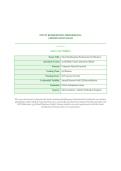
INTUIT BOOKKEEPING PROFESSIONAL
CERTIFICATION EXAM
━━━━━━━━━━━━━━━━━━━━━━━━━━━━━━━━━━━━━━━━━━━━━━
━━━━
Edition
Exam Title Intuit Bookkeeping Professional Certification
Question Count 50 Multiple-Choice Questions (MCQ)
Format Computer-Based, Proctored
Testing Time 90 Minutes
Passing Score 80% (40/50 Correct)
Credential Validity Annual Renewal with CE/Recertification
Domains 8 Core Competency Areas
Source Intuit Academy / Intuit Certification Program
This exam document is aligned with Intuit Academy Bookkeeping Professional Certification curriculum,
QuickBooks Online Help & Learning Resources, Generally Accepted Accounting Principles (GAAP), and
IRS Publication 334 (Small Business Guide). Always confirm current requirements with the Intuit
Certification Program prior to examination.
, EXAM INSTRUCTIONS
• This examination consists of 50 multiple-choice questions (MCQ) covering eight core competency
domains of the Intuit Bookkeeping Professional Certification.
• Each question has four answer options (A, B, C, D). Select the single best answer unless the question
is explicitly marked as Select-All-That-Apply (SATA).
• Questions are presented in bold. Correct answers are highlighted in bold green (#32CD32).
Rationales are provided in italic with a lavender background.
• You have 90 minutes to complete this examination. A passing score of 80% (40/50 correct) is
required for certification eligibility.
• This exam assesses proficiency in bookkeeping fundamentals, QuickBooks Online proficiency, and
professional practice competency aligned with Intuit certification standards.
• No outside materials, electronic devices, or reference resources are permitted during the proctored
examination unless specifically authorized.
Domain 1
Bookkeeping Fundamentals & Accounting Principles
Double-Entry Accounting, Accounting Equation, Accrual vs. Cash Basis, Chart of Accounts, Financial
Statement Relationships
Q1. In double-entry accounting, when a business purchases office supplies on account for
$500, which of the following correctly records this transaction?
A) Debit Office Supplies $500; Credit Cash $500
B) Debit Office Supplies $500; Credit Accounts Payable $500
C) Debit Accounts Payable $500; Credit Office Supplies $500
D) Debit Cash $500; Credit Office Supplies $500
Correct Answer: B
Rationale: Purchasing office supplies on account increases the Office Supplies asset (debit) and
increases the Accounts Payable liability (credit). This follows the double-entry principle where
every transaction affects at least two accounts with equal debits and credits. Option A incorrectly
credits Cash, which would apply only if the purchase were paid immediately. Option C reverses
the debit/credit entries, and Option D incorrectly debits Cash while crediting Office Supplies,
which would represent a sale of supplies for cash rather than a purchase on account.
Q2. The accounting equation Assets = Liabilities + Equity must always remain in balance. If
a company's total assets are $125,000 and its total liabilities are $45,000, what is the
owner's equity?
A) $170,000
B) $80,000
C) $125,000
D) $45,000
Correct Answer: B
Rationale: Using the accounting equation, Equity = Assets - Liabilities = $125,000 - $45,000 =
$80,000. The accounting equation must always balance, meaning total resources (assets) must
equal the claims against those resources (liabilities plus owner's equity). Option A adds assets and
liabilities rather than subtracting. Option C simply restates the asset value without performing
the calculation. Option D restates the liability amount without computing equity.
, Q3. Under accrual basis accounting, when should revenue be recognized?
A) When the customer pays the invoice
B) When the product or service is delivered to the customer
C) When the invoice is mailed to the customer
D) When the business needs the revenue to meet financial targets
Correct Answer: B
Rationale: Under accrual basis accounting, the revenue recognition principle requires that
revenue be recorded when it is earned, which occurs when the product or service is delivered,
regardless of when cash is received. Option A describes cash basis accounting timing. Option C is
incorrect because mailing an invoice does not constitute performance of the service or delivery of
goods. Option D violates GAAP principles entirely, as revenue recognition must never be driven
by financial targets or manipulation.
Q4. A company uses cash basis accounting. In December 2026, it receives a $3,000
advance payment from a customer for services to be performed in January 2027. How
should this payment be recorded in December 2026?
A) As a liability (Unearned Revenue) on the balance sheet
B) As revenue on the income statement for December 2026
C) As a prepaid expense on the balance sheet
D) As a contra-revenue account on the income statement
Correct Answer: B
Rationale: Under cash basis accounting, revenue is recognized when cash is received, regardless
of when the service is actually performed. Therefore, the $3,000 advance payment is recorded as
revenue in December 2026 when the cash is received. Option A describes the correct accrual basis
treatment, where unearned revenue would be recorded as a liability until the service is
performed. Option C misclassifies the transaction as a prepaid expense, which applies to expenses
paid in advance, not revenue received. Option D incorrectly treats the amount as a contra-
revenue deduction.
Q5. Which of the following is the most appropriate numbering system for a Chart of
Accounts in a small retail business using QuickBooks Online?
A) Sequential numbering starting at 1 with no category grouping
B) Account numbers using a hierarchical system: 1000s for assets, 2000s for
liabilities, 3000s for equity, 4000s for revenue, 5000s-6000s for expenses
C) Alphabetical ordering based on account names
D) Random numbering assigned by the software with no logical structure
Correct Answer: B
Rationale: A hierarchical numbering system using ranges (1000s for assets, 2000s for liabilities,
etc.) is the standard best practice for Chart of Accounts design because it provides logical
grouping, allows for easy account identification, and supports future expansion by leaving gaps
within each range. Option A provides no categorization, making financial statement preparation
and analysis difficult. Option C does not support numerical sorting or account type grouping.
Option D eliminates any organizational benefit that account numbering should provide.
Q6. How does the Net Income reported on the Income Statement relate to the Balance
Sheet?
A) Net Income has no relationship to the Balance Sheet
B) Net Income increases the Retained Earnings account within the Equity section of
the Balance Sheet
C) Net Income is reported as a separate liability on the Balance Sheet
D) Net Income reduces total assets on the Balance Sheet
Correct Answer: B
CERTIFICATION EXAM
━━━━━━━━━━━━━━━━━━━━━━━━━━━━━━━━━━━━━━━━━━━━━━
━━━━
Edition
Exam Title Intuit Bookkeeping Professional Certification
Question Count 50 Multiple-Choice Questions (MCQ)
Format Computer-Based, Proctored
Testing Time 90 Minutes
Passing Score 80% (40/50 Correct)
Credential Validity Annual Renewal with CE/Recertification
Domains 8 Core Competency Areas
Source Intuit Academy / Intuit Certification Program
This exam document is aligned with Intuit Academy Bookkeeping Professional Certification curriculum,
QuickBooks Online Help & Learning Resources, Generally Accepted Accounting Principles (GAAP), and
IRS Publication 334 (Small Business Guide). Always confirm current requirements with the Intuit
Certification Program prior to examination.
, EXAM INSTRUCTIONS
• This examination consists of 50 multiple-choice questions (MCQ) covering eight core competency
domains of the Intuit Bookkeeping Professional Certification.
• Each question has four answer options (A, B, C, D). Select the single best answer unless the question
is explicitly marked as Select-All-That-Apply (SATA).
• Questions are presented in bold. Correct answers are highlighted in bold green (#32CD32).
Rationales are provided in italic with a lavender background.
• You have 90 minutes to complete this examination. A passing score of 80% (40/50 correct) is
required for certification eligibility.
• This exam assesses proficiency in bookkeeping fundamentals, QuickBooks Online proficiency, and
professional practice competency aligned with Intuit certification standards.
• No outside materials, electronic devices, or reference resources are permitted during the proctored
examination unless specifically authorized.
Domain 1
Bookkeeping Fundamentals & Accounting Principles
Double-Entry Accounting, Accounting Equation, Accrual vs. Cash Basis, Chart of Accounts, Financial
Statement Relationships
Q1. In double-entry accounting, when a business purchases office supplies on account for
$500, which of the following correctly records this transaction?
A) Debit Office Supplies $500; Credit Cash $500
B) Debit Office Supplies $500; Credit Accounts Payable $500
C) Debit Accounts Payable $500; Credit Office Supplies $500
D) Debit Cash $500; Credit Office Supplies $500
Correct Answer: B
Rationale: Purchasing office supplies on account increases the Office Supplies asset (debit) and
increases the Accounts Payable liability (credit). This follows the double-entry principle where
every transaction affects at least two accounts with equal debits and credits. Option A incorrectly
credits Cash, which would apply only if the purchase were paid immediately. Option C reverses
the debit/credit entries, and Option D incorrectly debits Cash while crediting Office Supplies,
which would represent a sale of supplies for cash rather than a purchase on account.
Q2. The accounting equation Assets = Liabilities + Equity must always remain in balance. If
a company's total assets are $125,000 and its total liabilities are $45,000, what is the
owner's equity?
A) $170,000
B) $80,000
C) $125,000
D) $45,000
Correct Answer: B
Rationale: Using the accounting equation, Equity = Assets - Liabilities = $125,000 - $45,000 =
$80,000. The accounting equation must always balance, meaning total resources (assets) must
equal the claims against those resources (liabilities plus owner's equity). Option A adds assets and
liabilities rather than subtracting. Option C simply restates the asset value without performing
the calculation. Option D restates the liability amount without computing equity.
, Q3. Under accrual basis accounting, when should revenue be recognized?
A) When the customer pays the invoice
B) When the product or service is delivered to the customer
C) When the invoice is mailed to the customer
D) When the business needs the revenue to meet financial targets
Correct Answer: B
Rationale: Under accrual basis accounting, the revenue recognition principle requires that
revenue be recorded when it is earned, which occurs when the product or service is delivered,
regardless of when cash is received. Option A describes cash basis accounting timing. Option C is
incorrect because mailing an invoice does not constitute performance of the service or delivery of
goods. Option D violates GAAP principles entirely, as revenue recognition must never be driven
by financial targets or manipulation.
Q4. A company uses cash basis accounting. In December 2026, it receives a $3,000
advance payment from a customer for services to be performed in January 2027. How
should this payment be recorded in December 2026?
A) As a liability (Unearned Revenue) on the balance sheet
B) As revenue on the income statement for December 2026
C) As a prepaid expense on the balance sheet
D) As a contra-revenue account on the income statement
Correct Answer: B
Rationale: Under cash basis accounting, revenue is recognized when cash is received, regardless
of when the service is actually performed. Therefore, the $3,000 advance payment is recorded as
revenue in December 2026 when the cash is received. Option A describes the correct accrual basis
treatment, where unearned revenue would be recorded as a liability until the service is
performed. Option C misclassifies the transaction as a prepaid expense, which applies to expenses
paid in advance, not revenue received. Option D incorrectly treats the amount as a contra-
revenue deduction.
Q5. Which of the following is the most appropriate numbering system for a Chart of
Accounts in a small retail business using QuickBooks Online?
A) Sequential numbering starting at 1 with no category grouping
B) Account numbers using a hierarchical system: 1000s for assets, 2000s for
liabilities, 3000s for equity, 4000s for revenue, 5000s-6000s for expenses
C) Alphabetical ordering based on account names
D) Random numbering assigned by the software with no logical structure
Correct Answer: B
Rationale: A hierarchical numbering system using ranges (1000s for assets, 2000s for liabilities,
etc.) is the standard best practice for Chart of Accounts design because it provides logical
grouping, allows for easy account identification, and supports future expansion by leaving gaps
within each range. Option A provides no categorization, making financial statement preparation
and analysis difficult. Option C does not support numerical sorting or account type grouping.
Option D eliminates any organizational benefit that account numbering should provide.
Q6. How does the Net Income reported on the Income Statement relate to the Balance
Sheet?
A) Net Income has no relationship to the Balance Sheet
B) Net Income increases the Retained Earnings account within the Equity section of
the Balance Sheet
C) Net Income is reported as a separate liability on the Balance Sheet
D) Net Income reduces total assets on the Balance Sheet
Correct Answer: B


