

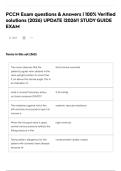
PCCN Exam questions & Answers | 100% Verified
solutions (2026) UPDATE |2026!! STUDY GUIDE
EXAM
Save
Terms in this set (363)
The nurse observes that the fluid volume overload.
patient's jugular veins distend in the
semi-upright position to more than
5 cm above the sternal angle. This is
an indication of:
what is normal Pulmonary artery 5-12 mmHg
occlusion pressure (PAOP)?
The resistance against which the systemic vascular resistance.
left ventricle must pump to eject its
volume is:
When the tricuspid valve is open, right ventricle.
central venous pressure reflects the
filling pressure in the:
Tachycardia is dangerous for the compromised cardiac output.
patient with ischemic heart disease
because of:
, During initial examination of a central cyanosis.
critical care patient, the nurse
observes wide and convex nails
and bulbous fingertips. This is
evidence of:
Priorities for palpation of the estimating edema.
patient with cardiovascular disease checking capillary refill
include: checking for DVT
arterial pulses
By blocking the conversion of b. vasodilation.
angiotensin I to angiotensin II,
angiotensin-converting enzyme
inhibitors produce:
The nurse has read that the a. Verapamil, diltiazem, or amlodipine
cardiologist recommends the use
of class IV drugs to depress sinus
and atrioventricular node
conduction and terminate
supraventricular tachycardias in the
patient at this time. The nurse will
anticipate orders for which
medications?
The nurse has administered a drug a. increased heart rate.
that stimulates β1-adrenergic sites.
Following administration of the
drug, the nurse will assess for:
The nurse is observing the patient's c. atrium is being paced.
electrocardiographic monitor after
insertion of a temporary pacemaker.
Seeing a P-wave after the pacing
artifact, the nurse knows that the:
solutions (2026) UPDATE |2026!! STUDY GUIDE
EXAM
Save
Terms in this set (363)
The nurse observes that the fluid volume overload.
patient's jugular veins distend in the
semi-upright position to more than
5 cm above the sternal angle. This is
an indication of:
what is normal Pulmonary artery 5-12 mmHg
occlusion pressure (PAOP)?
The resistance against which the systemic vascular resistance.
left ventricle must pump to eject its
volume is:
When the tricuspid valve is open, right ventricle.
central venous pressure reflects the
filling pressure in the:
Tachycardia is dangerous for the compromised cardiac output.
patient with ischemic heart disease
because of:
, During initial examination of a central cyanosis.
critical care patient, the nurse
observes wide and convex nails
and bulbous fingertips. This is
evidence of:
Priorities for palpation of the estimating edema.
patient with cardiovascular disease checking capillary refill
include: checking for DVT
arterial pulses
By blocking the conversion of b. vasodilation.
angiotensin I to angiotensin II,
angiotensin-converting enzyme
inhibitors produce:
The nurse has read that the a. Verapamil, diltiazem, or amlodipine
cardiologist recommends the use
of class IV drugs to depress sinus
and atrioventricular node
conduction and terminate
supraventricular tachycardias in the
patient at this time. The nurse will
anticipate orders for which
medications?
The nurse has administered a drug a. increased heart rate.
that stimulates β1-adrenergic sites.
Following administration of the
drug, the nurse will assess for:
The nurse is observing the patient's c. atrium is being paced.
electrocardiographic monitor after
insertion of a temporary pacemaker.
Seeing a P-wave after the pacing
artifact, the nurse knows that the:

