
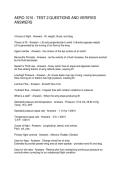
AERO 1010 - TEST 2 QUESTIONS AND VERIFIED
ANSWERS
4 forces of flight - Answers - lift, weight, thrust, and drag
Theory of lift - Answers - Lift acts perpendicular to wind. It directly opposes weight
Lift is generated by the turning of air flow by the wing
Upper camber - Answers - the contour of the top surface of an airfoil
Bernoulli's Principle - Answers - as the velocity of a fluid increases, the pressure exerted
by the fluid decreases
Newton's Third Law - Answers - Every action has an equal and opposite reaction
Air flow striking bottom of wing reflects down, causing lift
Low/High Pressure - Answers - Air moves faster over top of wing, causing low pressure.
Slow moving air on bottom has high pressure, creating lift
Laminar Flow - Answers - Smooth flow of air
Turbulent flow - Answers - Irregular flow with random variations in pressure.
What is a stall? - Answers - When the wing stops producing lift
Standard pressure and temperature - Answers - Pressure: 1014 mb, 29.92 in/Hg
Temp: 15'C, 59'F
Standard pressure lapse rate - Answers - -1 in Hg/ 1,000 ft
Temperature lapse rate - Answers - -2'C/ 1,000 ft
-3.5'F/ 1,000 ft
3 axes of flight - Answers - Longitudinal, lateral, and vertical.
Pitch, roll, yaw
Primary flight controls - Answers - Ailerons, Rudder, Elevator
Uses for flaps - Answers - Change chord line of wing
Extended to provide greater wing area at lower speeds - provides more lift and drag
Uses for trim tabs - Answers - Relieve pilot from maintaining continuous pressure on
controls when correcting for an unbalanced flight condition
ANSWERS
4 forces of flight - Answers - lift, weight, thrust, and drag
Theory of lift - Answers - Lift acts perpendicular to wind. It directly opposes weight
Lift is generated by the turning of air flow by the wing
Upper camber - Answers - the contour of the top surface of an airfoil
Bernoulli's Principle - Answers - as the velocity of a fluid increases, the pressure exerted
by the fluid decreases
Newton's Third Law - Answers - Every action has an equal and opposite reaction
Air flow striking bottom of wing reflects down, causing lift
Low/High Pressure - Answers - Air moves faster over top of wing, causing low pressure.
Slow moving air on bottom has high pressure, creating lift
Laminar Flow - Answers - Smooth flow of air
Turbulent flow - Answers - Irregular flow with random variations in pressure.
What is a stall? - Answers - When the wing stops producing lift
Standard pressure and temperature - Answers - Pressure: 1014 mb, 29.92 in/Hg
Temp: 15'C, 59'F
Standard pressure lapse rate - Answers - -1 in Hg/ 1,000 ft
Temperature lapse rate - Answers - -2'C/ 1,000 ft
-3.5'F/ 1,000 ft
3 axes of flight - Answers - Longitudinal, lateral, and vertical.
Pitch, roll, yaw
Primary flight controls - Answers - Ailerons, Rudder, Elevator
Uses for flaps - Answers - Change chord line of wing
Extended to provide greater wing area at lower speeds - provides more lift and drag
Uses for trim tabs - Answers - Relieve pilot from maintaining continuous pressure on
controls when correcting for an unbalanced flight condition

