

Escrito por estudiantes que aprobaron Inmediatamente disponible después del pago Leer en línea o como PDF ¿Documento equivocado? Cámbialo gratis 4,6 TrustPilot
logo-home
Document preview thumbnail
Vista previa 3 fuera de 23 páginas
Examen

PNB 2265 Heart Part 2 Exam Questions and Answers | 180+ Cardiac Conduction, EKG, Cardiac Cycle, Coronary Circulation & Action Potential Concepts | Human Physiology Exam

Document preview thumbnail
Vista previa 3 fuera de 23 páginas

This comprehensive PNB 2265 Heart Part 2 study guide contains more than 180 essential cardiovascular physiology concepts, cardiac electrophysiology principles, coronary circulation mechanisms, EKG interpretation topics, and verified exam questions with correct answers specifically designed to support students preparing for physiology examinations, anatomy and physiology coursework, pre-medical studies, nursing science assessments, and biomedical science competency evaluations. The material provides an in-depth review of coronary blood flow, cardiac muscle physiology, electrical conduction pathways, cardiac action potentials, electrocardiogram interpretation, and autonomic regulation of heart function required for mastering advanced cardiovascular physiology concepts. The document thoroughly explains coronary circulation, including the role of coronary arteries and veins, oxygen delivery to myocardial tissue, and the pathophysiology of coronary artery disease (CAD), angina, myocardial ischemia, and heart failure. Students will gain a strong understanding of cardiac skeleton structure and function, including support, elasticity, electrical insulation, and coordinated conduction between atria and ventricles. The guide also explores the specialized anatomy of cardiac muscle, including intercalated discs, desmosomes, gap junctions, branching cardiac myocytes, and the differences between cardiac and skeletal muscle physiology. Key cellular physiology concepts reviewed include depolarization, calcium-induced calcium release (CICR), L-type calcium channels (LTCC), ryanodine receptors (RyR), excitation-contraction coupling, refractory periods, and calcium-dependent regulation of cardiac contractility. Additionally, this resource provides extensive coverage of the cardiac conduction system and electrophysiology pathways, including the sinoatrial (SA) node, atrioventricular (AV) node, internodal pathways, bundle of His, bundle branches, and Purkinje fibers. Students will review pacemaker physiology, funny current (If current), autorhythmic tissue, autonomic nervous system modulation of heart rate, and backup pacemaker mechanisms that maintain cardiac rhythm when the SA node fails. The guide also explains the sequence of atrial and ventricular depolarization, contractile versus non-contractile cardiac cells, and coordinated excitation-contraction events that ensure efficient cardiac output and synchronized ventricular contraction. The study guide further examines ventricular contractile action potentials and electrocardiogram (EKG/ECG) interpretation, including P waves, QRS complexes, T waves, PR intervals, QT intervals, tachycardia, bradycardia, normal sinus rhythm, and the relationship between electrical activity and mechanical contraction. Students will strengthen their understanding of the cardiac cycle, including atrial systole, ventricular systole, ventricular ejection, isovolumetric contraction, isovolumetric relaxation, stroke volume (SV), end-diastolic volume (EDV), end-systolic volume (ESV), cardiac output (CO), Frank-Starling law, venous return, sympathetic stimulation, parasympathetic regulation, norepinephrine signaling, vagus nerve activity, and autonomic cardiovascular control mechanisms. This study material is highly relevant for students enrolled in human physiology, cardiovascular physiology, anatomy and physiology, pre-nursing, pre-medical, exercise physiology, kinesiology, biomedical sciences, and allied health programs. It is especially beneficial for students preparing for university physiology examinations, ATI and HESI science assessments, MCAT cardiovascular review, nursing entrance exams, and health science coursework involving cardiac electrophysiology, coronary circulation, EKG interpretation, and cardiovascular regulation. The organized question-and-answer format supports active recall learning, rapid concept review, critical thinking development, and long-term retention of essential cardiac physiology principles. The study content aligns with evidence-based cardiovascular physiology and electrophysiology standards outlined in Guyton and Hall Textbook of Medical Physiology, Ganong’s Review of Medical Physiology, Principles of Anatomy and Physiology by Tortora and Derrickson, and Human Physiology: From Cells to Systems by Lauralee Sherwood. Additional cardiac conduction, coronary circulation, and cardiovascular regulation concepts are supported by scientific resources and educational recommendations published by the American Heart Association, the American Physiological Society, the National Institutes of Health, and the World Health Organization. These references emphasize evidence-based cardiovascular science, electrophysiology, hemodynamics, and cardiac regulation principles essential for healthcare and biomedical science education. Keywords PNB 2265, cardiac physiology, heart conduction system, EKG interpretation, ECG physiology, coronary circulation, coronary artery disease, cardiac muscle physiology, action potentials, cardiac cycle, stroke volume, cardiac output, Frank Starling law, SA node physiology, AV node conduction, Purkinje fibers, bundle of His, ventricular depolarization, atrial depolarization, ventricular repolarization, QT interval, PR interval, tachycardia, bradycardia, normal sinus rhythm, autonomic nervous system heart regulation, sympathetic stimulation, parasympathetic regulation, vagus nerve physiology, norepinephrine heart effects, calcium induced calcium release, CICR physiology, L type calcium channels, ryanodine receptors, intercalated discs, desmosomes, gap junctions, myocardial contraction, excitation contraction coupling, coronary arteries and veins, cardiac electrophysiology, cardiovascular physiology review, anatomy and physiology, human physiology study guide, pre nursing physiology, pre med physiology, MCAT cardiovascular review, ATI science review, HESI physiology, university physiology exam prep, evidence based physiology

Vista previa del contenido

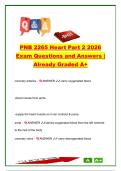
PNB 2265 Heart Part 2 2026
Exam Questions and Answers |
Already Graded A+

coronary arteries - ANSWER ✔✔-carry oxygenated blood


-blood comes from aorta


-supply the heart muscle so it can contract & pump


aorta - ANSWER ✔✔carries oxygenated blood from the left ventricle

to the rest of the body


coronary veins - ANSWER ✔✔-carry deoxygenated blood

,-blood drains into right atrium


-removes carbon dioxide & metabolic waste from heart muscle


coronary artery disease - ANSWER ✔✔-occurs when coronary

arteries become narrowed or blocked


-usually due to plaque buildup (atherosclerosis)


-leads to reduced oxygen delivery to heart muscle


what can coronary artery disease cause? - ANSWER ✔✔-angina


-heart attack


-heart failure


anastomoses - ANSWER ✔✔connections between:


-artery to artery

, -vein to vein

-artery to vein


functions of anastomoses - ANSWER ✔✔-provide alternate pathways

for blood flow


-can help protect heart tissue if one artery becomes blocked


cardiac skeleton - ANSWER ✔✔-fibrous connective tissue skeleton


-cardiac muscle attaches


-supportive framework for heart


functions of cardiac skeleton - ANSWER ✔✔-support


-elasticity


-prevents over expansion


COPYRIGHT©PROFFKERRYMARTIN 2025/2026. YEAR PUBLISHED 2026. COMPANY REGISTRATION NUMBER: 619652435. TERMS OF USE.
PRIVACY STATEMENT. ALL RIGHTS RESERVED


Información del documento

Subido en
22 de mayo de 2026
Número de páginas
23
Escrito en
2025/2026
Tipo
Examen
Contiene
Preguntas y respuestas
$18.99

¿Documento equivocado? Cámbialo gratis Dentro de los 14 días posteriores a la compra y antes de descargarlo, puedes elegir otro documento. Puedes gastar el importe de nuevo.
Escrito por estudiantes que aprobaron
Inmediatamente disponible después del pago
Leer en línea o como PDF

Seller avatar
Los indicadores de reputación están sujetos a la cantidad de artículos vendidos por una tarifa y las reseñas que ha recibido por esos documentos. Hay tres niveles: Bronce, Plata y Oro. Cuanto mayor reputación, más podrás confiar en la calidad del trabajo del vendedor.
PROFFKERRYMARTIN
3.3
(55)
Vendido
287
Seguidores
9
Artículos
11174
Última venta
9 horas hace


Por qué los estudiantes eligen Stuvia

Creado por compañeros estudiantes, verificado por reseñas

Calidad en la que puedes confiar: escrito por estudiantes que aprobaron y evaluado por otros que han usado estos resúmenes.

¿No estás satisfecho? Elige otro documento

¡No te preocupes! Puedes elegir directamente otro documento que se ajuste mejor a lo que buscas.

Paga como quieras, empieza a estudiar al instante

Sin suscripción, sin compromisos. Paga como estés acostumbrado con tarjeta de crédito y descarga tu documento PDF inmediatamente.

Student with book image

“Comprado, descargado y aprobado. Así de fácil puede ser.”

Alisha Student

Preguntas frecuentes