

Escrito por estudiantes que aprobaron Inmediatamente disponible después del pago Leer en línea o como PDF ¿Documento equivocado? Cámbialo gratis 4,6 TrustPilot
logo-home
Examen

HED4813 Assignment 2 (ANSWERS) 2026 - Due June 2026

Puntuación
3.0
(1)
Vendido
1
Páginas
19
Grado
A+
Subido en
21-05-2026
Escrito en
2025/2026

HED4813 Assignment 2 (ANSWERS) 2026 - Due June 2026. Guaranteed distinction quality with trusted academic solutions, clear explanations, professional formatting, and reliable support.... Read each question carefully and select the one correct answer from the options provided (A–D). 1.1. In Learning Unit 1, problem solving in mathematics education is best described as: A. The ability to apply memorised formulas correctly B. A higher order cognitive process that involves reasoning and decision making C. Completing word problems at the end of an exercise D. Following a prescribed routine procedure (2) 1.2. According to CAPS, which percentage of formal assessment tasks should assess problem solving at the highest cognitive level? A. 45% B. 30% C. 20% D. 10% (2) 1.3. Which of the following is NOT a characteristic of mathematical problem solving at the highest cognitive level? A. The problem is non routine B. The problem is necessarily difficult C. The problem often requires decomposition D. The problem demands higher order thinking (2) 1.4. Which statement best explains why finding the correct answer alone is insufficient to demonstrate understanding? A. Learners may memorise procedures without conceptual insight B. Correct answers eliminate the need for justification C. Teachers prioritise speed over reasoning D. Correct answers guarantee transfer to new contexts (2) 1.5. In Learning Unit 1, word problems are criticised mainly because they: A. Always test problem-solving skills B. Focus too heavily on abstract reasoning C. Often test language proficiency instead of mathematical understanding D. Are unsuitable for assessment (2) 1.6. Problem solving as a mathematical action refers to: A. A fixed algorithmic procedure B. The cognitive level of recall C. A systematic process of reasoning through a problem D. Reproducing learnt examples (2) 1.7. Which distinction is emphasised in Learning Unit 1 regarding problem solving? A. Problem solving vs calculation B. Problem solving as process vs problem solving as cognitive level C. Teacher led vs learner led problem solving D. Formal vs informal problem solving (2) 1.8. Problem solving in mathematics education should be: A. Restricted to gifted learners B. Taught as an isolated topic C. Integrated into all content areas D. Practised only after mastery (2) 1.9. According to Polya, what is the first phase of problem solving? A. Devising a plan B. Carrying out the plan C. Understanding the problem D. Reviewing the solution (2) 1.10. Which phase of Polya’s model focuses on selecting strategies and methods? A. Understanding the problem B. Devising a plan C. Carrying out the plan D. Looking back (2) 1.11. Which of the following activities best aligns with the “looking back” phase? A. Identifying relevant data B. Checking the correctness of calculations C. Drawing a diagram D. Writing down known formulas (2) 1.12. Polya’s model is still relevant today mainly because it: A. Applies only to algebra B. Emphasises memorisation C. Supports metacognitive reflection D. Eliminates learner errors (2) 1.13. Which strategy is most appropriate during the “understanding the problem” phase? A. Performing calculations B. Seeking similar previously solved problems C. Asking clarifying questions D. Applying a formula (2) 1.14. According to Learning Unit 1, one limitation of treating Polya’s steps rigidly is that: A. It discourages discussion B. It ignores learner diversity C. It assumes a single problem-solving pathway D. It eliminates modelling (2) 1.15. Which modern educational emphasis does Polya's work support? A. Examination driven teaching B. Transmission teaching C. Constructivist learning D. Behaviourist reinforcement (2) 1.16. A problem centred mathematics classroom is characterised primarily by: A. Teacher explanations B. Learners engaging with meaningful problems C. Frequent testing D. Drill and practice (2) 1.17. Mathematical modelling is best defined as: A. Manipulating physical objects B. Translating real world situations into mathematical representations C. Drawing diagrams only D. Using technology in lessons (2) 1.18. Which step is essential in the mathematical modelling process? A. Guessing the correct answer B. Making assumptions C. Memorising formulas D. Copying examples (2) 1.19. According to Hartono (2020), mathematical modelling primarily supports the development of: A. Routine procedural fluency B. Examination performance C. Real-world problem-solving competence D. Teacher control (2) 1.20. Which representation is NOT a valid mathematical model according to Learning Unit 1? A. Physical model B. Mental image C. Pen and paper diagram D. Memorised formula without context (2) 1.21. One essential characteristic of effective mathematical models is that they are: A. Linear and fixed B. Cyclic and iterative C. Teacher controlled D. Independent of context (2) 1.22. In modelling, horizontal mathematisation refers to: A. Formal symbolic reasoning B. Learners’ informal problem-solving strategies C. Teacher demonstrations D. Assessment standardisation (2) 1.23. Vertical mathematisation involves: A. Returning to concrete materials B. Formalising learners’ informal reasoning C. Guess and check strategies D. Physical manipulation only (2) 1.24. A teacher centred teaching style is characterised by: A. Learner autonomy B. Teacher as authority and knowledge source C. Peer collaboration D. Discovery learning (2) 1.25. Which teaching style integrates learner activity and teacher guidance equally? A. Authority style B. Subject centred style C. Interactive/participatory style D. Transmission style (2) 1.26. Teaching as transaction is most closely aligned with: A. Behaviourism B. Constructivism C. Formalism D. Examination driven teaching (2) 1.27. Which learning preference is dominant when learners need to talk through a problem to understand it? A. Visual B. Kinaesthetic C. Auditory D. Reading/writing (2) 1.28. According to Piaget, learners who rely heavily on physical manipulatives are most likely in the: A. Formal operational stage B. Preoperational stage C. Concrete operational stage D. Sensorimotor stage (2) 1.29. Learning Unit 1 suggests that effective teaching styles should: A. Be consistent across all classes B. Match learners’ cognitive development and preferences C. Avoid modelling D. Emphasise silence and discipline only (2) 1.30. Which factor does NOT significantly influence learning styles? A. Cognitive development B. Personality C. Real life exposure D. Examination timetable (2) [60] Question 2 In not more than 1500 words, critically discuss the relationship between cognition and modelling, drawing from the cognitive modelling of the learning process and the subjective perception of cognition. Furthermore, investigate the role of modelling in the formulation of pedagogical content knowledge, considering the perspectives presented in the textbook 'Elementary and Middle School Mathematics: Teaching Developmentally' by Van De Walle, JA. (2013) and its impact on teacher knowledge and learner learning.

Mostrar más Leer menos
Institución
Grado

Vista previa del contenido

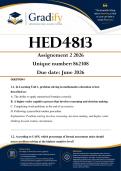
HED4813
Assignement 2 2026
Unique number: 862308
Due date: June 2026
QUESTION 1


1.1. In Learning Unit 1, problem solving in mathematics education is best
described as:
A. The ability to apply memorised formulas correctly
B. A higher order cognitive process that involves reasoning and decision making
C. Completing word problems at the end of an exercise
D. Following a prescribed routine procedure
Explanation: Problem-solving involves reasoning, decision-making, and higher-order
thinking beyond routine calculations .


1.2. According to CAPS, which percentage of formal assessment tasks should
assess problem solving at the highest cognitive level?

,QUESTION 1


1.1. In Learning Unit 1, problem solving in mathematics education is best
described as:
A. The ability to apply memorised formulas correctly
B. A higher order cognitive process that involves reasoning and decision
making
C. Completing word problems at the end of an exercise
D. Following a prescribed routine procedure
Explanation: Problem-solving involves reasoning, decision-making, and higher-
order thinking beyond routine calculations .


1.2. According to CAPS, which percentage of formal assessment tasks
should assess problem solving at the highest cognitive level?
A. 45%
B. 30%
C. 20%
D. 10%
Explanation: CAPS specifies that 10% of assessments should target the
problem-solving cognitive level, emphasizing higher-order thinking rather than
procedural fluency .


1.3. Which of the following is NOT a characteristic of mathematical
problem solving at the highest cognitive level?
A. The problem is non routine
B. The problem is necessarily difficult
C. The problem often requires decomposition

, D. The problem demands higher order thinking
Explanation: High-level problems are not necessarily difficult; they are unseen,
non-routine, and require reasoning .


1.4. Which statement best explains why finding the correct answer alone is
insufficient to demonstrate understanding?
A. Learners may memorise procedures without conceptual insight
B. Correct answers eliminate the need for justification
C. Teachers prioritise speed over reasoning
D. Correct answers guarantee transfer to new contexts
Explanation: Understanding requires reasoning and conceptual insight, not just
memorised answers .


1.5. In Learning Unit 1, word problems are criticised mainly because they:
A. Always test problem-solving skills
B. Focus too heavily on abstract reasoning
C. Often test language proficiency instead of mathematical understanding
D. Are unsuitable for assessment
Explanation: Word problems can unintentionally assess language skills rather
than purely mathematical reasoning .


1.6. Problem solving as a mathematical action refers to:
A. A fixed algorithmic procedure
B. The cognitive level of recall
C. A systematic process of reasoning through a problem
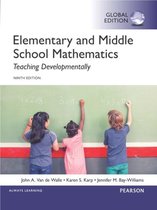
Libro relacionado

Escuela, estudio y materia

Institución
Grado

Información del documento

Subido en
21 de mayo de 2026
Número de páginas
19
Escrito en
2025/2026
Tipo
Examen
Contiene
Preguntas y respuestas

Temas

$4.76
Accede al documento completo:

¿Documento equivocado? Cámbialo gratis Dentro de los 14 días posteriores a la compra y antes de descargarlo, puedes elegir otro documento. Puedes gastar el importe de nuevo.
Escrito por estudiantes que aprobaron
Inmediatamente disponible después del pago
Leer en línea o como PDF

Reseñas de compradores verificados

Se muestran los comentarios
1 mes hace

3.0

1 reseñas

5
0
4
0
3
1
2
0
1
0
Reseñas confiables sobre Stuvia

Todas las reseñas las realizan usuarios reales de Stuvia después de compras verificadas.

Conoce al vendedor

Seller avatar
Los indicadores de reputación están sujetos a la cantidad de artículos vendidos por una tarifa y las reseñas que ha recibido por esos documentos. Hay tres niveles: Bronce, Plata y Oro. Cuanto mayor reputación, más podrás confiar en la calidad del trabajo del vendedor.
Gradify University of South Africa (Unisa)
Seguir Necesitas iniciar sesión para seguir a otros usuarios o asignaturas
Vendido
153
Miembro desde
1 mes
Número de seguidores
0
Documentos
72
Última venta
9 horas hace

4.2

29 reseñas

5
21
4
1
3
3
2
1
1
3

Recientemente visto por ti

Por qué los estudiantes eligen Stuvia

Creado por compañeros estudiantes, verificado por reseñas

Calidad en la que puedes confiar: escrito por estudiantes que aprobaron y evaluado por otros que han usado estos resúmenes.

¿No estás satisfecho? Elige otro documento

¡No te preocupes! Puedes elegir directamente otro documento que se ajuste mejor a lo que buscas.

Paga como quieras, empieza a estudiar al instante

Sin suscripción, sin compromisos. Paga como estés acostumbrado con tarjeta de crédito y descarga tu documento PDF inmediatamente.

Student with book image

“Comprado, descargado y aprobado. Así de fácil puede ser.”

Alisha Student

Preguntas frecuentes
