

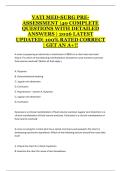
VATI MED-SURG PRE-
ASSESSMENT |40 COMPLETE
QUESTIONS WITH DETAILED
ANSWERS | 2026 LATEST
UPDATED| 100% RATED CORRECT
| GET AN A+!!
A nurse is preparing to administer a transfusion of RBCs to a client who has heart
failure. For which of the following manifestations should the nurse monitor to prevent
fluid volume overload? (Select all that apply.)
A. Dyspnea
B. Gastrointestinal bloating
C. Jugular vein distention
D. Confusion
E. Hypotension - answer-A. Dyspnea
C. Jugular vein distention
D. Confusion
Dyspnea is a clinical manifestation of fluid volume overload. Jugular vein distention is a
clinical manifestation of fluid volume overload. Confusion is a clinical manifestation of
fluid volume overload.
A nurse is caring for a client who has a spinal cord injury and suspects the client is
developing autonomic dysreflexia. Which of the following actions should the nurse take
first?
A. Check the client for a fecal impaction.
B. Examine the client for areas of skin breakdown.
,C. Check the client's bladder for distention.
D. Place the client in a sitting position. - answer-D. Place the client in a sitting position.
The nurse should use the least invasive intervention first. Therefore, the nurse should
place the client in a sitting position to decrease the manifestation of hypertension.
The nurse might have to check the client for fecal impaction, which can precipitate
autonomic dysreflexia. However, the nurse should use a less invasive intervention first.
The nurse might have to examine the client's skin for areas of skin breakdown or
pressure, which can trigger autonomic dysreflexia. However, the nurse should use a less
invasive intervention first. The nurse might have to check the client for bladder
distention, which can precipitate autonomic dysreflexia. However, the nurse should use
a less invasive intervention first.
A nurse is teaching a newly licensed nurse about the risk factors for dehiscence for
clients who have surgical incisions. Which of the following factors should the nurse
include in the teaching? (Select all that apply.)
A. Poor nutritional state
B. Altered mental status
C. Obesity
D. Pain medication administration
E. Wound infection - answer-A. Poor nutritional state
C. Obesity
E. Wound infection
A nurse is caring for a client who has an endotracheal tube and is receiving mechanical
ventilation. Which of the following interventions should the nurse take to reduce the risk
for ventilator-associated pneumonia?
A. Position the head of the client's bed in the flat position.
, B. Turn the client every 4 hr.
C. Rinse the client's mouth with an antimicrobial solution every 4 hr.
D. Perform hand hygiene prior to suctioning the client's endotracheal tube. - answer-C.
Rinse the client's mouth with an antimicrobial solution every 4 hr.
The nurse should brush the client's teeth every 8 hr and rinse the client's mouth with an
antimicrobial rinse every 2 hr to reduce the growth of bacteria.
The nurse should elevate the head of the client's bed 30° to reduce the risk for
aspiration and pneumonia. The nurse should turn the client every 2 hr to promote lung
expansion and reduce the risk for pneumonia. The nurse should perform hand hygiene
prior to suctioning the client's endotracheal tube to reduce the risk of introducing
bacteria.
A nurse is providing instruction to a new nurse about caring for clients who are receiving
diuretic therapy to treat heart failure. The nurse should explain that which of the
following medications puts clients at risk for both hyperkalemia and hyponatremia?
A. Furosemide
B. Hydrochlorothiazide
C. Metolazone
D. Spironolactone - answer-D. Spironolactone
Spironolactone is a potassium-sparing diuretic. It blocks the effects of aldosterone in
the renal tubules, causing a loss of sodium and water and the retention of potassium.
The possible adverse reactions include hyperkalemia and hyponatremia.
Furosemide is a high-ceiling (loop) diuretic that increases the risk of hyponatremia and
hypokalemia, not hyperkalemia. Hydrochlorothiazide is a thiazide diuretic that
increases the risk of hypokalemia, not hyperkalemia. Metolazone is a thiazide diuretic
that increases the risk of hyponatremia and hypokalemia, not hyperkalemia.
ASSESSMENT |40 COMPLETE
QUESTIONS WITH DETAILED
ANSWERS | 2026 LATEST
UPDATED| 100% RATED CORRECT
| GET AN A+!!
A nurse is preparing to administer a transfusion of RBCs to a client who has heart
failure. For which of the following manifestations should the nurse monitor to prevent
fluid volume overload? (Select all that apply.)
A. Dyspnea
B. Gastrointestinal bloating
C. Jugular vein distention
D. Confusion
E. Hypotension - answer-A. Dyspnea
C. Jugular vein distention
D. Confusion
Dyspnea is a clinical manifestation of fluid volume overload. Jugular vein distention is a
clinical manifestation of fluid volume overload. Confusion is a clinical manifestation of
fluid volume overload.
A nurse is caring for a client who has a spinal cord injury and suspects the client is
developing autonomic dysreflexia. Which of the following actions should the nurse take
first?
A. Check the client for a fecal impaction.
B. Examine the client for areas of skin breakdown.
,C. Check the client's bladder for distention.
D. Place the client in a sitting position. - answer-D. Place the client in a sitting position.
The nurse should use the least invasive intervention first. Therefore, the nurse should
place the client in a sitting position to decrease the manifestation of hypertension.
The nurse might have to check the client for fecal impaction, which can precipitate
autonomic dysreflexia. However, the nurse should use a less invasive intervention first.
The nurse might have to examine the client's skin for areas of skin breakdown or
pressure, which can trigger autonomic dysreflexia. However, the nurse should use a less
invasive intervention first. The nurse might have to check the client for bladder
distention, which can precipitate autonomic dysreflexia. However, the nurse should use
a less invasive intervention first.
A nurse is teaching a newly licensed nurse about the risk factors for dehiscence for
clients who have surgical incisions. Which of the following factors should the nurse
include in the teaching? (Select all that apply.)
A. Poor nutritional state
B. Altered mental status
C. Obesity
D. Pain medication administration
E. Wound infection - answer-A. Poor nutritional state
C. Obesity
E. Wound infection
A nurse is caring for a client who has an endotracheal tube and is receiving mechanical
ventilation. Which of the following interventions should the nurse take to reduce the risk
for ventilator-associated pneumonia?
A. Position the head of the client's bed in the flat position.
, B. Turn the client every 4 hr.
C. Rinse the client's mouth with an antimicrobial solution every 4 hr.
D. Perform hand hygiene prior to suctioning the client's endotracheal tube. - answer-C.
Rinse the client's mouth with an antimicrobial solution every 4 hr.
The nurse should brush the client's teeth every 8 hr and rinse the client's mouth with an
antimicrobial rinse every 2 hr to reduce the growth of bacteria.
The nurse should elevate the head of the client's bed 30° to reduce the risk for
aspiration and pneumonia. The nurse should turn the client every 2 hr to promote lung
expansion and reduce the risk for pneumonia. The nurse should perform hand hygiene
prior to suctioning the client's endotracheal tube to reduce the risk of introducing
bacteria.
A nurse is providing instruction to a new nurse about caring for clients who are receiving
diuretic therapy to treat heart failure. The nurse should explain that which of the
following medications puts clients at risk for both hyperkalemia and hyponatremia?
A. Furosemide
B. Hydrochlorothiazide
C. Metolazone
D. Spironolactone - answer-D. Spironolactone
Spironolactone is a potassium-sparing diuretic. It blocks the effects of aldosterone in
the renal tubules, causing a loss of sodium and water and the retention of potassium.
The possible adverse reactions include hyperkalemia and hyponatremia.
Furosemide is a high-ceiling (loop) diuretic that increases the risk of hyponatremia and
hypokalemia, not hyperkalemia. Hydrochlorothiazide is a thiazide diuretic that
increases the risk of hypokalemia, not hyperkalemia. Metolazone is a thiazide diuretic
that increases the risk of hyponatremia and hypokalemia, not hyperkalemia.

