
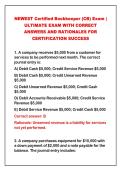
NEWEST Certified Bookkeeper (CB) Exam |
ULTIMATE EXAM WITH CORRECT
ANSWERS AND RATIONALES FOR
CERTIFICATION SUCCESS
1. A company receives $5,000 from a customer for
services to be performed next month. The correct
journal entry is:
A) Debit Cash $5,000; Credit Service Revenue $5,000
B) Debit Cash $5,000; Credit Unearned Revenue
$5,000
C) Debit Unearned Revenue $5,000; Credit Cash
$5,000
D) Debit Accounts Receivable $5,000; Credit Service
Revenue $5,000
E) Debit Service Revenue $5,000; Credit Cash $5,000
Correct answer: B
Rationale: Unearned revenue is a liability for services
not yet performed.
2. A company purchases equipment for $10,000 with
a down payment of $2,000 and a note payable for the
balance. The journal entry includes:
,A) Debit Equipment $10,000; Credit Cash $2,000;
Credit Notes Payable $8,000
B) Debit Equipment $10,000; Credit Cash $10,000
C) Debit Cash $2,000; Debit Notes Payable $8,000;
Credit Equipment $10,000
D) Debit Equipment $2,000; Debit Notes Payable
$8,000; Credit Cash $10,000
E) Debit Cash $10,000; Credit Equipment $10,000
Correct answer: A
Rationale: Equipment is debited for full cost, cash
credited for down payment, note payable credited for
balance.
3. The purpose of adjusting entries is to:
A) Record transactions that occurred during the
period
B) Update account balances for accruals and
deferrals
C) Close temporary accounts
D) Prepare the post-closing trial balance
E) Record reversing entries
Correct answer: B
,Rationale: Adjusting entries apply the matching
principle.
4. A company fails to record accrued interest
revenue of $1,000. The effect on the financial
statements is:
A) Assets understated, equity understated
B) Assets overstated, equity overstated
C) Liabilities understated, equity understated
D) Liabilities overstated, equity overstated
E) No effect
Correct answer: A
Rationale: Accrued interest receivable (asset) is
understated; interest revenue (equity) is understated.
5. A company has a beginning inventory of $20,000,
purchases of $100,000, and ending inventory of
$30,000. Cost of goods sold is:
A) $90,000
B) $100,000
C) $110,000
D) $120,000
E) $80,000
, Correct answer: A
Rationale: COGS = beginning inventory + purchases -
ending inventory = 20,000 + 100,000 - 30,000 =
90,000.
6. A company uses the straight-line depreciation
method. An asset with a cost of $50,000, salvage
value of $5,000, and useful life of 5 years has annual
depreciation of:
A) $9,000
B) $10,000
C) $9,000? (50,000-5,000)/5 = 9,000. Option A.
Correct answer: A
7. Under the accrual basis, revenue is recognized
when:
A) Cash is received
B) The earnings process is complete and collection is
reasonably assured
C) The invoice is sent
D) The customer orders the product
E) The product is manufactured
Correct answer: B

