
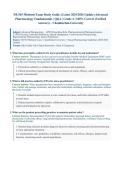
NR 565 Midterm Exam Study Guide: (Latest 2025/2026 Update) Advanced
Pharmacology Fundamentals | Q&A | Grade A | 100% Correct (Verified
Answers) – Chamberlain University
Subject: Advanced Pharmacology – APRN Prescribing Role, Pharmacokinetics/Pharmacodynamics,
CYP450 System, Controlled Substances, Opioid Management, Cardiovascular Pharmacology,
Rheumatologic Pharmacology, Special Populations
Source: NR 565 Midterm Exam / Chamberlain University / Clinical Pharmacology Guidelines (2025/2026
Update)
Format: Q&A Guide with Clinical Rationales | Grade A Guaranteed
1. What does prescriptive authority for nurse practitioners include beyond medications?
Correct Answer: Therapeutic devices and services including Durable Medical Equipment (DME) such
as wheelchairs, power scooters, hospital beds, portable oxygen, handicap placards, and medical services
such as Physical Therapy, Occupational Therapy, and home health services.
1. Prescriptive authority is outlined in state practice laws and regulations.
2. Ethical prescribing requires knowledge of mechanism of action, efficacy, safety, and patient-
specific circumstances.
2. What is full practice authority (FPA) for nurse practitioners?
Correct Answer: Nurse practitioners have autonomy to evaluate patients, diagnose, order and interpret
tests, initiate and manage treatments, and prescribe medications including controlled substances without
physician oversight.
1. Benefits include improved access to care, reduced wait times, and better utilization of NP skills
in rural areas.
2. Reduced practice authority requires collaborative agreement; restricted practice requires
supervision/delegation by physician.
3. What are the prudent prescribing practices to maintain patient safety?
Correct Answer: Documentation of provider-patient relationship; thorough history and physical;
discussions of risks/side effects; drug monitoring/titration plan; consultations; avoidance of prescribing
for self/family/friends.
1. Rational drug selection includes diagnosis based on clinical reasoning and selection/monitoring
of most appropriate treatment.
2. Considerations: cost, guidelines, availability, interactions, side effects, allergies, hepatic/renal
function, monitoring needs, special populations.
, 4. What is pharmacodynamics?
Correct Answer: The study of the biochemical and physiologic effects of drugs on the body and the
molecular mechanisms by which those effects are produced ("what the drug does to the body").
1. Includes receptor binding, signal transduction, and dose-response relationships.
2. Agonists activate receptors; antagonists block receptors; partial agonists produce submaximal
activation.
5. What is pharmacokinetics?
Correct Answer: The study of drug movement throughout the body, including absorption, distribution,
metabolism, and excretion (ADME) ("what the body does to the drug").
1. Influenced by age, organ function, genetics, and drug interactions.
2. Poor metabolizer phenotype leads to slower metabolism and increased side effect risk.
6. What is pharmacogenomics?
Correct Answer: The study of how genes affect a person's response to drugs, combining genomics and
pharmacology to provide individualized, targeted, safe drug therapies.
1. Informed consent required for genetic testing.
2. Genetic Information Non-Discriminatory Act (GINA) protects patients from discrimination by
employers and insurers based on genetic information.
7. What are CYP450 inducers and how do they affect drug metabolism?
Correct Answer: Inducers elevate CYP450 enzyme activity by increasing enzyme synthesis, creating
additional sites for biotransformation. Enhances medication metabolism, decreasing parent drug
concentration. Inducers = Increase medication metabolism.
1. Mnemonic: "Bullshit Crap GPS INDUCES rage" → Barbiturates, St. John's Wort,
Carbamazepine, Rifampin, Alcohol, Phenytoin, Griseofulvin, Phenobarbital, Sulfonylureas.
2. Result: decreased drug effect, may require higher doses.
8. What are CYP450 inhibitors and how do they affect drug metabolism?
Correct Answer: Inhibitors slow or block metabolism of other medications, increasing levels of
medications dependent on that enzyme. Inhibitors = decrease medication metabolism = increase drug
levels and toxicity risk.
1. Mnemonic: "VISA credit card debt INHIBITS spending on designers like CK to look GQ" →
Valproate, Isoniazid, Sulfonamides, Amiodarone, Chloramphenicol, Ketoconazole, Grapefruit
Juice, Quinidine.
2. Result: increased side effects, adverse reactions, and toxicity.
9. What is the Beers Criteria?
Correct Answer: Identifies drugs with high likelihood of causing adverse effects in older adults (≥65
years). Drugs on this list should generally be avoided unless benefits significantly outweigh risks.
1. Prescriber ultimately decides whether to use these medications.
2. Focuses on potentially inappropriate medications (PIMs) in geriatric patients.
Pharmacology Fundamentals | Q&A | Grade A | 100% Correct (Verified
Answers) – Chamberlain University
Subject: Advanced Pharmacology – APRN Prescribing Role, Pharmacokinetics/Pharmacodynamics,
CYP450 System, Controlled Substances, Opioid Management, Cardiovascular Pharmacology,
Rheumatologic Pharmacology, Special Populations
Source: NR 565 Midterm Exam / Chamberlain University / Clinical Pharmacology Guidelines (2025/2026
Update)
Format: Q&A Guide with Clinical Rationales | Grade A Guaranteed
1. What does prescriptive authority for nurse practitioners include beyond medications?
Correct Answer: Therapeutic devices and services including Durable Medical Equipment (DME) such
as wheelchairs, power scooters, hospital beds, portable oxygen, handicap placards, and medical services
such as Physical Therapy, Occupational Therapy, and home health services.
1. Prescriptive authority is outlined in state practice laws and regulations.
2. Ethical prescribing requires knowledge of mechanism of action, efficacy, safety, and patient-
specific circumstances.
2. What is full practice authority (FPA) for nurse practitioners?
Correct Answer: Nurse practitioners have autonomy to evaluate patients, diagnose, order and interpret
tests, initiate and manage treatments, and prescribe medications including controlled substances without
physician oversight.
1. Benefits include improved access to care, reduced wait times, and better utilization of NP skills
in rural areas.
2. Reduced practice authority requires collaborative agreement; restricted practice requires
supervision/delegation by physician.
3. What are the prudent prescribing practices to maintain patient safety?
Correct Answer: Documentation of provider-patient relationship; thorough history and physical;
discussions of risks/side effects; drug monitoring/titration plan; consultations; avoidance of prescribing
for self/family/friends.
1. Rational drug selection includes diagnosis based on clinical reasoning and selection/monitoring
of most appropriate treatment.
2. Considerations: cost, guidelines, availability, interactions, side effects, allergies, hepatic/renal
function, monitoring needs, special populations.
, 4. What is pharmacodynamics?
Correct Answer: The study of the biochemical and physiologic effects of drugs on the body and the
molecular mechanisms by which those effects are produced ("what the drug does to the body").
1. Includes receptor binding, signal transduction, and dose-response relationships.
2. Agonists activate receptors; antagonists block receptors; partial agonists produce submaximal
activation.
5. What is pharmacokinetics?
Correct Answer: The study of drug movement throughout the body, including absorption, distribution,
metabolism, and excretion (ADME) ("what the body does to the drug").
1. Influenced by age, organ function, genetics, and drug interactions.
2. Poor metabolizer phenotype leads to slower metabolism and increased side effect risk.
6. What is pharmacogenomics?
Correct Answer: The study of how genes affect a person's response to drugs, combining genomics and
pharmacology to provide individualized, targeted, safe drug therapies.
1. Informed consent required for genetic testing.
2. Genetic Information Non-Discriminatory Act (GINA) protects patients from discrimination by
employers and insurers based on genetic information.
7. What are CYP450 inducers and how do they affect drug metabolism?
Correct Answer: Inducers elevate CYP450 enzyme activity by increasing enzyme synthesis, creating
additional sites for biotransformation. Enhances medication metabolism, decreasing parent drug
concentration. Inducers = Increase medication metabolism.
1. Mnemonic: "Bullshit Crap GPS INDUCES rage" → Barbiturates, St. John's Wort,
Carbamazepine, Rifampin, Alcohol, Phenytoin, Griseofulvin, Phenobarbital, Sulfonylureas.
2. Result: decreased drug effect, may require higher doses.
8. What are CYP450 inhibitors and how do they affect drug metabolism?
Correct Answer: Inhibitors slow or block metabolism of other medications, increasing levels of
medications dependent on that enzyme. Inhibitors = decrease medication metabolism = increase drug
levels and toxicity risk.
1. Mnemonic: "VISA credit card debt INHIBITS spending on designers like CK to look GQ" →
Valproate, Isoniazid, Sulfonamides, Amiodarone, Chloramphenicol, Ketoconazole, Grapefruit
Juice, Quinidine.
2. Result: increased side effects, adverse reactions, and toxicity.
9. What is the Beers Criteria?
Correct Answer: Identifies drugs with high likelihood of causing adverse effects in older adults (≥65
years). Drugs on this list should generally be avoided unless benefits significantly outweigh risks.
1. Prescriber ultimately decides whether to use these medications.
2. Focuses on potentially inappropriate medications (PIMs) in geriatric patients.

