

NUR 242 MED SURG EXAM 3 , Complete Test ||
Questions and Answers (Verified Answers)
(Latest Update 2026) UPDATE!!
Save
Terms in this set (273)
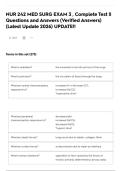
What is ventilation? the movement of air into and out of the lungs
What is perfusion? the circulation of blood through the lungs
What are central chemoreceptors increased H+ in the brain ECF;
responsive to? increased PaCO2;
"hypercarbic drive"
What are peripheral decreased pH;
chemoreceptors responsive to? increased PaCO2;
decreased PaO2;
"hypoxic drive"
What are elastic forces? lungs recoil due to elastin, collagen, fibrin
What are surface forces? surface tension due to water-air interface
What is airway resistance? opposition to flow caused by the forces of
friction; primarily determined by airway radius
, What is the distensibility of the ease with which the lungs can be inflated
lungs?
What is lung distensibility increased neonates and children;
in? emphysema
What is lung distensibility elderly;
decreased in? pneumonia, pulmonary edema, ARDS, atelectasis,
fibrosis
What is surfactant? complex substance lining the alveoli and smallest
bronchioles containing phospholipids and a
number of apoproteins which reduces surface
tension throughout the lungs, thereby
contributing to its general compliance;
stabilizes the alveoli and keeps them dry
What produces surfactant? produced by the Type II alveolar cells
What is Ohm's law? velocity = driving force/resistance
What is Poiseuille law? resistance = (8 x viscosity x length) / (pi x
radius^4)
What happens if the radius in the the resistance goes up
lungs goes down?
How is the ventilation distributed in the top of the lungs are more distended and less
the lungs? compliant whereas the lower lung is small and
highly compliant
Questions and Answers (Verified Answers)
(Latest Update 2026) UPDATE!!
Save
Terms in this set (273)
What is ventilation? the movement of air into and out of the lungs
What is perfusion? the circulation of blood through the lungs
What are central chemoreceptors increased H+ in the brain ECF;
responsive to? increased PaCO2;
"hypercarbic drive"
What are peripheral decreased pH;
chemoreceptors responsive to? increased PaCO2;
decreased PaO2;
"hypoxic drive"
What are elastic forces? lungs recoil due to elastin, collagen, fibrin
What are surface forces? surface tension due to water-air interface
What is airway resistance? opposition to flow caused by the forces of
friction; primarily determined by airway radius
, What is the distensibility of the ease with which the lungs can be inflated
lungs?
What is lung distensibility increased neonates and children;
in? emphysema
What is lung distensibility elderly;
decreased in? pneumonia, pulmonary edema, ARDS, atelectasis,
fibrosis
What is surfactant? complex substance lining the alveoli and smallest
bronchioles containing phospholipids and a
number of apoproteins which reduces surface
tension throughout the lungs, thereby
contributing to its general compliance;
stabilizes the alveoli and keeps them dry
What produces surfactant? produced by the Type II alveolar cells
What is Ohm's law? velocity = driving force/resistance
What is Poiseuille law? resistance = (8 x viscosity x length) / (pi x
radius^4)
What happens if the radius in the the resistance goes up
lungs goes down?
How is the ventilation distributed in the top of the lungs are more distended and less
the lungs? compliant whereas the lower lung is small and
highly compliant

