

Topic 9 – Kinetics I
In order to develop their practical skills, students should be encouraged to carry out a range of practical experiments related to this topic. Possible
experiments include investigating a variety of factors that influence the rates of reaction between, for example, marble chips and hydrochloric acid,
or sodium thiosulfate and hydrochloric acid, investigating catalysis using hydrogen peroxide. Mathematical skills that could be developed in this
topic include calculating rates from reaction time, plotting graphs and having an appreciation of the nature of the graph for a Maxwell-Boltzmann
distribution. Within this topic, students can consider how the use of models in chemistry is illustrated by the way in which the Maxwell-Boltzmann
distribution and collision theory can account for the effects of changing variables on the rate of a chemical reaction.
1. understand, in terms of collision theory, the effect of a change in concentration, temperature, pressure
and surface area on the rate of a chemical reaction
How does increasing the surface area of a solid change the rate of reaction?
Increasing the surface area of a solid increases the frequency of successful collisions between reactant particles,
increasing the rate of reaction.
How does increasing the concentration of a solution / pressure of a gas change the rate of reaction?
Increasing the concentration of a solution / pressure of a gas increases the number of reactant particles in a given
volume, increasing the frequency of successful collisions between reactant particles, increasing the rate of reaction.
How does increasing the temperature of a solution change the rate of reaction?
Increasing the temperature of a solution increases the amount of kinetic energy in the reactant particles, increasing
the percentage of reactant particles with an energy greater than or equal to the activation energy, increasing the
frequency of successful collisions between reactant particles, increasing the rate of reaction.
2. understand that reactions only take place when collisions take place with sufficient energy, known as
activation energy
Define ‘activation energy’. (do I really have to do this?)
The energy required for a reaction to take place.
3. be able to calculate the rate of a reaction from:
i data showing the time taken for reaction
A reaction took 160 seconds to produce 45cm3 of CO2. Calculate the average rate of reaction.
45/160 = 0.28cm3s-1
ii the gradient of a suitable graph, by drawing a tangent, either for initial rate, or at a time, t
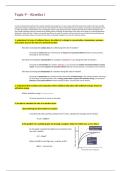
For the graph, calculate the initial rate of reaction for the
‘low-conc’ reaction.
60/5 = 12cm3s-1
What is the RR for the ‘high-conc.' reaction at 20s?
0cm3s-1 – horizontal line.
In order to develop their practical skills, students should be encouraged to carry out a range of practical experiments related to this topic. Possible
experiments include investigating a variety of factors that influence the rates of reaction between, for example, marble chips and hydrochloric acid,
or sodium thiosulfate and hydrochloric acid, investigating catalysis using hydrogen peroxide. Mathematical skills that could be developed in this
topic include calculating rates from reaction time, plotting graphs and having an appreciation of the nature of the graph for a Maxwell-Boltzmann
distribution. Within this topic, students can consider how the use of models in chemistry is illustrated by the way in which the Maxwell-Boltzmann
distribution and collision theory can account for the effects of changing variables on the rate of a chemical reaction.
1. understand, in terms of collision theory, the effect of a change in concentration, temperature, pressure
and surface area on the rate of a chemical reaction
How does increasing the surface area of a solid change the rate of reaction?
Increasing the surface area of a solid increases the frequency of successful collisions between reactant particles,
increasing the rate of reaction.
How does increasing the concentration of a solution / pressure of a gas change the rate of reaction?
Increasing the concentration of a solution / pressure of a gas increases the number of reactant particles in a given
volume, increasing the frequency of successful collisions between reactant particles, increasing the rate of reaction.
How does increasing the temperature of a solution change the rate of reaction?
Increasing the temperature of a solution increases the amount of kinetic energy in the reactant particles, increasing
the percentage of reactant particles with an energy greater than or equal to the activation energy, increasing the
frequency of successful collisions between reactant particles, increasing the rate of reaction.
2. understand that reactions only take place when collisions take place with sufficient energy, known as
activation energy
Define ‘activation energy’. (do I really have to do this?)
The energy required for a reaction to take place.
3. be able to calculate the rate of a reaction from:
i data showing the time taken for reaction
A reaction took 160 seconds to produce 45cm3 of CO2. Calculate the average rate of reaction.
45/160 = 0.28cm3s-1
ii the gradient of a suitable graph, by drawing a tangent, either for initial rate, or at a time, t
For the graph, calculate the initial rate of reaction for the
‘low-conc’ reaction.
60/5 = 12cm3s-1
What is the RR for the ‘high-conc.' reaction at 20s?
0cm3s-1 – horizontal line.

