

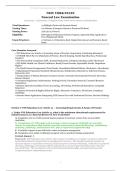
NYS Funeral Law Exam 2026/2027 — NYSDOS / State Board of Mortuary Science
NEW YORK STATE
Funeral Law Examination
2026/2027 | 75 Questions | Complete Exam with Correct Answers and Rationales
Total Questions: 75 Multiple-Choice and Scenario-Based
Testing Time: 120 Minutes (Computer-Based or Proctored Written)
Passing Score: 75% (56/75 Correct)
Eligibility: NYS-Approved Mortuary Science Program, Apprenticeship, Application +
Fees, Background Check
Exam Structure: 11 Sections, 6–8 Questions Each, Single-Best-Answer and Scenario-Based
Items
Core Domains Assessed
• NYS Education Law Article 13 (Licensing, Scope of Practice, Supervision, Continuing Education)
• 8 NYCRR Title 8 Part 79 (Standards of Practice, Record Keeping, Facility Specifications, Professional
Conduct)
• FTC Funeral Rule Compliance (GPL, Itemized Statements, Telephone Quoting, Casket Disclosure)
• NYS Public Health Law (Death Certificates, Burial/Transit Permits, Reportable Deaths, Disposition
Rights)
• Pre-Need Funeral Arrangements (Trust Funds, Cancellation/Refund Policies, Disclosures, Advertising)
• Embalming & Preparation Standards (Requirements, Refrigeration Alternatives, Infectious Disease,
Restorative Art)
• Transportation of Human Remains (Common Carrier, Interstate/International Protocols, Receiving
Director Duties)
• Cremation Regulations (Authorization, Waiting Periods, Pacemaker Removal, Cremated Remains
Disposition)
• Business Operations & Ethics (Trust Accounting, Advertising, Professional Boundaries, Complaint
Response)
• Consumer Protection & Rights (Selection Rights, Alternative Containers, Disclosures, Complaint
Handling)
• Scenario-Based Application (Integrating NYS Funeral Law with Professional Practice Decision-Making)
Section I: NYS Education Law Article 13 — Licensing Requirements & Scope of Practice
1. Under NYS Education Law Article 13, what is the minimum educational requirement for
initial licensure as a funeral director in New York State?
A. Completion of a 60-credit associate degree program in mortuary science from an accredited
institution
B. Completion of a NYS-approved mortuary science program (typically an associate
degree or equivalent) that includes specific coursework in funeral directing, embalming,
anatomy, pathology, and business law, plus a supervised apprenticeship
C. A bachelor's degree in any field with a minor in business management
D. Completion of an online certification program with no practical training requirement
Correct Answer: B
Rationale: NYS Education Law Section 7602 requires candidates to complete a program registered
by the State Education Department as qualifying for licensure. The standard pathway involves an
associate degree or equivalent mortuary science program covering embalming, restorative art, funeral
directing, pathology, and related subjects, followed by a one-year apprenticeship under a licensed
funeral director. This combination ensures both theoretical knowledge and supervised practical
competency before independent practice.
1
, NYS Funeral Law Exam 2026/2027 — NYSDOS / State Board of Mortuary Science
2. According to Article 13, how many continuing education contact hours must a licensed
funeral director complete during each three-year registration period?
A. 12 contact hours per three-year period
B. 24 contact hours per three-year period
C. 36 contact hours per three-year period
D. No continuing education is required once initial licensure is obtained
Correct Answer: A
Rationale: NYS Education Law Section 7606 and the corresponding regulations mandate that
licensed funeral directors complete a minimum of 12 hours of approved continuing education during
each three-year registration period. These hours must cover approved topics relevant to funeral service
practice and may include courses on ethics, regulation updates, public health, and professional
development. Failure to complete CE requirements can result in non-renewal of the license.
3. Under NYS Education Law Article 13, which activity constitutes the unauthorized practice
of funeral directing?
A. A licensed funeral director consulting with a colleague about a complex case
B. A person who is not licensed arranging, directing, or supervising the funeral of a
human body for compensation, including but not limited to embalming, cremation
coordination, or the disposition of remains
C. A mortuary science student assisting under direct supervision during an approved apprenticeship
D. A cemetery employee opening and closing a grave without handling the remains
Correct Answer: B
Rationale: NYS Education Law Section 7601 defines the practice of funeral directing and prohibits
unlicensed individuals from engaging in it for compensation. Unauthorized practice includes directing
or supervising funerals, arranging for cremation or burial, or otherwise disposing of human remains.
Penalties for unauthorized practice can include fines and criminal prosecution. The law does provide
specific exemptions for apprentices acting under supervision, cemetery employees performing
interment-only duties, and certain religious practitioners.
4. What is the requirement for funeral director apprentice supervision under NYS Education
Law Article 13?
A. The apprentice must be supervised by a licensed funeral director for at least 50% of working hours
B. The apprentice must work under the direct, personal supervision of a licensed New
York State funeral director at all times while performing funeral directing duties, and the
supervising funeral director must maintain records of the apprenticeship activities
C. The apprentice may work independently after completing the first six months of the apprenticeship
period
D. The apprentice requires only written supervision via electronic communication with the licensed
supervisor
Correct Answer: B
Rationale: Article 13 requires that apprentices perform all funeral directing activities under the
direct, personal supervision of a currently licensed NYS funeral director. Direct supervision means the
licensed director is physically present and available to observe, guide, and evaluate the apprentice's
work. The supervising funeral director must maintain detailed records of the types and quantities of
services performed, which are submitted to the State Education Department as part of the licensure
application.
5. Under Article 13, what is the scope of practice distinction between a funeral director license
and an embalmer license in New York State?
A. There is no distinction; a funeral director may perform all functions including embalming
B. A funeral director license authorizes the holder to arrange and supervise funerals,
while an embalmer license specifically authorizes the practice of embalming; however,
most NYS licensees hold both credentials as a combined funeral director-embalmer
C. An embalmer license is a higher-level credential that automatically includes all funeral directing
privileges
D. The distinction is based solely on the type of funeral home (urban versus rural) where the licensee
practices
Correct Answer: B
2
, NYS Funeral Law Exam 2026/2027 — NYSDOS / State Board of Mortuary Science
Rationale: NYS Education Law Article 13 maintains separate definitions for funeral directing and
embalming. Funeral directing involves arranging, conducting, and supervising funeral services and
the disposition of remains. Embalming is defined as the preservation, disinfection, and preparation of a
deceased human body. While the licenses are distinct, most practitioners in New York State obtain the
combined funeral director-embalmer credential, which requires passing both examination components
and meeting all educational and apprenticeship requirements for each.
6. A funeral director's license in New York State must be renewed every how many years?
A. 1 year
B. 2 years
C. 3 years
D. 5 years
Correct Answer: B
Rationale: NYS Education Law Section 7606 requires that funeral director licenses be registered
(renewed) every two years. The renewal process requires submission of a renewal application,
payment of the applicable fee, and attestation of completion of the required continuing education
hours. Licenses that are not renewed by the expiration date become inactive, and the individual may
not practice until the license is reinstated through the reinstatement process, which may include
additional requirements.
7. Under Article 13, what action can the State Board of Mortuary Science take against a
licensee who violates NYS funeral law?
A. Only issue a written warning with no further consequences
B. The Board may impose disciplinary sanctions including license suspension, revocation,
censure, probation, and/or monetary penalties, depending on the severity and nature of
the violation
C. The Board may only refer the matter to local law enforcement for criminal prosecution
D. The Board has no enforcement authority and must rely on the court system for all disciplinary actions
Correct Answer: B
Rationale: NYS Education Law Section 6510 authorizes the Board of Regents and the State Board of
Mortuary Science to discipline licensed funeral directors and embalmers for professional misconduct.
Disciplinary measures range from censure and reprimand to license revocation. Grounds for discipline
include fraud, negligence, substance abuse affecting practice, criminal convictions, and violation of any
provision of Education Law or the regulations governing funeral directing practice. The process
includes investigation, hearing, and determination phases.
Section II: NYS Codes, Rules and Regulations Title 8, Part 79 — Standards of Practice
8. Under 8 NYCRR Part 79, what are the minimum record-keeping requirements for a
licensed funeral director in New York State?
A. Records must be maintained for 3 years after the date of service
B. Complete records of each funeral service must be maintained for a period of at least 6
years and must include the name of the deceased, date of death, date of funeral, services
performed, merchandise provided, and a signed authorization from the next of kin
C. Records must be maintained for 10 years and submitted annually to the State Board
D. Only financial records must be retained; service records may be destroyed after 30 days
Correct Answer: B
Rationale: 8 NYCRR Section 79.5 mandates that funeral directors maintain complete and accurate
records of all professional services rendered. These records must include identification of the deceased,
dates of service, all services performed, merchandise provided, and the legal authorization for the
disposition. Records must be retained for a minimum of six years and must be available for inspection
by the State Education Department upon request. Failure to maintain adequate records constitutes
professional misconduct.
9. According to 8 NYCRR Part 79, what facility specifications must a funeral establishment
meet in New York State?
A. A funeral home may operate from any commercially zoned property without specific facility
requirements
3
NEW YORK STATE
Funeral Law Examination
2026/2027 | 75 Questions | Complete Exam with Correct Answers and Rationales
Total Questions: 75 Multiple-Choice and Scenario-Based
Testing Time: 120 Minutes (Computer-Based or Proctored Written)
Passing Score: 75% (56/75 Correct)
Eligibility: NYS-Approved Mortuary Science Program, Apprenticeship, Application +
Fees, Background Check
Exam Structure: 11 Sections, 6–8 Questions Each, Single-Best-Answer and Scenario-Based
Items
Core Domains Assessed
• NYS Education Law Article 13 (Licensing, Scope of Practice, Supervision, Continuing Education)
• 8 NYCRR Title 8 Part 79 (Standards of Practice, Record Keeping, Facility Specifications, Professional
Conduct)
• FTC Funeral Rule Compliance (GPL, Itemized Statements, Telephone Quoting, Casket Disclosure)
• NYS Public Health Law (Death Certificates, Burial/Transit Permits, Reportable Deaths, Disposition
Rights)
• Pre-Need Funeral Arrangements (Trust Funds, Cancellation/Refund Policies, Disclosures, Advertising)
• Embalming & Preparation Standards (Requirements, Refrigeration Alternatives, Infectious Disease,
Restorative Art)
• Transportation of Human Remains (Common Carrier, Interstate/International Protocols, Receiving
Director Duties)
• Cremation Regulations (Authorization, Waiting Periods, Pacemaker Removal, Cremated Remains
Disposition)
• Business Operations & Ethics (Trust Accounting, Advertising, Professional Boundaries, Complaint
Response)
• Consumer Protection & Rights (Selection Rights, Alternative Containers, Disclosures, Complaint
Handling)
• Scenario-Based Application (Integrating NYS Funeral Law with Professional Practice Decision-Making)
Section I: NYS Education Law Article 13 — Licensing Requirements & Scope of Practice
1. Under NYS Education Law Article 13, what is the minimum educational requirement for
initial licensure as a funeral director in New York State?
A. Completion of a 60-credit associate degree program in mortuary science from an accredited
institution
B. Completion of a NYS-approved mortuary science program (typically an associate
degree or equivalent) that includes specific coursework in funeral directing, embalming,
anatomy, pathology, and business law, plus a supervised apprenticeship
C. A bachelor's degree in any field with a minor in business management
D. Completion of an online certification program with no practical training requirement
Correct Answer: B
Rationale: NYS Education Law Section 7602 requires candidates to complete a program registered
by the State Education Department as qualifying for licensure. The standard pathway involves an
associate degree or equivalent mortuary science program covering embalming, restorative art, funeral
directing, pathology, and related subjects, followed by a one-year apprenticeship under a licensed
funeral director. This combination ensures both theoretical knowledge and supervised practical
competency before independent practice.
1
, NYS Funeral Law Exam 2026/2027 — NYSDOS / State Board of Mortuary Science
2. According to Article 13, how many continuing education contact hours must a licensed
funeral director complete during each three-year registration period?
A. 12 contact hours per three-year period
B. 24 contact hours per three-year period
C. 36 contact hours per three-year period
D. No continuing education is required once initial licensure is obtained
Correct Answer: A
Rationale: NYS Education Law Section 7606 and the corresponding regulations mandate that
licensed funeral directors complete a minimum of 12 hours of approved continuing education during
each three-year registration period. These hours must cover approved topics relevant to funeral service
practice and may include courses on ethics, regulation updates, public health, and professional
development. Failure to complete CE requirements can result in non-renewal of the license.
3. Under NYS Education Law Article 13, which activity constitutes the unauthorized practice
of funeral directing?
A. A licensed funeral director consulting with a colleague about a complex case
B. A person who is not licensed arranging, directing, or supervising the funeral of a
human body for compensation, including but not limited to embalming, cremation
coordination, or the disposition of remains
C. A mortuary science student assisting under direct supervision during an approved apprenticeship
D. A cemetery employee opening and closing a grave without handling the remains
Correct Answer: B
Rationale: NYS Education Law Section 7601 defines the practice of funeral directing and prohibits
unlicensed individuals from engaging in it for compensation. Unauthorized practice includes directing
or supervising funerals, arranging for cremation or burial, or otherwise disposing of human remains.
Penalties for unauthorized practice can include fines and criminal prosecution. The law does provide
specific exemptions for apprentices acting under supervision, cemetery employees performing
interment-only duties, and certain religious practitioners.
4. What is the requirement for funeral director apprentice supervision under NYS Education
Law Article 13?
A. The apprentice must be supervised by a licensed funeral director for at least 50% of working hours
B. The apprentice must work under the direct, personal supervision of a licensed New
York State funeral director at all times while performing funeral directing duties, and the
supervising funeral director must maintain records of the apprenticeship activities
C. The apprentice may work independently after completing the first six months of the apprenticeship
period
D. The apprentice requires only written supervision via electronic communication with the licensed
supervisor
Correct Answer: B
Rationale: Article 13 requires that apprentices perform all funeral directing activities under the
direct, personal supervision of a currently licensed NYS funeral director. Direct supervision means the
licensed director is physically present and available to observe, guide, and evaluate the apprentice's
work. The supervising funeral director must maintain detailed records of the types and quantities of
services performed, which are submitted to the State Education Department as part of the licensure
application.
5. Under Article 13, what is the scope of practice distinction between a funeral director license
and an embalmer license in New York State?
A. There is no distinction; a funeral director may perform all functions including embalming
B. A funeral director license authorizes the holder to arrange and supervise funerals,
while an embalmer license specifically authorizes the practice of embalming; however,
most NYS licensees hold both credentials as a combined funeral director-embalmer
C. An embalmer license is a higher-level credential that automatically includes all funeral directing
privileges
D. The distinction is based solely on the type of funeral home (urban versus rural) where the licensee
practices
Correct Answer: B
2
, NYS Funeral Law Exam 2026/2027 — NYSDOS / State Board of Mortuary Science
Rationale: NYS Education Law Article 13 maintains separate definitions for funeral directing and
embalming. Funeral directing involves arranging, conducting, and supervising funeral services and
the disposition of remains. Embalming is defined as the preservation, disinfection, and preparation of a
deceased human body. While the licenses are distinct, most practitioners in New York State obtain the
combined funeral director-embalmer credential, which requires passing both examination components
and meeting all educational and apprenticeship requirements for each.
6. A funeral director's license in New York State must be renewed every how many years?
A. 1 year
B. 2 years
C. 3 years
D. 5 years
Correct Answer: B
Rationale: NYS Education Law Section 7606 requires that funeral director licenses be registered
(renewed) every two years. The renewal process requires submission of a renewal application,
payment of the applicable fee, and attestation of completion of the required continuing education
hours. Licenses that are not renewed by the expiration date become inactive, and the individual may
not practice until the license is reinstated through the reinstatement process, which may include
additional requirements.
7. Under Article 13, what action can the State Board of Mortuary Science take against a
licensee who violates NYS funeral law?
A. Only issue a written warning with no further consequences
B. The Board may impose disciplinary sanctions including license suspension, revocation,
censure, probation, and/or monetary penalties, depending on the severity and nature of
the violation
C. The Board may only refer the matter to local law enforcement for criminal prosecution
D. The Board has no enforcement authority and must rely on the court system for all disciplinary actions
Correct Answer: B
Rationale: NYS Education Law Section 6510 authorizes the Board of Regents and the State Board of
Mortuary Science to discipline licensed funeral directors and embalmers for professional misconduct.
Disciplinary measures range from censure and reprimand to license revocation. Grounds for discipline
include fraud, negligence, substance abuse affecting practice, criminal convictions, and violation of any
provision of Education Law or the regulations governing funeral directing practice. The process
includes investigation, hearing, and determination phases.
Section II: NYS Codes, Rules and Regulations Title 8, Part 79 — Standards of Practice
8. Under 8 NYCRR Part 79, what are the minimum record-keeping requirements for a
licensed funeral director in New York State?
A. Records must be maintained for 3 years after the date of service
B. Complete records of each funeral service must be maintained for a period of at least 6
years and must include the name of the deceased, date of death, date of funeral, services
performed, merchandise provided, and a signed authorization from the next of kin
C. Records must be maintained for 10 years and submitted annually to the State Board
D. Only financial records must be retained; service records may be destroyed after 30 days
Correct Answer: B
Rationale: 8 NYCRR Section 79.5 mandates that funeral directors maintain complete and accurate
records of all professional services rendered. These records must include identification of the deceased,
dates of service, all services performed, merchandise provided, and the legal authorization for the
disposition. Records must be retained for a minimum of six years and must be available for inspection
by the State Education Department upon request. Failure to maintain adequate records constitutes
professional misconduct.
9. According to 8 NYCRR Part 79, what facility specifications must a funeral establishment
meet in New York State?
A. A funeral home may operate from any commercially zoned property without specific facility
requirements
3

