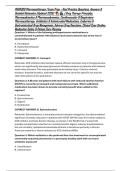
PHAR300 Pharmacotherapy I Exam Prep – Real Practice Questions, Answers &
Detailed Rationales (Updated 2026) | Drug Therapy Principles,
Pharmacokinetics & Pharmacodynamics, Cardiovascular & Respiratory
Pharmacotherapy, Antibiotics & Antimicrobial Medications, Endocrine &
Gastrointestinal Drug Management, Adverse Drug Reactions, Clinical Case Studies,
Medication Safety & Patient Care Planning
Question 1: Which of the following antihypertensive medications is
contraindicated in patients with bilateral renal artery stenosis due to the risk of
acute kidney injury?
A. Amlodipine
B. Hydrochlorothiazide
C. Lisinopril
D. Metoprolol
CORRECT ANSWER: C. Lisinopril
Rationale: ACE inhibitors like lisinopril reduce efferent arteriolar tone in the glomerulus,
which can significantly decrease glomerular filtration pressure in patients with bilateral
renal artery stenosis. This may precipitate acute kidney injury. Calcium channel
blockers, thiazide diuretics, and beta-blockers do not carry this specific risk and are
safer alternatives in this population.
Question 2: A 68-year-old patient with heart failure with reduced ejection fraction
(HFrEF) is currently on lisinopril and metoprolol succinate. Which additional
medication has been shown to provide mortality benefit when added to this
regimen?
A. Furosemide
B. Spironolactone
C. Digoxin
D. Hydralazine
CORRECT ANSWER: B. Spironolactone
Rationale: Spironolactone, a mineralocorticoid receptor antagonist, has demonstrated
significant mortality reduction in patients with HFrEF (NYHA Class III-IV) when added to
ACE inhibitor and beta-blocker therapy, as shown in the RALES trial. Furosemide
provides symptomatic relief but no mortality benefit; digoxin reduces hospitalizations
but not mortality; hydralazine/isosorbide dinitrate is beneficial primarily in African
American patients or those intolerant to ACE inhibitors/ARBs.
Question 3: Which antibiotic is the preferred first-line treatment for uncomplicated
community-acquired pneumonia in a previously healthy adult with no recent
antibiotic exposure?
A. Ciprofloxacin
B. Azithromycin
,C. Vancomycin
D. Metronidazole
CORRECT ANSWER: B. Azithromycin
Rationale: For uncomplicated community-acquired pneumonia in healthy adults
without comorbidities or recent antibiotic use, macrolides like azithromycin are
recommended as first-line therapy by IDSA/ATS guidelines due to coverage of typical
pathogens (S. pneumoniae, H. influenzae) and atypical organisms (Mycoplasma,
Chlamydia). Fluoroquinolones are reserved for patients with comorbidities or recent
antibiotic exposure; vancomycin targets MRSA; metronidazole covers anaerobes, not
typical pneumonia pathogens.
Question 4: A patient with type 2 diabetes mellitus and established atherosclerotic
cardiovascular disease should be initiated on which glucose-lowering agent to
reduce cardiovascular risk?
A. Glipizide
B. Pioglitazone
C. Empagliflozin
D. Acarbose
CORRECT ANSWER: C. Empagliflozin
Rationale: SGLT2 inhibitors like empagliflozin have demonstrated cardiovascular
benefit, including reduction in major adverse cardiovascular events and heart failure
hospitalizations, in patients with type 2 diabetes and established ASCVD, as shown in
the EMPA-REG OUTCOME trial. Sulfonylureas (glipizide) and thiazolidinediones
(pioglitazone) lack consistent cardiovascular benefit and may have adverse effects;
acarbose has minimal systemic absorption and no proven CV risk reduction.
Question 5: Which of the following medications requires therapeutic drug
monitoring due to its narrow therapeutic index and risk of toxicity?
A. Lisinopril
B. Warfarin
C. Atorvastatin
D. Metformin
CORRECT ANSWER: B. Warfarin
Rationale: Warfarin has a narrow therapeutic index, significant interindividual variability
in dosing requirements, and serious risks of bleeding or thrombosis if not properly
monitored. INR monitoring is essential to maintain therapeutic anticoagulation.
Lisinopril, atorvastatin, and metformin do not require routine therapeutic drug
monitoring as they have wider therapeutic windows and predictable pharmacokinetics.
Question 6: A patient presents with acute gout flare. Which medication is most
appropriate for immediate symptom relief?
,A. Allopurinol
B. Colchicine
C. Febuxostat
D. Probenecid
CORRECT ANSWER: B. Colchicine
Rationale: Colchicine is effective for acute gout flare management when initiated within
36 hours of symptom onset, working by inhibiting neutrophil migration and
inflammation. Allopurinol and febuxostat are urate-lowering therapies used for chronic
management, not acute flares, and may worsen symptoms if started during an acute
attack. Probenecid is a uricosuric agent also used for chronic management, not acute
treatment.
Question 7: Which antidepressant is most likely to cause significant
anticholinergic side effects such as dry mouth, constipation, and urinary
retention?
A. Fluoxetine
B. Sertraline
C. Amitriptyline
D. Venlafaxine
CORRECT ANSWER: C. Amitriptyline
Rationale: Amitriptyline is a tricyclic antidepressant (TCA) with potent anticholinergic
properties, leading to side effects like dry mouth, constipation, blurred vision, and
urinary retention. SSRIs (fluoxetine, sertraline) and SNRIs (venlafaxine) have minimal
anticholinergic activity, making them better tolerated in patients sensitive to these
effects.
Question 8: A patient with chronic kidney disease stage 4 (eGFR 25 mL/min/1.73m²)
requires pain management. Which analgesic is safest to use at recommended
doses?
A. Ibuprofen
B. Naproxen
C. Acetaminophen
D. Ketorolac
CORRECT ANSWER: C. Acetaminophen
Rationale: Acetaminophen is the preferred analgesic in patients with chronic kidney
disease as it undergoes hepatic metabolism and does not adversely affect renal
function at recommended doses. NSAIDs (ibuprofen, naproxen, ketorolac) inhibit renal
prostaglandin synthesis, which can precipitate acute kidney injury, worsen
hypertension, and accelerate CKD progression, especially in advanced stages.
, Question 9: Which medication is the first-line pharmacologic treatment for
absence seizures in pediatric patients?
A. Phenytoin
B. Carbamazepine
C. Ethosuximide
D. Valproic acid
CORRECT ANSWER: C. Ethosuximide
Rationale: Ethosuximide is the first-line treatment for childhood absence epilepsy due
to its efficacy in controlling absence seizures and favorable side effect profile compared
to valproic acid. Phenytoin and carbamazepine may exacerbate absence seizures and
are not recommended. Valproic acid is effective but reserved for cases with
concomitant generalized tonic-clonic seizures due to risks of hepatotoxicity and
teratogenicity.
Question 10: A patient with GERD unresponsive to standard-dose proton pump
inhibitor therapy should next be evaluated for which condition before escalating
therapy?
A. Helicobacter pylori infection
B. Zollinger-Ellison syndrome
C. Medication adherence
D. Esophageal cancer
CORRECT ANSWER: C. Medication adherence
Rationale: Before escalating PPI therapy or pursuing invasive testing, clinicians should
assess medication adherence, as improper timing (not taking PPI 30-60 minutes before
meals) or inconsistent use is a common cause of apparent treatment failure. H. pylori
testing is indicated in peptic ulcer disease, not routine GERD; Zollinger-Ellison
syndrome is rare; endoscopy for cancer screening is reserved for alarm symptoms.
Question 11: Which antipsychotic medication carries the highest risk of metabolic
side effects including weight gain, dyslipidemia, and new-onset diabetes?
A. Aripiprazole
B. Lurasidone
C. Olanzapine
D. Ziprasidone
CORRECT ANSWER: C. Olanzapine
Rationale: Olanzapine is associated with the highest risk of metabolic adverse effects
among second-generation antipsychotics, including significant weight gain, insulin
resistance, dyslipidemia, and increased diabetes risk. Aripiprazole, lurasidone, and
ziprasidone have more favorable metabolic profiles and are preferred in patients with
metabolic risk factors.
Detailed Rationales (Updated 2026) | Drug Therapy Principles,
Pharmacokinetics & Pharmacodynamics, Cardiovascular & Respiratory
Pharmacotherapy, Antibiotics & Antimicrobial Medications, Endocrine &
Gastrointestinal Drug Management, Adverse Drug Reactions, Clinical Case Studies,
Medication Safety & Patient Care Planning
Question 1: Which of the following antihypertensive medications is
contraindicated in patients with bilateral renal artery stenosis due to the risk of
acute kidney injury?
A. Amlodipine
B. Hydrochlorothiazide
C. Lisinopril
D. Metoprolol
CORRECT ANSWER: C. Lisinopril
Rationale: ACE inhibitors like lisinopril reduce efferent arteriolar tone in the glomerulus,
which can significantly decrease glomerular filtration pressure in patients with bilateral
renal artery stenosis. This may precipitate acute kidney injury. Calcium channel
blockers, thiazide diuretics, and beta-blockers do not carry this specific risk and are
safer alternatives in this population.
Question 2: A 68-year-old patient with heart failure with reduced ejection fraction
(HFrEF) is currently on lisinopril and metoprolol succinate. Which additional
medication has been shown to provide mortality benefit when added to this
regimen?
A. Furosemide
B. Spironolactone
C. Digoxin
D. Hydralazine
CORRECT ANSWER: B. Spironolactone
Rationale: Spironolactone, a mineralocorticoid receptor antagonist, has demonstrated
significant mortality reduction in patients with HFrEF (NYHA Class III-IV) when added to
ACE inhibitor and beta-blocker therapy, as shown in the RALES trial. Furosemide
provides symptomatic relief but no mortality benefit; digoxin reduces hospitalizations
but not mortality; hydralazine/isosorbide dinitrate is beneficial primarily in African
American patients or those intolerant to ACE inhibitors/ARBs.
Question 3: Which antibiotic is the preferred first-line treatment for uncomplicated
community-acquired pneumonia in a previously healthy adult with no recent
antibiotic exposure?
A. Ciprofloxacin
B. Azithromycin
,C. Vancomycin
D. Metronidazole
CORRECT ANSWER: B. Azithromycin
Rationale: For uncomplicated community-acquired pneumonia in healthy adults
without comorbidities or recent antibiotic use, macrolides like azithromycin are
recommended as first-line therapy by IDSA/ATS guidelines due to coverage of typical
pathogens (S. pneumoniae, H. influenzae) and atypical organisms (Mycoplasma,
Chlamydia). Fluoroquinolones are reserved for patients with comorbidities or recent
antibiotic exposure; vancomycin targets MRSA; metronidazole covers anaerobes, not
typical pneumonia pathogens.
Question 4: A patient with type 2 diabetes mellitus and established atherosclerotic
cardiovascular disease should be initiated on which glucose-lowering agent to
reduce cardiovascular risk?
A. Glipizide
B. Pioglitazone
C. Empagliflozin
D. Acarbose
CORRECT ANSWER: C. Empagliflozin
Rationale: SGLT2 inhibitors like empagliflozin have demonstrated cardiovascular
benefit, including reduction in major adverse cardiovascular events and heart failure
hospitalizations, in patients with type 2 diabetes and established ASCVD, as shown in
the EMPA-REG OUTCOME trial. Sulfonylureas (glipizide) and thiazolidinediones
(pioglitazone) lack consistent cardiovascular benefit and may have adverse effects;
acarbose has minimal systemic absorption and no proven CV risk reduction.
Question 5: Which of the following medications requires therapeutic drug
monitoring due to its narrow therapeutic index and risk of toxicity?
A. Lisinopril
B. Warfarin
C. Atorvastatin
D. Metformin
CORRECT ANSWER: B. Warfarin
Rationale: Warfarin has a narrow therapeutic index, significant interindividual variability
in dosing requirements, and serious risks of bleeding or thrombosis if not properly
monitored. INR monitoring is essential to maintain therapeutic anticoagulation.
Lisinopril, atorvastatin, and metformin do not require routine therapeutic drug
monitoring as they have wider therapeutic windows and predictable pharmacokinetics.
Question 6: A patient presents with acute gout flare. Which medication is most
appropriate for immediate symptom relief?
,A. Allopurinol
B. Colchicine
C. Febuxostat
D. Probenecid
CORRECT ANSWER: B. Colchicine
Rationale: Colchicine is effective for acute gout flare management when initiated within
36 hours of symptom onset, working by inhibiting neutrophil migration and
inflammation. Allopurinol and febuxostat are urate-lowering therapies used for chronic
management, not acute flares, and may worsen symptoms if started during an acute
attack. Probenecid is a uricosuric agent also used for chronic management, not acute
treatment.
Question 7: Which antidepressant is most likely to cause significant
anticholinergic side effects such as dry mouth, constipation, and urinary
retention?
A. Fluoxetine
B. Sertraline
C. Amitriptyline
D. Venlafaxine
CORRECT ANSWER: C. Amitriptyline
Rationale: Amitriptyline is a tricyclic antidepressant (TCA) with potent anticholinergic
properties, leading to side effects like dry mouth, constipation, blurred vision, and
urinary retention. SSRIs (fluoxetine, sertraline) and SNRIs (venlafaxine) have minimal
anticholinergic activity, making them better tolerated in patients sensitive to these
effects.
Question 8: A patient with chronic kidney disease stage 4 (eGFR 25 mL/min/1.73m²)
requires pain management. Which analgesic is safest to use at recommended
doses?
A. Ibuprofen
B. Naproxen
C. Acetaminophen
D. Ketorolac
CORRECT ANSWER: C. Acetaminophen
Rationale: Acetaminophen is the preferred analgesic in patients with chronic kidney
disease as it undergoes hepatic metabolism and does not adversely affect renal
function at recommended doses. NSAIDs (ibuprofen, naproxen, ketorolac) inhibit renal
prostaglandin synthesis, which can precipitate acute kidney injury, worsen
hypertension, and accelerate CKD progression, especially in advanced stages.
, Question 9: Which medication is the first-line pharmacologic treatment for
absence seizures in pediatric patients?
A. Phenytoin
B. Carbamazepine
C. Ethosuximide
D. Valproic acid
CORRECT ANSWER: C. Ethosuximide
Rationale: Ethosuximide is the first-line treatment for childhood absence epilepsy due
to its efficacy in controlling absence seizures and favorable side effect profile compared
to valproic acid. Phenytoin and carbamazepine may exacerbate absence seizures and
are not recommended. Valproic acid is effective but reserved for cases with
concomitant generalized tonic-clonic seizures due to risks of hepatotoxicity and
teratogenicity.
Question 10: A patient with GERD unresponsive to standard-dose proton pump
inhibitor therapy should next be evaluated for which condition before escalating
therapy?
A. Helicobacter pylori infection
B. Zollinger-Ellison syndrome
C. Medication adherence
D. Esophageal cancer
CORRECT ANSWER: C. Medication adherence
Rationale: Before escalating PPI therapy or pursuing invasive testing, clinicians should
assess medication adherence, as improper timing (not taking PPI 30-60 minutes before
meals) or inconsistent use is a common cause of apparent treatment failure. H. pylori
testing is indicated in peptic ulcer disease, not routine GERD; Zollinger-Ellison
syndrome is rare; endoscopy for cancer screening is reserved for alarm symptoms.
Question 11: Which antipsychotic medication carries the highest risk of metabolic
side effects including weight gain, dyslipidemia, and new-onset diabetes?
A. Aripiprazole
B. Lurasidone
C. Olanzapine
D. Ziprasidone
CORRECT ANSWER: C. Olanzapine
Rationale: Olanzapine is associated with the highest risk of metabolic adverse effects
among second-generation antipsychotics, including significant weight gain, insulin
resistance, dyslipidemia, and increased diabetes risk. Aripiprazole, lurasidone, and
ziprasidone have more favorable metabolic profiles and are preferred in patients with
metabolic risk factors.