

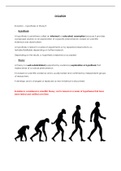
EVOLUTION
Evolution – hypothesis or theory?
- Hypothesis
A hypothesis is sometimes called an informed (or educated) assumption because it provides
a proposed solution or an explanation of a specific phenomenon, based on scientific
evidence and observations
A hypothesis is tested in a series of experiments or by repeated observations i.e.,
testable/falsifiable depending on further research.
Depending on the results, a hypothesis is rejected or accepted
- Theory
A theory is a well-substantiated (supported by evidence) explanation or hypothesis that
makes sense of a natural phenomenon
It is based on scientific evidence and is usually tested and confirmed by independent groups
of researchers.
It develops and is changed or replaced as new evidence is discovered
Evolution is considered a scientific theory, as it is based on a series of hypotheses that have
been tested and verified over time.
,Macro vs Micro evolution
Macro Evolution
This is the development of new life forms or species from earlier life forms over many
generations. This refers to large-scale changes that occur over an extended period of time.
Micro evolution
This is the variation that occurs within a species. Small changes originate in the gene pool,
resulting in small changes in the genotype of the species. These changes are passed on to.
The offspring.
There are three major observations that may be made when studying the natural
environment:
1. The rich biodiversity of living organisms
2. How living organisms are well adapted to a particular environment
3. Continuous changes take place in the environment
*LAMARACKISM
Jean-Baptiste de Lamarck (1744-1829), a French naturalist proposed his theory of evolution in
1809.
Lamarck’s theory of evolution:
INHERITANCE OF AQUIRED CHARACTERISTICS
1. Individuals change in response to their environment
2. Individuals change within their lifetime
3. These changes occurring within one’s lifetime are passed down onto offspring
THE USE AND DISUSE HYPOTHESIS
- If a structure is used/useful/beneficial it will get bigger/better/faster
➔ become more effective
- if a structure is useless/not needed it will become smaller/worse/slower
➔ Become less effective
Lamarck’s “laws”:
1. Inheritance of acquired characteristics X completely rejected
2. Use and disuse hypothesis. to an extent
3.
Application of Lamarckism
, The best-known example of the application of Lamarck’s theory is the elongated necks of
giraffes. According to Lamarck, giraffe ancestors had short necks.
Over generations these short-necked giraffes
stretched their necks to reach the leaves on the
top branches for food. The stretching caused
their necks to grow stronger and longer. The
acquired trait (long neck) was passed on to
the next generations. As a result, all modern
giraffes have long necks.
Lamarck believed that organisms possess an internal driving force – to strive for complexity
and perfection.
Reasons for rejection of Lamarckism
1. After the discovery of modern genetics, Lamarck’s theory of ‘the inheritance of
acquired traits’ was completely rejected as it was not supported by evidence.
2. Although he was wrong, Lamarck was the first scientist to propose that ‘something’
passed on the characteristics of the parents to the offspring
3. The knowledge of genetics did not yet exist in Lamarck’s time, so he had no
understanding of genetics and mutations
4. The ancestors of giraffes possessed the gene for long, strong necks and did not
acquire the gene by stretching their necks.
Although Lamarck’s theory was rejected, his pioneering work led to the formulation of
Charles Darwin’s theory of evolution.
Evolution – hypothesis or theory?
- Hypothesis
A hypothesis is sometimes called an informed (or educated) assumption because it provides
a proposed solution or an explanation of a specific phenomenon, based on scientific
evidence and observations
A hypothesis is tested in a series of experiments or by repeated observations i.e.,
testable/falsifiable depending on further research.
Depending on the results, a hypothesis is rejected or accepted
- Theory
A theory is a well-substantiated (supported by evidence) explanation or hypothesis that
makes sense of a natural phenomenon
It is based on scientific evidence and is usually tested and confirmed by independent groups
of researchers.
It develops and is changed or replaced as new evidence is discovered
Evolution is considered a scientific theory, as it is based on a series of hypotheses that have
been tested and verified over time.
,Macro vs Micro evolution
Macro Evolution
This is the development of new life forms or species from earlier life forms over many
generations. This refers to large-scale changes that occur over an extended period of time.
Micro evolution
This is the variation that occurs within a species. Small changes originate in the gene pool,
resulting in small changes in the genotype of the species. These changes are passed on to.
The offspring.
There are three major observations that may be made when studying the natural
environment:
1. The rich biodiversity of living organisms
2. How living organisms are well adapted to a particular environment
3. Continuous changes take place in the environment
*LAMARACKISM
Jean-Baptiste de Lamarck (1744-1829), a French naturalist proposed his theory of evolution in
1809.
Lamarck’s theory of evolution:
INHERITANCE OF AQUIRED CHARACTERISTICS
1. Individuals change in response to their environment
2. Individuals change within their lifetime
3. These changes occurring within one’s lifetime are passed down onto offspring
THE USE AND DISUSE HYPOTHESIS
- If a structure is used/useful/beneficial it will get bigger/better/faster
➔ become more effective
- if a structure is useless/not needed it will become smaller/worse/slower
➔ Become less effective
Lamarck’s “laws”:
1. Inheritance of acquired characteristics X completely rejected
2. Use and disuse hypothesis. to an extent
3.
Application of Lamarckism
, The best-known example of the application of Lamarck’s theory is the elongated necks of
giraffes. According to Lamarck, giraffe ancestors had short necks.
Over generations these short-necked giraffes
stretched their necks to reach the leaves on the
top branches for food. The stretching caused
their necks to grow stronger and longer. The
acquired trait (long neck) was passed on to
the next generations. As a result, all modern
giraffes have long necks.
Lamarck believed that organisms possess an internal driving force – to strive for complexity
and perfection.
Reasons for rejection of Lamarckism
1. After the discovery of modern genetics, Lamarck’s theory of ‘the inheritance of
acquired traits’ was completely rejected as it was not supported by evidence.
2. Although he was wrong, Lamarck was the first scientist to propose that ‘something’
passed on the characteristics of the parents to the offspring
3. The knowledge of genetics did not yet exist in Lamarck’s time, so he had no
understanding of genetics and mutations
4. The ancestors of giraffes possessed the gene for long, strong necks and did not
acquire the gene by stretching their necks.
Although Lamarck’s theory was rejected, his pioneering work led to the formulation of
Charles Darwin’s theory of evolution.

