
• ¿Documento equivocado? Cámbialo gratis
  • Escrito por estudiantes que aprobaron
  • Inmediatamente disponible después del pago
  • Leer en línea o como PDF
Vender
¿Dónde estudias?
Tu idioma
Document preview thumbnail
Vista previa 2 fuera de 11 páginas
Resumen

Summary Afrikaans FAL

Document preview thumbnail
Vista previa 2 fuera de 11 páginas

This document introduces the basics of the Afrikaans terminology that students from the juinor grades all the way up until the senior grades will need to become familiar with. This document introduces the topic and provides you with detailed English definitions! Improve your Afrikaans today and do not miss out on this opportunity!

Vista previa del contenido

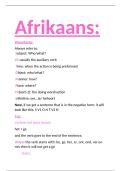
Afrikaans:
Woordorde:
Always refer to:
Subject: Who/what?
V1:usually the auxiliary verb
Time: when the action is being preformed
Object: who/what?
Manner: how?
Place: where?
V2(verb 2): the doing word/action
Infinitive: om…te/ behoort
Now, if we get a sentence that is in the negative form, it will
look like this: S V1 O N T V2 N
Tye:
Verlede tyd (past tense):
het + ge
and the verb goes to the end of the sentence,
Unless the verb starts with: be, ge, her, er, ont, ond, ver en
mis then it will not get a ge
Rules:

,  Words that change: is-was; sal-sou; wil-wou; kan-kon;
moet-moes, when you get these words, you don’t need
to change the sentence, only change the word.
 If the verb is het, you will add another het and take it to
the end of the sentence and change it to gehad.
 If there is a verb and a preposition, it will become:
preposition+ge-verb (ingekom)
 If given the helping verbs gaan, laat and kom, they will
go to the end of the sentence before the verb
 If you can do both verbs at the same time, the first one
gets a ge, if you cant do both they both get a ge.
 The words: as, wanner, dan en nou change to “toe”,
(Jeremy is bly as hy vir sara sien-jeremy was blye to hy
vir sara sien)
 If the sentence contains an infinitive you just need to
replace the verb with “het” and after that you add in the
place then the verb + -ge and your infinitive will always
come last
(Pierce bly in die bed om te rus- Pierce het in die bed gebly
om to rus)
Toekomende tyd:
Sal in the place of the verb and the verb moves to the end of
the sentence.
Rules:
Has the word “wil, moet en kan” as the verb, sal will take its
place and it will go just before the verb.


Información del documento

Schooljaar
200
Subido en
6 de mayo de 2026
Número de páginas
11
Escrito en
2025/2026
Tipo
Resumen
$3.86

¿Documento equivocado? Cámbialo gratis Dentro de los 14 días posteriores a la compra y antes de descargarlo, puedes elegir otro documento. Puedes gastar el importe de nuevo.
Escrito por estudiantes que aprobaron
Inmediatamente disponible después del pago
Leer en línea o como PDF

Vendido
0
Seguidores
0
Artículos
10
Última venta
-


Por qué los estudiantes eligen Stuvia

Creado por compañeros estudiantes, verificado por reseñas

Calidad en la que puedes confiar: escrito por estudiantes que aprobaron y evaluado por otros que han usado estos resúmenes.

¿No estás satisfecho? Elige otro documento

¡No te preocupes! Puedes elegir directamente otro documento que se ajuste mejor a lo que buscas.

Paga como quieras, empieza a estudiar al instante

Sin suscripción, sin compromisos. Paga como estés acostumbrado con tarjeta de crédito y descarga tu documento PDF inmediatamente.

Student with book image

“Comprado, descargado y aprobado. Así de fácil puede ser.”

Alisha Student

Preguntas frecuentes