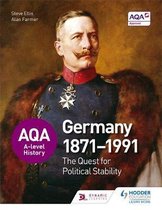
Germany 1871–1991
Comprehensive Evidence Bank
Organised by the AQA six thematic key questions
Format: bold = the evidence | italic = what it proves / how to use it in argument
,How to use this bank
Every entry is structured: evidence first (statistic, name, date, event, place), then a brief note on what it
proves — i.e. which arguments it can support and what nuance it adds. Where evidence cuts both ways (e.g.
1918–19 revolution: real change vs. continuity of elites), it's flagged so you can deploy it on either side.
The six themes are AQA's. Within each theme, evidence is arranged chronologically across the four sections
of the course (Kaiserreich → Weimar → Nazi → FRG) so you can track change and con nuity. The strongest
essays consistently link evidence across periods — e.g. comparing the role of elites in 1871–1900 with 1919–
1945, or the relationship between economic crisis and political collapse in 1929–33 with economic strength
and democratic stability post-1949.
Pieces flagged as 'versatile' work across multiple themes — memorise these first.
,Theme 1 — How was Germany governed and how did political
authority change and develop?
Kaiserreich, 1871–1914
The 1871 Constitution and Bismarck's authority, 1871–1890
1871 Constitution: Kaiser appointed/dismissed Chancellor; controlled foreign policy, army, declarations of
war; could dissolve Reichstag.
Proves: Foundational evidence for a 'sham democracy' / semi-autocracy interpretation. Power was
concentrated in the Crown — democracy was constitutional veneer over Prussian autocracy.
Bundesrat: 58 seats, Prussia held 17; 14 votes could veto constitutional change.
Proves: Prussia could block any constitutional reform alone. Confirms Liebknecht's description of the
Reichstag as 'the fig-leaf of absolutism' — federal structure was rigged for Prussian dominance.
Reichstag elected by universal male suffrage (over 25); could not initiate, amend or dismiss government —
but had to approve the budget.
Proves: The lever the Reichstag did possess: budgetary consent. Used to argue Reichstag was 'something
in between' (Layton) — not powerless, but unable to govern. Vital for essays on whether
Bismarck/Wilhelm II could ignore opposition.
1874 Septennial Law: army budget reviewed every seven years (compromise after Bismarck failed to
remove military finance from Reichstag entirely).
Proves: Bismarck's most important domestic concession to the Reichstag — proves the parliament was
'troublesome' (Carr) even at the height of his power. Use against the 'all-powerful Bismarck' line.
Bismarck dominated cabinet — no imperial cabinet existed; ministers were 'senior clerks'; he relied on his
son Herbert (Foreign Office Sec. 1886).
Proves: Personal, not institutional, authority. When Bismarck fell, the system fell with him — supports
William Carr's argument that the constitution worked only as long as Bismarck did.
1887 Septennates crisis: Bismarck dissolved Reichstag, conjured French invasion threat, won
Conservative–National Liberal majority.
Proves: Shows Bismarck's tactical flexibility and willingness to bypass Reichstag through electoral
manipulation — but also that he had to do this repeatedly proves the Reichstag was a real constraint.
Williamson (historian): the constitution 'avoided problems by ignoring them … by the 1880s a straitjacket'.
Proves: Useful interpretation showing the system was unsustainable. Bismarck's fall left 'rival centres of
power' (Crown, Reichstag, bureaucracy, army, pressure groups) — explains the chaos under Wilhelm II.
Wilhelm II's 'personal rule', 1888–1914
Wilhelm II dismissed Bismarck March 1890 over the Anti-Socialist Law renewal, foreign policy (Russia vs
Austria), and Bismarck's plan to alter the constitution to weaken Reichstag.
Proves: Turning point. Authority shifted from Chancellor to Kaiser. All four successors (Caprivi,
Hohenlohe, Bülow, Bethmann-Hollweg) were essentially civil servants dependent on the Kaiser.
Caprivi 1890–94: 'New Course' — let Anti-Socialist Law lapse, recognised trade unions, introduced
progressive income tax, banned Sunday work, banned child labour under 13.
Proves: Brief liberal moment within the autocratic framework. Shows the system could conciliate, but
Caprivi was forced out by Junker Agrarian League pressure — proves elites, not parliament, decided
chancellor's fate.
Hohenlohe (1894–1900) called himself the Kaiser's 'straw doll'.
Proves: Self-described powerlessness illustrates the high-water mark of Wilhelm's personal rule. Use for
autocracy arguments.
, 1908 Daily Telegraph affair: Wilhelm's tactless interview led to massive press attack; Reichstag demanded
constitutional curbs on his power; Wilhelm forced to promise to respect formalities; Bülow scapegoated
and dismissed 1909.
Proves: Crucial event: Reichstag did extract a constitutional concession from Wilhelm. Proves the
'autocracy' was constrained by public opinion and parliamentary pressure — strong evidence against the
absolute-monarchy interpretation.
1912 Reichstag election: SPD became largest party with 110 seats and 4.25 million votes (~35%).
Proves: Proves Reichstag was politically dynamic and increasingly opposition-minded. Bethmann-Hollweg
could not pass legislation without backroom deals; he eventually ruled by imperial decree (1913).
1913 Zabern affair: army arrested 28 civilians; Bethmann-Hollweg lost vote of no confidence 293–54 in
December 1913.
Proves: Shows Reichstag could express the country's view but could not enforce it — Bethmann ignored
the vote. Strong nuance: parliament had voice but no power. Versatile evidence (Theme 1, 2, 5).
By 1914 the army numbered 4 million (8x its 1890 size); military spending reached £60m by 1913–14;
officer corps was over half titled aristocracy.
Proves: Underpins the 'culture of militarism' argument and shows civilian government's inability to
control the army. Versatile evidence (Themes 1, 4, 5).
Layton's verdict on 1914: 'political stalemate which made for weak and confused government' —
Kaiserreich governable but not yet ungovernable.
Proves: Crucial historiographical anchor for any essay on whether Imperial Germany was viable in 1914.
Empire to democracy and Weimar Republic, 1914–1929
Revolution and the Weimar Constitution, 1918–1919
October 1918 reforms (under Prince Max of Baden): Chancellor responsible to Reichstag; military
subordinate to civilian government — 'revolution from above'.
Proves: Critical for the 'revolution-from-above' interpretation: the autocracy had effectively been
dismantled before sailors mutinied. Limits the radicalism of November.
Kiel mutiny 3 November 1918 → workers' and soldiers' councils across Germany within days; Wilhelm II
abdicated 9 November; Republic proclaimed; armistice signed 11 November.
Proves: Speed of collapse. Crucial: Republic was born tied to defeat (the 'November criminals' / stab-in-
the-back myth was almost inevitable from this sequence).
Ebert–Groener Pact 10 November 1918: army would back government in return for crushing Bolshevism
and protecting officer authority.
Proves: Founding compromise of Weimar — moderate socialism allied to imperial elites against the
radical left. Made the Republic viable but discredited it on the left from day one.
Stinnes–Legien Agreement 15 November 1918: 8-hour day, full union recognition, factory committees,
joint arbitration board, in return for protecting private ownership.
Proves: Real social gain. Working class won institutional rights they never had under the Kaiserreich —
but at the cost of radical transformation. Versatile evidence (Themes 1, 4, 6).
Spartacist Rising January 1919 crushed by Freikorps under Noske; Liebknecht and Luxemburg murdered;
Bavarian Soviet Republic crushed April 1919.
Proves: Republic was born in counter-revolutionary violence. The political left was permanently split
between SPD and KPD — essential context for explaining the Republic's later collapse.
January 1919 National Assembly elections: 80%+ turnout (incl. women); SPD 38% (165 seats), Centre 91,
Democrats 75, Nationalists 44.
Proves: Strong democratic mandate. Used in 'Weimar started with broad support' arguments —
undermines the deterministic 'doomed from the start' line.
Comprehensive Evidence Bank
Organised by the AQA six thematic key questions
Format: bold = the evidence | italic = what it proves / how to use it in argument
,How to use this bank
Every entry is structured: evidence first (statistic, name, date, event, place), then a brief note on what it
proves — i.e. which arguments it can support and what nuance it adds. Where evidence cuts both ways (e.g.
1918–19 revolution: real change vs. continuity of elites), it's flagged so you can deploy it on either side.
The six themes are AQA's. Within each theme, evidence is arranged chronologically across the four sections
of the course (Kaiserreich → Weimar → Nazi → FRG) so you can track change and con nuity. The strongest
essays consistently link evidence across periods — e.g. comparing the role of elites in 1871–1900 with 1919–
1945, or the relationship between economic crisis and political collapse in 1929–33 with economic strength
and democratic stability post-1949.
Pieces flagged as 'versatile' work across multiple themes — memorise these first.
,Theme 1 — How was Germany governed and how did political
authority change and develop?
Kaiserreich, 1871–1914
The 1871 Constitution and Bismarck's authority, 1871–1890
1871 Constitution: Kaiser appointed/dismissed Chancellor; controlled foreign policy, army, declarations of
war; could dissolve Reichstag.
Proves: Foundational evidence for a 'sham democracy' / semi-autocracy interpretation. Power was
concentrated in the Crown — democracy was constitutional veneer over Prussian autocracy.
Bundesrat: 58 seats, Prussia held 17; 14 votes could veto constitutional change.
Proves: Prussia could block any constitutional reform alone. Confirms Liebknecht's description of the
Reichstag as 'the fig-leaf of absolutism' — federal structure was rigged for Prussian dominance.
Reichstag elected by universal male suffrage (over 25); could not initiate, amend or dismiss government —
but had to approve the budget.
Proves: The lever the Reichstag did possess: budgetary consent. Used to argue Reichstag was 'something
in between' (Layton) — not powerless, but unable to govern. Vital for essays on whether
Bismarck/Wilhelm II could ignore opposition.
1874 Septennial Law: army budget reviewed every seven years (compromise after Bismarck failed to
remove military finance from Reichstag entirely).
Proves: Bismarck's most important domestic concession to the Reichstag — proves the parliament was
'troublesome' (Carr) even at the height of his power. Use against the 'all-powerful Bismarck' line.
Bismarck dominated cabinet — no imperial cabinet existed; ministers were 'senior clerks'; he relied on his
son Herbert (Foreign Office Sec. 1886).
Proves: Personal, not institutional, authority. When Bismarck fell, the system fell with him — supports
William Carr's argument that the constitution worked only as long as Bismarck did.
1887 Septennates crisis: Bismarck dissolved Reichstag, conjured French invasion threat, won
Conservative–National Liberal majority.
Proves: Shows Bismarck's tactical flexibility and willingness to bypass Reichstag through electoral
manipulation — but also that he had to do this repeatedly proves the Reichstag was a real constraint.
Williamson (historian): the constitution 'avoided problems by ignoring them … by the 1880s a straitjacket'.
Proves: Useful interpretation showing the system was unsustainable. Bismarck's fall left 'rival centres of
power' (Crown, Reichstag, bureaucracy, army, pressure groups) — explains the chaos under Wilhelm II.
Wilhelm II's 'personal rule', 1888–1914
Wilhelm II dismissed Bismarck March 1890 over the Anti-Socialist Law renewal, foreign policy (Russia vs
Austria), and Bismarck's plan to alter the constitution to weaken Reichstag.
Proves: Turning point. Authority shifted from Chancellor to Kaiser. All four successors (Caprivi,
Hohenlohe, Bülow, Bethmann-Hollweg) were essentially civil servants dependent on the Kaiser.
Caprivi 1890–94: 'New Course' — let Anti-Socialist Law lapse, recognised trade unions, introduced
progressive income tax, banned Sunday work, banned child labour under 13.
Proves: Brief liberal moment within the autocratic framework. Shows the system could conciliate, but
Caprivi was forced out by Junker Agrarian League pressure — proves elites, not parliament, decided
chancellor's fate.
Hohenlohe (1894–1900) called himself the Kaiser's 'straw doll'.
Proves: Self-described powerlessness illustrates the high-water mark of Wilhelm's personal rule. Use for
autocracy arguments.
, 1908 Daily Telegraph affair: Wilhelm's tactless interview led to massive press attack; Reichstag demanded
constitutional curbs on his power; Wilhelm forced to promise to respect formalities; Bülow scapegoated
and dismissed 1909.
Proves: Crucial event: Reichstag did extract a constitutional concession from Wilhelm. Proves the
'autocracy' was constrained by public opinion and parliamentary pressure — strong evidence against the
absolute-monarchy interpretation.
1912 Reichstag election: SPD became largest party with 110 seats and 4.25 million votes (~35%).
Proves: Proves Reichstag was politically dynamic and increasingly opposition-minded. Bethmann-Hollweg
could not pass legislation without backroom deals; he eventually ruled by imperial decree (1913).
1913 Zabern affair: army arrested 28 civilians; Bethmann-Hollweg lost vote of no confidence 293–54 in
December 1913.
Proves: Shows Reichstag could express the country's view but could not enforce it — Bethmann ignored
the vote. Strong nuance: parliament had voice but no power. Versatile evidence (Theme 1, 2, 5).
By 1914 the army numbered 4 million (8x its 1890 size); military spending reached £60m by 1913–14;
officer corps was over half titled aristocracy.
Proves: Underpins the 'culture of militarism' argument and shows civilian government's inability to
control the army. Versatile evidence (Themes 1, 4, 5).
Layton's verdict on 1914: 'political stalemate which made for weak and confused government' —
Kaiserreich governable but not yet ungovernable.
Proves: Crucial historiographical anchor for any essay on whether Imperial Germany was viable in 1914.
Empire to democracy and Weimar Republic, 1914–1929
Revolution and the Weimar Constitution, 1918–1919
October 1918 reforms (under Prince Max of Baden): Chancellor responsible to Reichstag; military
subordinate to civilian government — 'revolution from above'.
Proves: Critical for the 'revolution-from-above' interpretation: the autocracy had effectively been
dismantled before sailors mutinied. Limits the radicalism of November.
Kiel mutiny 3 November 1918 → workers' and soldiers' councils across Germany within days; Wilhelm II
abdicated 9 November; Republic proclaimed; armistice signed 11 November.
Proves: Speed of collapse. Crucial: Republic was born tied to defeat (the 'November criminals' / stab-in-
the-back myth was almost inevitable from this sequence).
Ebert–Groener Pact 10 November 1918: army would back government in return for crushing Bolshevism
and protecting officer authority.
Proves: Founding compromise of Weimar — moderate socialism allied to imperial elites against the
radical left. Made the Republic viable but discredited it on the left from day one.
Stinnes–Legien Agreement 15 November 1918: 8-hour day, full union recognition, factory committees,
joint arbitration board, in return for protecting private ownership.
Proves: Real social gain. Working class won institutional rights they never had under the Kaiserreich —
but at the cost of radical transformation. Versatile evidence (Themes 1, 4, 6).
Spartacist Rising January 1919 crushed by Freikorps under Noske; Liebknecht and Luxemburg murdered;
Bavarian Soviet Republic crushed April 1919.
Proves: Republic was born in counter-revolutionary violence. The political left was permanently split
between SPD and KPD — essential context for explaining the Republic's later collapse.
January 1919 National Assembly elections: 80%+ turnout (incl. women); SPD 38% (165 seats), Centre 91,
Democrats 75, Nationalists 44.
Proves: Strong democratic mandate. Used in 'Weimar started with broad support' arguments —
undermines the deterministic 'doomed from the start' line.