
• ¿Documento equivocado? Cámbialo gratis
  • Escrito por estudiantes que aprobaron
  • Inmediatamente disponible después del pago
  • Leer en línea o como PDF
Vender
¿Dónde estudias?
Tu idioma
Document preview thumbnail
Vista previa 3 fuera de 22 páginas
Examen

Exam 2: NURS231/ NURS 231 (Latest 2026/ 2027 Update) Pathophysiology: Cellular Adaptation, Neoplasia, and Inflammation Review| Practice Questions with Verified Answers and Detailed Rationales| Grade A| 100% Correct (Verified Solutions) – Portage Learning

Document preview thumbnail
Vista previa 3 fuera de 22 páginas

INSTANT PDF DOWNLOAD — This comprehensive practice test for NURS 231 Exam 2 at Portage Learning covers Pathophysiology for the 2026/2027 academic year second examination. It features practice questions with verified answers and detailed rationales in multiple-choice, select-all-that-apply, true/false, and short answer formats aligned with the Portage Learning nursing curriculum. CELLULAR PATHOPHYSIOLOGY (EXAM 2 FOCUS) Fundamental Concepts 1. Define neoplasia and neoplasm. Answer: Neoplasia refers to the process characterized by abnormal and uncontrolled cell growth and differentiation, deviating from normal regulatory mechanisms . A neoplasm denotes the actual resultant mass or lesion of this abnormal proliferation, commonly referred to as a "new growth" or tumor . Rationale: Neoplasia involves alterations in the genetic and cellular pathways that normally govern cellular replication and differentiation. The resultant neoplasm can be benign (non-invasive and localized) or malignant (invasive and capable of metastasis). The study of neoplasia is fundamental to understanding cancer biology. 2. Define proliferation and differentiation. Answer: Proliferation is the process of cell division leading to an increase in cell number, crucial both for normal tissue growth and the replacement of lost cells . Differentiation refers to the process by which unspecialized cells become specialized in structure and function through changes in gene expression . Rationale: Cell proliferation enables tissue renewal and repair. Differentiation ensures that cells acquire specific structures and functions necessary for the diverse activities within tissues and organ systems . Pathologic disturbances in either proliferation or differentiation are central to neoplastic disorders. 3. A bodybuilder's muscles will display hyperplasia. True or False? Answer: False Rationale: Bodybuilders develop larger muscles through hypertrophy (increase in cell SIZE), not hyperplasia (increase in cell NUMBER) . Hypertrophy occurs when existing cells enlarge due to increased workload, a physiologic adaptation of muscle tissue to resistance training. Hyperplasia would involve an increase in the number of muscle fibers, which does not occur in response to weight training in adults . 4. Barrett's esophagus is an example of dysplasia. True or False? Answer: False Rationale: Barrett's esophagus is an example of metaplasia — the reversible replacement of one differentiated cell type (stratified squamous epithelium) with another (columnar epithelium) in response to chronic irritation from GERD . Dysplasia refers to disordered cellular growth, while metaplasia is adaptive cell type conversion. 5. Hypertrophy is an increase in the size of an organ or tissue caused by an increase in the number of cells. True or False? Answer: False Rationale: Hypertrophy is defined as an increase in the SIZE of existing cells, not an increase in cell number . Hyperplasia is the term for an increase in cell number. Hypertrophy can occur under normal (physiologic) conditions like muscle growth from exercise or pathological conditions like cardiac hypertrophy from hypertension . 6. Which of the following is NOT true of the cytoskeleton? A) It is made of microtubules, microfilaments, and intermediate filaments B) It includes peroxisomes and proteasomes C) It maintains cell shape D) It is involved in intracellular transport ** NURS 231 Pathophysiology Exam 1 1. DOCUMENT CLASSIFICATION & ISBN VERIFICATION Document Type: Supplemental Instructor Resource (Comprehensive Exam Preparation / Resource) Parent Textbook: N/A (NURS 231 Pathophysiology - Portage Learning / Geneva College) Edition: 2026/2027 Academic Year Edition ISBN: No ISBN available – NURS 231 Pathophysiology exam preparation resource. Mandatory Fallback Statement: No ISBN available – NURS 231 Pathophysiology exam preparation resource. 2. SEO-OPTIMIZED TITLE (with correct course code format) Exam 1: NURS231/ NURS 231 (Latest 2026/ 2027 Update) Pathophysiology: Cellular Adaptation, Injury, and Inflammation Review| Practice Questions with Verified Answers and Detailed Rationales| Grade A| 100% Correct (Verified Solutions) – Portage Learning 3. SEO-OPTIMIZED DESCRIPTION INSTANT PDF DOWNLOAD — This comprehensive practice test for NURS 231 Exam 1 at Portage Learning covers Pathophysiology for the 2026/2027 academic year first examination. It features practice questions with verified answers and detailed rationales in multiple-choice, select-all-that-apply, true/false, and short answer formats aligned with the Portage Learning nursing curriculum. CELLULAR BIOLOGY FUNDAMENTALS (EXAM 1 FOCUS) Basic Cellular Structures and Functions Question 1: Cell Membrane Composition The cell membrane is primarily composed of: A) A single layer of phospholipids with embedded proteins B) A phospholipid bilayer with hydrophobic tails facing outward and hydrophilic heads facing inward C) A phospholipid bilayer with hydrophilic heads facing the aqueous environments and hydrophobic tails facing each other D) A protein bilayer with embedded phospholipids Correct Answer: C Rationale: The cell membrane (plasma membrane) consists of a phospholipid bilayer. The hydrophilic (water-loving) phosphate heads face outward toward the aqueous intracellular and extracellular environments. The hydrophobic (water-fearing) fatty acid tails face each other, away from water. This arrangement creates a semipermeable barrier. Embedded proteins serve functions such as transport, cell recognition, and enzymatic activity. The fluid mosaic model describes this dynamic structure. Question 2: Nucleus Function The primary function of the nucleus is to: A) Synthesize proteins B) Generate ATP through cellular respiration C) Store and protect the cell's genetic material (DNA) D) Package and modify proteins for secretion Correct Answer: C Rationale: The nucleus contains the cell's chromosomal DNA, which carries the genetic blueprint for protein synthesis and cellular regulation. It is enclosed by a double membrane (nuclear envelope) with nuclear pores that regulate transport between the nucleus and cytoplasm. The nucleolus within the nucleus is responsible for ribosome synthesis. Protein synthesis (A) occurs at ribosomes. ATP generation (B) occurs in mitochondria. Protein packaging/modification (D) occurs in the Golgi apparatus. Question 3: Mitochondria Which statement about mitochondria is accurate? A) Mitochondria are responsible for lipid synthesis and detoxification B) Mitochondria convert glucose into ATP through aerobic cellular respiration C) Mitochondria contain their own DNA that is inherited from both parents D) Mitochondria are the site of protein synthesis Correct Answer: B Rationale: Mitochondria are the "powerhouses" of the cell, generating ATP through aerobic cellular respiration (Krebs cycle and electron transport chain). The inner membrane forms cristae to increase surface area for ATP production. Mitochondria contain their own circular DNA (mtDNA), which is inherited maternally (from the mother). Cells with high energy demands (muscle, nerve, liver) contain more mitochondria. Statement C is incorrect because mtDNA is inherited from the mother only (maternal inheritance not both parents). Question 4: Ribosomes Ribosomes are responsible for: A) Lipid synthesis and detoxification of drugs B) Packaging of proteins into vesicles for secretion C) Protein synthesis (translation of mRNA) D) Breakdown of cellular waste and pathogens Correct Answer: C

Vista previa del contenido

1|Page


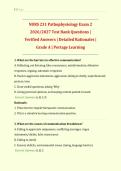
NURS 231 Pathophysiology Exam 2
2026/2027 Test Bank Questions |
Verified Answers | Detailed Rationales |
Grade A | Portage Learning

1. What are the barriers to effective communication?
A. Deflecting, not listening, false reassurance, misinformation, defensive
responses, arguing, automatic responses
B. Passive-aggressive statements, aggression, failing to clarify, unprofessional
posture, tone
C. Close-ended questions, asking 'Why'
D. Giving personal opinions, not keeping content patient-focused
Correct Answer: A, B, C, D.
Rationale:
1. These barriers impede therapeutic communication.
2. This is a standard nursing communication question.


2. What are the causes of communication breakdown?
A. Failing to appreciate uniqueness, conflicting messages, vague
statements/clichés, false reassurance
B. Failing to clarify
C. Sensory deficits, environmental issues, timing, language barriers
Correct Answer: A, B, C.

,2|Page


Rationale:
1. Multiple factors can disrupt effective communication.
2. This is a standard communication question.


3. How is documentation a form of communication?
Correct Answer: Documentation includes details and facts that are
necessary; timeliness is important; it must be clear and concise; it can be
written or electronic; it is a legal document; "If it wasn't documented... It
wasn't done."
Rationale:
1. Documentation communicates patient information across the care team.
2. This is a standard nursing documentation question.


4. What is conflict resolution or management?
Correct Answer: A method to settle disagreements peacefully and
respectfully, through compromise and accommodation, addressing each
other's needs, sharing goals, and avoiding competition.
Rationale:
1. Effective conflict resolution improves team function.
2. This is a standard leadership question.


5. What are the important components of professional hand-off reports
using the I-SBAR tool?
Correct Answer: I = Introduction, S = Situation, B = Background, A =
Assessment, R = Recommendation, Read back.

, 3|Page


Rationale:
1. I-SBAR is a standardized handoff communication tool.
2. This is a standard nursing communication question.


6. What is interprofessional collaboration (IPC)?
Correct Answer: Members or students of two or more professions associated
with health or social care, engaged in learning with, from, and about each
other.
Rationale:
1. IPC improves patient outcomes and team function.
2. This is a standard interprofessional education question.


7. What are the competencies for successful interprofessional education
(IPE)?
A. Good open communication skills
B. Mutual respect and trust
C. Understanding stakeholders' roles
D. Patient-centered approach
Correct Answer: A, B, C, D.
Rationale:
1. These competencies are essential for IPE.
2. This is a standard interprofessional education question.


8. What are the key elements of IPE from the literature?
A. Responsibility, accountability, coordination, communication
B. Cooperation, assertiveness, autonomy, trust, respect


Información del documento

Subido en
2 de mayo de 2026
Número de páginas
22
Escrito en
2025/2026
Tipo
Examen
Contiene
Preguntas y respuestas
$12.49

¿Documento equivocado? Cámbialo gratis Dentro de los 14 días posteriores a la compra y antes de descargarlo, puedes elegir otro documento. Puedes gastar el importe de nuevo.
Escrito por estudiantes que aprobaron
Inmediatamente disponible después del pago
Leer en línea o como PDF

Seller avatar
Los indicadores de reputación están sujetos a la cantidad de artículos vendidos por una tarifa y las reseñas que ha recibido por esos documentos. Hay tres niveles: Bronce, Plata y Oro. Cuanto mayor reputación, más podrás confiar en la calidad del trabajo del vendedor.
DoctorKen
3.8
(167)
Vendido
920
Seguidores
121
Artículos
6650
Última venta
2 horas hace


Por qué los estudiantes eligen Stuvia

Creado por compañeros estudiantes, verificado por reseñas

Calidad en la que puedes confiar: escrito por estudiantes que aprobaron y evaluado por otros que han usado estos resúmenes.

¿No estás satisfecho? Elige otro documento

¡No te preocupes! Puedes elegir directamente otro documento que se ajuste mejor a lo que buscas.

Paga como quieras, empieza a estudiar al instante

Sin suscripción, sin compromisos. Paga como estés acostumbrado con tarjeta de crédito y descarga tu documento PDF inmediatamente.

Student with book image

“Comprado, descargado y aprobado. Así de fácil puede ser.”

Alisha Student

Preguntas frecuentes