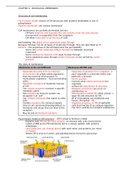
CHAPTER 6 – BIOLOGICAL MEMBRANES
Structure of cell membranes
Fluid mosaic model: theory of CM structures with proteins embedded in sea of
phospholipid
Plasma membrane: cell surface membrane
Cell membranes are partially permeable barriers
- CM form a barrier and separate the cell contents from the cells exterior
environment or organelles from the cytoplasm
- CM allow molecules to go into/out of cells
Permeability: the ability to let substances pass through
Because CM does not let all types of molecules through, they are described as PP
barriers – the properties of the CM determine the permeability
- Some very small molecules diffuse through CM between structural
molecules
- Some substances dissolve in BL layer to pass through
- Some substances pass through protein channels or are carried by carrier
proteins
The roles of membranes
Membranes at the cell SURFACE Membranes WITHIN cells
- Separates the cells from its external - Separates organelles from cytoplasm ->
environment (in single celled organisms – each organelle is a discrete entity and
from the external environment, in performs 1 function
multicellular organisms – fluid surrounding - Forms vesicles
cells) - Controls what enters and leaves the
- Regulates transport of materials into/out organelle
of cell - surface for attachment of enzymes
- Can contain enzymes involved in specific - Metabolic processes can occur on
metabolic paths membranes i.e.
- Has antigens so immune system can Mitochondria’s folded IM called cristae ->
recognise it as ‘self’ large SA and enzymes for AR
- Can release chemicals that signal to other IM of chloroplasts are thylakoids and
cells house chlorophyll – PS
- Contain receptors for chemical signals Digestive enzymes on PM of epithelial
(site of cell communication/signalling) i.e. cells that line the SI to catalyse digestion
hormones and drugs that can bind to the Can form vesicles to transport substances
receptors
- May be site of chemical reactions
Fluid mosaic model of CM structure – 1972 singer & Nicolson model
- Explains how CM can be more dynamic an interact with cells environment
- Called a FMM as the PB membrane forms a mosaic pattern with proteins
embedded
- Lipid molecules can change places with each other and proteins can move
-> fluidity
- Whole CM is around 5-10nm, glycolipids/proteins forms the glycocalyx
, CHAPTER 6 – BIOLOGICAL MEMBRANES
Lipid bilayer: forms basis of CM in which other substances are embedded
- Made of 2 layers of phospholipids, the phosphate heads are hydrophilic
(polar) and are in contact with the watery exterior/interior.
- CM provide a barrier to Hydrophilic (charged) molecules
- FA Hydrophobic (non-polar) tails are in the centre away from the water
Role Molecule Structure Function
Stability & Cholesterol - small steroid molecules - binds to hydrophobic tails
flexibility - a type of lipid - Causes phospholipids to pack closely
- hydrophobic so fits together
between fatty acid tails of - Makes the membrane less fluid,
the bilayer more rigid -> resists effects of temp
change
- Completes barrier so substances
cannot pass easily
Transport Channel - tubular proteins with a - these are integral proteins as they
proteins hydrophilic lining in centre span the CM, allows movement of
forming pores small polar molecules or ions i.e.
- often shaped or gated to water
allow only one type of
molecule through
Carrier - Changes its conformation - Transport larger ions and molecules
proteins shape to allow specific across membrane by AT
molecule that have binded - Peripheral proteins attach to carrier
and go through proteins, function as enzymes,
- requires energy (active) antigens or receptor sites for
complementary-shaped signalling
chemicals I.e. hormones
Recognition/ Glycoproteins - intrinsic protein molecules - cell signalling (receptors) detect
communicati with attached hormones when the comp chemicals
on carbohydrate chain bind to receptor -> chain response
- cell adhesion (binding cells together)
Glycolipids - lipid molecule with a - cell signalling (receptors) detect
carbohydrate chain hormones when the comp chemicals
attached bind to receptor -> chain response
- cell markers - antigens; cell
recognition in immune response
Metabolic Enzymes - globular proteins help to - speeds up rate of some reactions
activity control rate of reactions
Interaction Carbohydrate - Carb molecules on outside - Help the cell interact with the watery
of CM are hydrophilic and environment and obtain dissolved
attract water with substances
dissolved solutes
Not all membranes have the same composition
Cells become differentiated; specific distribution of proteins to enable function
Neurones:
Structure of cell membranes
Fluid mosaic model: theory of CM structures with proteins embedded in sea of
phospholipid
Plasma membrane: cell surface membrane
Cell membranes are partially permeable barriers
- CM form a barrier and separate the cell contents from the cells exterior
environment or organelles from the cytoplasm
- CM allow molecules to go into/out of cells
Permeability: the ability to let substances pass through
Because CM does not let all types of molecules through, they are described as PP
barriers – the properties of the CM determine the permeability
- Some very small molecules diffuse through CM between structural
molecules
- Some substances dissolve in BL layer to pass through
- Some substances pass through protein channels or are carried by carrier
proteins
The roles of membranes
Membranes at the cell SURFACE Membranes WITHIN cells
- Separates the cells from its external - Separates organelles from cytoplasm ->
environment (in single celled organisms – each organelle is a discrete entity and
from the external environment, in performs 1 function
multicellular organisms – fluid surrounding - Forms vesicles
cells) - Controls what enters and leaves the
- Regulates transport of materials into/out organelle
of cell - surface for attachment of enzymes
- Can contain enzymes involved in specific - Metabolic processes can occur on
metabolic paths membranes i.e.
- Has antigens so immune system can Mitochondria’s folded IM called cristae ->
recognise it as ‘self’ large SA and enzymes for AR
- Can release chemicals that signal to other IM of chloroplasts are thylakoids and
cells house chlorophyll – PS
- Contain receptors for chemical signals Digestive enzymes on PM of epithelial
(site of cell communication/signalling) i.e. cells that line the SI to catalyse digestion
hormones and drugs that can bind to the Can form vesicles to transport substances
receptors
- May be site of chemical reactions
Fluid mosaic model of CM structure – 1972 singer & Nicolson model
- Explains how CM can be more dynamic an interact with cells environment
- Called a FMM as the PB membrane forms a mosaic pattern with proteins
embedded
- Lipid molecules can change places with each other and proteins can move
-> fluidity
- Whole CM is around 5-10nm, glycolipids/proteins forms the glycocalyx
, CHAPTER 6 – BIOLOGICAL MEMBRANES
Lipid bilayer: forms basis of CM in which other substances are embedded
- Made of 2 layers of phospholipids, the phosphate heads are hydrophilic
(polar) and are in contact with the watery exterior/interior.
- CM provide a barrier to Hydrophilic (charged) molecules
- FA Hydrophobic (non-polar) tails are in the centre away from the water
Role Molecule Structure Function
Stability & Cholesterol - small steroid molecules - binds to hydrophobic tails
flexibility - a type of lipid - Causes phospholipids to pack closely
- hydrophobic so fits together
between fatty acid tails of - Makes the membrane less fluid,
the bilayer more rigid -> resists effects of temp
change
- Completes barrier so substances
cannot pass easily
Transport Channel - tubular proteins with a - these are integral proteins as they
proteins hydrophilic lining in centre span the CM, allows movement of
forming pores small polar molecules or ions i.e.
- often shaped or gated to water
allow only one type of
molecule through
Carrier - Changes its conformation - Transport larger ions and molecules
proteins shape to allow specific across membrane by AT
molecule that have binded - Peripheral proteins attach to carrier
and go through proteins, function as enzymes,
- requires energy (active) antigens or receptor sites for
complementary-shaped signalling
chemicals I.e. hormones
Recognition/ Glycoproteins - intrinsic protein molecules - cell signalling (receptors) detect
communicati with attached hormones when the comp chemicals
on carbohydrate chain bind to receptor -> chain response
- cell adhesion (binding cells together)
Glycolipids - lipid molecule with a - cell signalling (receptors) detect
carbohydrate chain hormones when the comp chemicals
attached bind to receptor -> chain response
- cell markers - antigens; cell
recognition in immune response
Metabolic Enzymes - globular proteins help to - speeds up rate of some reactions
activity control rate of reactions
Interaction Carbohydrate - Carb molecules on outside - Help the cell interact with the watery
of CM are hydrophilic and environment and obtain dissolved
attract water with substances
dissolved solutes
Not all membranes have the same composition
Cells become differentiated; specific distribution of proteins to enable function
Neurones: