
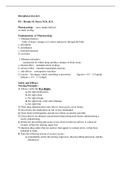
Pharmacology Notes study guide for better grades
PHARMACOLOGY BY : Hermie M. Pueyo M.D., R.N. Pharmacology - most simply defined as study of drug. Fundamentals of Pharmacology 1. Pharmacokinetics - study of drug’s changes as it enters and passes through the body. a. absorption b. distribution c. biotransformation d. excretion 2. Pharmacodynamics - mechanism by which drugs produce changes in body tissue. a. desired effect - intended action of drugs b. adverse effect - harmful unintended reactions c. side effects – consequence reactions d. toxicity – the degree which something is poisonous digoxin = 0.5 – 2.0 ng/mL lithium = 0.5 – 1.5 mEq/L Safety and Efficacy Nursing Principles : 1. Always verify the Five Rights . a. the right medications b. the right client c. the right dosage d. the right form, route and technique e. the right time 2. Chart drug administration only after its been given, never before. 3. Never leave the medication on cart or tray unattended. 4. Chart observed therapeutic and adverse effects accurately and fully. 5. Check history for allergies and potential drug interactions before administering a newly ordered drug. 6. Inform the prescribing physician of any observed adverse effects; if cannot be located, inform the nursing supervisor 7. Question drug orders that are unclear, that appear to contain errors, or that have potential to harm. 8. Take the following actions if an error occurs : a. immediately notify the nursing supervisor, the prescribing physician, and the pharmacist. b. assess the client’s condition and provide any necessary care. 9. For postpartum women, advice to take drugs after breastfeeding. Administration of Drugs : Routes and Nursing considerations: 1. Enteral – oral, sublingual, rectal, gastric tubes - capsulated pill, sustained release and enteric coated should not be crushed. 2. Parenteral – IV, IM, SQ, ID, IT, IA, epidural. - vastus lateralis (safest site for IM) 3. Topical – skin, inhalants, mucus membrane. Eye medications : - administer eyedrops first then ointment. - use a separate bottle for each client. - instruct the client to tilt the head backward, open eyes and look up. - avoid contact of medication bottle to the eyeball. - place prescribed dose in the lower conjunctival sac. - instruct the client to press the inner canthus for 30-60 seconds. - instruct the client to close the eye gently. Ear drops - in infant and children younger than 3 y.o, pull pinna downward and backward. - in older children and adult, upward and backward. - direct the solution on the wall of the ear canal, not directly on the ear drum. CLASSIFICATIONS Of DRUGS DRUGS AFFECTING THE CENTRAL AND AUTONOMIC SYSTEM Cholinergic Agents (Parasympathomemitics) Prototype : - synthetic acetylcholine, pilocarpine, carbachol, bethanecol (Urocholine), edrophonium (Tensilon), neostigmine (Prostigmine), pyridostigmine (Mestinon). Mechanism of action : - stimulates cholinergic receptors by mimicking acetylcholine or inhibition of enzyme cholinesterase. Indications : - glaucoma, urine retention, Myasthenia Gravis - antidote to neuromuscular blocking agents : tricyclic antidepressants and atropine Adverse effects : - blurring of vision, miosis - increase in salivation, intestinal cramps - bronchoconstriction, wheezing, DOB - hypotension and bradycardia Nursing considerations : 1. Warn & monitor clients of the side effects. 2. Have atropine available for use as antidote. Cholinergic Blocking Agents (Parasympatholytics, Anticholinergics) Prototype : - atropine, scopalamine (Triptone), dicyclomine (Bentyl), propantheline (Pro- Banthine). Mechanism of actions : - block the binding of acetylcholine in the receptors of parasympathetic nerves. Indications : - use preoperatively to dry up secretions. - treat spasticity of GI or urinary tract. - use for treatment of bradycardia, asthma, parkinsonism. - use for antidote in organophosphate poisoning. Adverse effects : ...........................................continued.............................................
Información del documento
- Subido en
- 14 de mayo de 2021
- Número de páginas
- 29
- Escrito en
- 2020/2021
- Tipo
- Otro
- Personaje
- Desconocido

