Virtual ATI Comprehensive Predictor — Green Light Exam 2026
VIRTUAL ATI
COMPREHENSIVE PREDICTOR
GREEN LIGHT READINESS ASSESSMENT
RN Comprehensive NCLEX-RN Content Review | 2026 Edition
74 Questions with Correct Answers and Detailed Rationales
Total Questions: 74 | Sections: 10 | Format: Multiple Choice
Name: ________________________ Date: ________________________
Score: ________ / 74 Grade: ________
INSTRUCTIONS
Select the BEST answer for each question. Each question is worth 1 point.
Correct answers shown in bold cyan blue with detailed NCLEX-aligned rationales covering clinical reasoning and
evidence-based practice.
NCLEX-RN Test Plan Coverage: Safe & Effective Care, Health Promotion, Psychosocial Integrity, Physiological Integrity
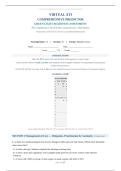
SCORING GUIDE
S I I I I VVVVI XT
e IIV IIIX o
c I II t
t I a
i l
o
n
P8 7 8 7 5 8 8 1 7 6 7
o 0 4
i
n
t
s
S
c
o
r
e
Green Light Threshold: 70% (52.5/75) | A Grade: 85% (64/75) | A+ Grade: 93% (70/75)
SECTION I: Management of Care — Delegation, Prioritization & Continuity (8 Questions)
1. A nurse on a medical-surgical unit receives change-of-shift report on four clients. Which client should the
nurse assess first?
A. A client with type 2 diabetes scheduled for discharge teaching today
B. A client 2 hours post-angioplasty with a palpable pedal pulse but new-onset coolness of the affected
extremity
C. A client with COPD receiving 2 L/min oxygen via nasal cannula with SpO2 of 95%
Page 1 of 27
, Virtual ATI Comprehensive Predictor — Green Light Exam 2026
D. A client admitted yesterday with dehydration receiving IV fluids who is now oriented to person and
place
Correct Answer: B. A client 2 hours post-angioplasty with a palpable pedal pulse but new-onset coolness of the
affected extremity
Rationale: The client 2 hours post-angioplasty with new-onset coolness of the extremity requires immediate assessment.
Coolness of the affected extremity after angioplasty may indicate acute arterial occlusion, a surgical emergency that can
lead to limb ischemia and amputation if not rapidly identified and treated. The angioplasty site must also be assessed for
hematoma, bleeding, and signs of infection. This client takes priority using the ABC approach and the acute-vs-stable
principle. The diabetic client needs discharge teaching but is stable. The COPD client has adequate oxygenation. The
dehydrated client shows improvement.
2. Which task is appropriate for a nurse to delegate to an experienced unlicensed assistive personnel (UAP)?
A. Assessing a postoperative client's incision for signs of infection
B. Measuring intake and output for a stable client with heart failure
C. Providing discharge instructions for a client with newly diagnosed hypertension
D. Evaluating the effectiveness of pain medication for a post-operative client
Correct Answer: B. Measuring intake and output for a stable client with heart failure
Rationale: Measuring intake and output for a stable client is within the UAP scope of practice. It involves routine data
collection that does not require nursing judgment. According to the Five Rights of Delegation (right task, right
circumstance, right person, right direction/communication, right supervision), this task is appropriate for delegation.
Assessment, evaluation, and teaching require registered nurse-level knowledge, critical thinking, and licensure and cannot
be delegated. The RN remains responsible for interpreting I&O data and making clinical decisions based on the findings.
3. A nurse is caring for a client who has a DNR order. The client's family demands full resuscitation. What is the
nurse's best action?
A. Perform full resuscitation to satisfy the family's demands
B. Follow the DNR order and explain the client's previously expressed wishes to the family
C. Remove the DNR until the dispute is resolved
D. Call the hospital administrator to make the final decision
Correct Answer: B. Follow the DNR order and explain the client's previously expressed wishes to the family
Rationale: A valid DNR order reflects the client's autonomous decision and must be followed. The nurse should uphold
the DNR while compassionately explaining to the family that the client's wishes must be respected. It is helpful to involve
the healthcare provider, palliative care team, and social worker to facilitate a family meeting. Family members cannot
override a competent patient's advance directive. Only the client (if competent) or the legally designated healthcare proxy
may modify the DNR. The nurse must advocate for the patient's self-determination.
4. A nurse is preparing to transfer a client from the ICU to a medical-surgical unit. Which action is most
important?
A. Ensure the receiving nurse is competent to care for the client
B. Complete the transfer using SBAR communication and verify the receiving unit has necessary
equipment
C. Leave a detailed note at the bedside for the receiving nurse
D. Transfer the client during the busiest time of day to free the ICU bed quickly
Correct Answer: B. Complete the transfer using SBAR communication and verify the receiving unit has
necessary equipment
Page 2 of 27
, Virtual ATI Comprehensive Predictor — Green Light Exam 2026
Rationale: Using SBAR (Situation, Background, Assessment, Recommendation) for the handoff communication and
verifying that the receiving unit has the necessary equipment and monitoring capabilities are the most important actions
for safe patient transfer. SBAR provides a standardized, structured format that reduces communication errors, a leading
cause of adverse events. The nurse must provide a complete report including current status, recent changes, pending tests,
medications, and potential concerns. The transfer should be planned, not rushed, and the receiving nurse must be
informed of any special needs. Leaving a note is not an adequate substitute for a verbal report.
5. A nurse manager is implementing an evidence-based practice (EBP) change to reduce catheter-associated
urinary tract infections (CAUTIs). Using the PDSA cycle, what occurs during the 'Do' phase?
A. Identify the problem and set measurable goals
B. Implement the change on a small scale and collect data
C. Analyze the data and compare results to the goals
D. Adopt, adapt, or abandon the change based on findings
Correct Answer: B. Implement the change on a small scale and collect data
Rationale: The 'Do' phase of the PDSA (Plan-Do-Study-Act) cycle involves implementing the planned change on a small
scale and simultaneously collecting data to evaluate the outcomes. During the 'Plan' phase, the team identifies the
problem, reviews evidence, and sets measurable goals. The 'Study' phase involves analyzing collected data and comparing
results to the predictions. The 'Act' phase uses the findings to decide whether to adopt, modify, or abandon the change and
to plan the next cycle. This iterative approach allows for continuous quality improvement while minimizing risk.
6. A client with end-stage liver disease tells the nurse, 'I do not want any more procedures. Just let me die in
peace.' What is the nurse's most appropriate response?
A. I cannot do anything until your family agrees.
B. You have the right to refuse treatment. I will communicate your wishes to the healthcare team so we can
discuss your comfort care goals.
C. You are just depressed. Things will get better once you feel stronger.
D. I need to call your family to come and change your mind.
Correct Answer: B. You have the right to refuse treatment. I will communicate your wishes to the healthcare
team so we can discuss your comfort care goals.
Rationale: The competent adult has the legal and ethical right to refuse any treatment, including life-sustaining
interventions. The nurse should respect the client's autonomy, validate the client's feelings, and communicate the decision
to the healthcare team so that goals-of-care discussions can occur. The nurse should assess for pain, dyspnea, and other
symptoms that may be influencing the decision and ensure the client's comfort. The family does not have the authority to
override a competent patient's decisions. Dismissing the client's statement as depression or calling the family to change
the client's mind violates the principles of autonomy and informed consent.
7. A client is being discharged home with a new prescription for warfarin (Coumadin). Which statement by the
client indicates a need for further teaching?
A. I should avoid eating large amounts of dark leafy green vegetables
B. I will have my INR checked regularly as prescribed
C. I will take an aspirin every day for headache prevention while on this medication
D. I should inform my dentist and all healthcare providers that I am taking warfarin
Correct Answer: C. I will take an aspirin every day for headache prevention while on this medication
Rationale: The client should not take aspirin (or aspirin-containing products) while on warfarin without the healthcare
provider's approval. Both warfarin (a vitamin K antagonist) and aspirin (an antiplatelet agent) increase bleeding risk, and
Page 3 of 27