

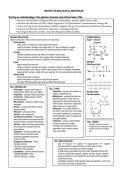
REVIEW OF BIOLOGICAL PRINCIPLES
Develop an understanding of the physical, chemical, and cellular basis of life.
Structure and Functions of Organic Molecules (carbohydrates, proteins, lipids, nucleic acids)
Structure and Functions of Cells, Cellular Organelles, Cell Specialization, Communication Among Cells
Cell as a Living System, Homeostasis, Cellular Transport, Energy Use and Release in Biochemical Reactions
Structure and Function of Enzymes, Importance in Biological Systems
Bioenergetic Reactions, Aerobic / Anaerobic Respiration, Photosynthesis
ORGANIC MOLECULES: CARBOHYDRATE
Organic compounds contain carbon and are found in all living things. (Sugar – Glucose)
- Carbohydrates
major source of energy and include sugars and starches
made up of carbon, hydrogen, and oxygen with a 2:1 ratio of hydrogen to oxygen
plants and animals use carbohydrates for maintaining structure within the cells
- Proteins
Nitrogen-containing compounds made up of chains of amino acids
20 amino acids can combine to form a great variety of protein molecules
can compose enzymes, hormones, antibodies, and structural components
- Lipids PROTEIN
water-insoluble (fats and oils) (One Amino Acid)
made up of carbon, hydrogen and oxygen; composed of glycerol and fatty acid
provide insulation, store energy, cushion internal organs, found in biological membranes
saturated (with hydrogen, single bonds, see example ) and unsaturated (double bonds)
- Nucleic Acids
direct the instruction of proteins
genetic information an organism receives from its parents LIPID
two types: DNA (deoxyribonucleic acid) and RNA (ribonucleic acid)
CELL ORGANELLES:
- Chloroplast – capture solar energy for CELL TYPES:
photosynthesis (plant cells, some algae) - Unicellular – organism that exists as a NUCLEIC ACID
- Golgi Body – package, distribute products singular, independent cell (One Nucleotide)
- Lysosomes – digests excess products - Multicellular – organism that exists as
and food particles specialized groups of cells; cells are
- Mitochondria – transform energy through organized into tissues that perform the
respiration same function; tissues form organs and
- Nucleus – contains DNA which controls organs make up an organ system
cellular activities - Prokaryote – has nuclear material in
- Ribosome – produce proteins the center of the cell, but is not enclosed
- Vacuole – store substances by a nuclear membrane; no membrane-
- Cell (plasma) membrane – phospholipid bound organelles; found in bacteria and
bilayer that protects and encloses the cell; blue-green bacteria
controls transport; maintains homeostasis - Eukaryote – contain a clearly defined CELL THEORY:
- Cell wall – rigid second layer that protects nucleus enclosed by a nuclear - The cell is the basic unit of life.
and encloses the cell (plant cells and membrane and membrane-bound - All organisms are composed of cells
some bacteria) organelles; found in plants, animals, - All cells come from pre-existing
- Cytoplasm – fluid-like substance that fungi, and protists cells.
contains various membrane-bound
structures (organelles) that perform
various functions
- Endoplasmic Reticulum – site of CELL SPECIALIZATION:
chemical reactions - cells >>>> tissues >>>> organs >>>> organ systems >>>> organism
- ROUGH: contains ribosomes - each cell performs a specific function for each tissue or organ
- SMOOTH: lipid production - as cells mature, they shape and contents change
- Cytoskeleton – provides internal structure - as cells become specialized they may contain organelles that are NOT
- MICROFILAMENTS: fibers common to all cells (for example: plastids, cell wall, vacuole, centriole)
- MICROTUBULES: cylinders - design and shape of a cell is dictated by its function and the conditions
under which it works
- multicellular organisms exhibit greater cellular specialization, such as red
blood cells, nerve cells, and gland cells
,CELL TRANSPORT:
- Passive Transport – movement of substances across the plasma membrane without the use of the cell’s energy (with the concentration gradient)
1. DIFFUSION – movement of substances across the plasma membrane from an area of high concentration to an area of low concentration
2. OSMOSIS – diffusion of water across the plasma membrane from areas of high concentration to areas of lower concentration
3. FACILITATED TRANSPORT – a carrier molecule embedded in the plasma membrane transports a substance across the plasma membrane following
the high-to-low concentration gradient
- Active Transport – movement of substances across the plasma membrane that requires the use of the cell’s energy and carrier molecules; substances
are moving from an area of low concentration to an area of higher concentration (against the concentration gradient)
1. ENDOCYTOSIS – large particles are brought into the cell
2. EXOCYTOSIS – large particles leave the cell
- HOMEOSTASIS – internal equilibrium; the plasma membrane regulates what enters and leaves the cell; a selectively permeable membrane only allows
certain substances to pass through
- Effect of Concentration on a Cell
1. HYPOTONIC – water moves in; cell bursts
2. HYPERTONIC – water moves out; cell shrivels
3. ISOTONIC – no net movement; cell maintains equilibrium
HOMEOSTASIS: Self-regulating mechanism that maintains internal conditions (with individual cells and within organs, systems) Example: body temperature,
respiration, nutritional balance, etc. Cells communicate their needs to each other mainly through their cell membranes by releasing chemical messengers
that, ultimately, tell the hypothalamus gland in the brain that a change needs to be made in the interstitial fluid. Since it is the ruler of homeostasis, the
hypothalamus sends neural and chemical signals to other glands, tissues, organs, and organ systems to adjust the internal environment, the interstitial fluid,
so that it is more suitable for all the cells at that particular time. And since we are always changing what we are doing, homeostasis needs to change along
with our activities, both day and night. This constantly changing internal environment is the process of homeostasis.
- Negative Feedback: Glucose / Insulin levels in cells
- Positive Feedback: Blood platelets / Blood clotting
BIOCHEMICAL REACTIONS: chemical bonds are formed and broken within living things creating chemical reactions that impact the ability to maintain
life and carry out life functions
- Cellular Respiration – food molecules are converted to energy; there are three stages to cellular respiration; the first stage is called
glycolysis and is anaerobic (no oxygen is required); the next two stages are called the citric acid cycle and the electron transport chain and
are aerobic (oxygen is required)
C6H12O6 + 6O2 6CO2 + 6H2O + ENERGY (36 ATP)
- Photosynthesis – plant cells capture energy from the Sun and convert it into food (carbohydrates); plant cells then convert the
carbohydrates into energy during cellular respiration; the ultimate source of energy for all living things is the Sun (in Chemosynthesis,
organisms use sulfur or nitrogen as the main energy source)
6CO2 + 6H2O + ENERGY(from sunlight) C6H12O6 + 6O2
- ATP – ATP is a molecule that stores and releases the energy in its bonds when the cell needs it; removing a phosphate group (P) releases
energy for chemical reactions to occur in the cell and ATP becomes ADP; when the cell has energy, the energy is stored in the bond when
the phosphate group is added to the ADP
ATP ADP + P + ENERGY
- Fermentation – when cells are not provided with oxygen in a timely manner, this process occurs to continue producing ATP until oxygen is
available again; glucose is broken down; there are two types of fermentation
Lactic Acid Fermentation (muscle cells) Glucose Lactic Acid + 2ATP
Alcoholic Fermentation (plant cells) Glucose CO2 + Alcohol + 2ATP
, AEROBIC AND ANAEROBIC RESPIRATION:
Aerobic Respiration –
- requires the presence of oxygen
- release of energy from the breakdown of glucose (or another organic compound) in the presence of oxygen
- energy released is used to make ATP, which provides energy for bodily processes
- takes place in almost all living things
Anaerobic Respiration –
- occurs in the absence of oxygen
- breakdown of food substances in the absence of oxygen with the production of a small amount of energy
- produces less energy than aerobic respiration
- often called fermentation
- seen as an adaptation for organisms that live in environments that lack oxygen
COMPARISON OF CELLULAR RESPIRATION, PHOTOSYNTHESIS AND CHEMOSYNTHESIS
CELLULAR RESPIRATION PHOTOSYNTHESIS CHEMOSYNTHESIS
Food Broken Down Food Synthesized Food Synthesized
Energy from Glucose Released Energy from Sun stored in Glucose Energy from Methane or Inorganic Material
Carbon Dioxide given off Carbon Dioxide taken in (ex: H gas or Hydrogen sulfide)
Oxygen taken in Oxygen given off Organisms often called chemotrophs
Produces Carbon Dioxide and Water Produces Sugars (Glucose) from PGAL Organisms called extremophiles
Does not require Light Requires Light Live in environments without oxygen
Occurs in ALL Living Cells Occurs only in presence of Chlorophyll Anaerobic Bacteria
Organisms often called Heterotrophs Organisms called Autotrophs Habitats: hydrothermal vents
ENZYMES:
Enzymes are special proteins that regulate nearly every biochemical reaction in the cell. Different reactions require different enzymes.
Enzymes function to:
- Provide energy to cells
- Build new cells
- Aid in digestion
- Break down complex molecules (“substrate” = reactant)
- Catalysts (speed up chemical reactions without being used up or altered)
- Factors that affect enzymes: pH, temperature, and quantity
Develop an understanding of the physical, chemical, and cellular basis of life.
Structure and Functions of Organic Molecules (carbohydrates, proteins, lipids, nucleic acids)
Structure and Functions of Cells, Cellular Organelles, Cell Specialization, Communication Among Cells
Cell as a Living System, Homeostasis, Cellular Transport, Energy Use and Release in Biochemical Reactions
Structure and Function of Enzymes, Importance in Biological Systems
Bioenergetic Reactions, Aerobic / Anaerobic Respiration, Photosynthesis
ORGANIC MOLECULES: CARBOHYDRATE
Organic compounds contain carbon and are found in all living things. (Sugar – Glucose)
- Carbohydrates
major source of energy and include sugars and starches
made up of carbon, hydrogen, and oxygen with a 2:1 ratio of hydrogen to oxygen
plants and animals use carbohydrates for maintaining structure within the cells
- Proteins
Nitrogen-containing compounds made up of chains of amino acids
20 amino acids can combine to form a great variety of protein molecules
can compose enzymes, hormones, antibodies, and structural components
- Lipids PROTEIN
water-insoluble (fats and oils) (One Amino Acid)
made up of carbon, hydrogen and oxygen; composed of glycerol and fatty acid
provide insulation, store energy, cushion internal organs, found in biological membranes
saturated (with hydrogen, single bonds, see example ) and unsaturated (double bonds)
- Nucleic Acids
direct the instruction of proteins
genetic information an organism receives from its parents LIPID
two types: DNA (deoxyribonucleic acid) and RNA (ribonucleic acid)
CELL ORGANELLES:
- Chloroplast – capture solar energy for CELL TYPES:
photosynthesis (plant cells, some algae) - Unicellular – organism that exists as a NUCLEIC ACID
- Golgi Body – package, distribute products singular, independent cell (One Nucleotide)
- Lysosomes – digests excess products - Multicellular – organism that exists as
and food particles specialized groups of cells; cells are
- Mitochondria – transform energy through organized into tissues that perform the
respiration same function; tissues form organs and
- Nucleus – contains DNA which controls organs make up an organ system
cellular activities - Prokaryote – has nuclear material in
- Ribosome – produce proteins the center of the cell, but is not enclosed
- Vacuole – store substances by a nuclear membrane; no membrane-
- Cell (plasma) membrane – phospholipid bound organelles; found in bacteria and
bilayer that protects and encloses the cell; blue-green bacteria
controls transport; maintains homeostasis - Eukaryote – contain a clearly defined CELL THEORY:
- Cell wall – rigid second layer that protects nucleus enclosed by a nuclear - The cell is the basic unit of life.
and encloses the cell (plant cells and membrane and membrane-bound - All organisms are composed of cells
some bacteria) organelles; found in plants, animals, - All cells come from pre-existing
- Cytoplasm – fluid-like substance that fungi, and protists cells.
contains various membrane-bound
structures (organelles) that perform
various functions
- Endoplasmic Reticulum – site of CELL SPECIALIZATION:
chemical reactions - cells >>>> tissues >>>> organs >>>> organ systems >>>> organism
- ROUGH: contains ribosomes - each cell performs a specific function for each tissue or organ
- SMOOTH: lipid production - as cells mature, they shape and contents change
- Cytoskeleton – provides internal structure - as cells become specialized they may contain organelles that are NOT
- MICROFILAMENTS: fibers common to all cells (for example: plastids, cell wall, vacuole, centriole)
- MICROTUBULES: cylinders - design and shape of a cell is dictated by its function and the conditions
under which it works
- multicellular organisms exhibit greater cellular specialization, such as red
blood cells, nerve cells, and gland cells
,CELL TRANSPORT:
- Passive Transport – movement of substances across the plasma membrane without the use of the cell’s energy (with the concentration gradient)
1. DIFFUSION – movement of substances across the plasma membrane from an area of high concentration to an area of low concentration
2. OSMOSIS – diffusion of water across the plasma membrane from areas of high concentration to areas of lower concentration
3. FACILITATED TRANSPORT – a carrier molecule embedded in the plasma membrane transports a substance across the plasma membrane following
the high-to-low concentration gradient
- Active Transport – movement of substances across the plasma membrane that requires the use of the cell’s energy and carrier molecules; substances
are moving from an area of low concentration to an area of higher concentration (against the concentration gradient)
1. ENDOCYTOSIS – large particles are brought into the cell
2. EXOCYTOSIS – large particles leave the cell
- HOMEOSTASIS – internal equilibrium; the plasma membrane regulates what enters and leaves the cell; a selectively permeable membrane only allows
certain substances to pass through
- Effect of Concentration on a Cell
1. HYPOTONIC – water moves in; cell bursts
2. HYPERTONIC – water moves out; cell shrivels
3. ISOTONIC – no net movement; cell maintains equilibrium
HOMEOSTASIS: Self-regulating mechanism that maintains internal conditions (with individual cells and within organs, systems) Example: body temperature,
respiration, nutritional balance, etc. Cells communicate their needs to each other mainly through their cell membranes by releasing chemical messengers
that, ultimately, tell the hypothalamus gland in the brain that a change needs to be made in the interstitial fluid. Since it is the ruler of homeostasis, the
hypothalamus sends neural and chemical signals to other glands, tissues, organs, and organ systems to adjust the internal environment, the interstitial fluid,
so that it is more suitable for all the cells at that particular time. And since we are always changing what we are doing, homeostasis needs to change along
with our activities, both day and night. This constantly changing internal environment is the process of homeostasis.
- Negative Feedback: Glucose / Insulin levels in cells
- Positive Feedback: Blood platelets / Blood clotting
BIOCHEMICAL REACTIONS: chemical bonds are formed and broken within living things creating chemical reactions that impact the ability to maintain
life and carry out life functions
- Cellular Respiration – food molecules are converted to energy; there are three stages to cellular respiration; the first stage is called
glycolysis and is anaerobic (no oxygen is required); the next two stages are called the citric acid cycle and the electron transport chain and
are aerobic (oxygen is required)
C6H12O6 + 6O2 6CO2 + 6H2O + ENERGY (36 ATP)
- Photosynthesis – plant cells capture energy from the Sun and convert it into food (carbohydrates); plant cells then convert the
carbohydrates into energy during cellular respiration; the ultimate source of energy for all living things is the Sun (in Chemosynthesis,
organisms use sulfur or nitrogen as the main energy source)
6CO2 + 6H2O + ENERGY(from sunlight) C6H12O6 + 6O2
- ATP – ATP is a molecule that stores and releases the energy in its bonds when the cell needs it; removing a phosphate group (P) releases
energy for chemical reactions to occur in the cell and ATP becomes ADP; when the cell has energy, the energy is stored in the bond when
the phosphate group is added to the ADP
ATP ADP + P + ENERGY
- Fermentation – when cells are not provided with oxygen in a timely manner, this process occurs to continue producing ATP until oxygen is
available again; glucose is broken down; there are two types of fermentation
Lactic Acid Fermentation (muscle cells) Glucose Lactic Acid + 2ATP
Alcoholic Fermentation (plant cells) Glucose CO2 + Alcohol + 2ATP
, AEROBIC AND ANAEROBIC RESPIRATION:
Aerobic Respiration –
- requires the presence of oxygen
- release of energy from the breakdown of glucose (or another organic compound) in the presence of oxygen
- energy released is used to make ATP, which provides energy for bodily processes
- takes place in almost all living things
Anaerobic Respiration –
- occurs in the absence of oxygen
- breakdown of food substances in the absence of oxygen with the production of a small amount of energy
- produces less energy than aerobic respiration
- often called fermentation
- seen as an adaptation for organisms that live in environments that lack oxygen
COMPARISON OF CELLULAR RESPIRATION, PHOTOSYNTHESIS AND CHEMOSYNTHESIS
CELLULAR RESPIRATION PHOTOSYNTHESIS CHEMOSYNTHESIS
Food Broken Down Food Synthesized Food Synthesized
Energy from Glucose Released Energy from Sun stored in Glucose Energy from Methane or Inorganic Material
Carbon Dioxide given off Carbon Dioxide taken in (ex: H gas or Hydrogen sulfide)
Oxygen taken in Oxygen given off Organisms often called chemotrophs
Produces Carbon Dioxide and Water Produces Sugars (Glucose) from PGAL Organisms called extremophiles
Does not require Light Requires Light Live in environments without oxygen
Occurs in ALL Living Cells Occurs only in presence of Chlorophyll Anaerobic Bacteria
Organisms often called Heterotrophs Organisms called Autotrophs Habitats: hydrothermal vents
ENZYMES:
Enzymes are special proteins that regulate nearly every biochemical reaction in the cell. Different reactions require different enzymes.
Enzymes function to:
- Provide energy to cells
- Build new cells
- Aid in digestion
- Break down complex molecules (“substrate” = reactant)
- Catalysts (speed up chemical reactions without being used up or altered)
- Factors that affect enzymes: pH, temperature, and quantity

