

College Algebra
1
by Avinash Sathaye, Professor of Mathematics
Department of Mathematics, University of Kentucky
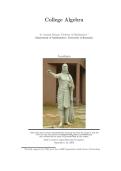
Āryabhat.a
This book may be freely downloaded for personal use from the author’s web site
www.msc.uky.edu/sohum/ma109 fa08/fa08 edition/ma109fa08.pdf.
Any commercial use must be preauthorized by the author.
Send an email to for inquiries.
September 18, 2008
1
Partially supported by NSF grant thru AMSP(Appalachian Math Science Partnership)
,ii
, iii
Introduction.
This book represents a significant departure from the current crop of commercial
college algebra textbooks. In our view, the core material for the (non-remedial)
courses defined by these tomes is but a shadow of that traditionally covered material
in a reasonable high school program. Moreover, much of the material is substantially
repeated from earlier study and it proceeds at a slow pace with extensive practice and
a large number of routine exercises. As taught, such courses tend to be ill-advised
attempts to prepare the student for extensive calculations using calculators, with
supposed “real life” examples offered for motivation and practice. Given the limited
time and large number of individual topics to study, the average student emerges,
perhaps, with the ability to answer isolated questions and the well-founded view that
the rewards of the study of algebra (and of mathematics in general) lie solely in the
experience of applying opaque formulas and mysterious algorithms in the production
of quantitative answers.
As rational, intelligent individuals with many demands on their time, students in
such an environment are more than justified when they say to the teacher: “don’t
tell me too many ways of doing something; don’t tell me how the formula is derived;
just show me how to do the problems which will appear on the test!. Individuals, who
experience only this type of mathematics leave with a static collection of tools and
perhaps the ability to apply each to one or two elementary or artificial situations. In
our view, a fundamental objective of the students mathematical development should
be an understanding of how mathematical tools are made and the experience of
working as an apprentice to a teacher, learning to build his or her own basic tools
from “the ground up. Students imbued with this philosophy are prepared to profit as
much from their incorrect answers, as from their correct ones. They are able to view a
small number of expected outcomes of exercises as a validation of their understanding
of the underlying concepts. They are further prepared to profit from those “real world
applications through an understanding of them as elementary mathematical models
and an appreciation of the fact that only through a fundamental understanding of
the underlying mathematics can one understand the limits of such models. They
understand how to participate in and even assume responsibility for their subsequent
mathematical education.
This text is intended to be part of a College Algebra course which exposes students
to this philosophy. Such a course will almost certainly be a compromise, particularly
if it must be taught in a lecture/recitation format to large numbers of students.
The emphasis in this course is on mastering the Algebraic technique. Algebra
is a discipline which studies the results of manipulating expressions (according to a
set of rules which may vary with the context) to put them in convenient form, for
enhanced understanding. In this view, Algebra consists of looking for ways of finding
information about various quantities, even though it is difficult or even impossible to
explicitly solve for them. Algebra consists of finding multiple expressions for the same
quantities, since the comparison of different expressions often leads to new discoveries.
, iv
Here is our sincere request and strong advice to the reader:
• We urge the readers to approach this book with an open mind. If you do, then
you will find new perspective on known topics.
• We urge the reader to carefully study and memorize the definitions. A majority
of mistakes are caused by forgetting what a certain term means.
• We urge the reader to be bold. Don’t be afraid of a long involved calculation.
Exercises designed to reach an answer in just a step or two, often hide the true
meaning of what is going on.
As far as possible, try to do the derivations yourself. If you get stuck, look up
or ask. The derivations are not to be memorized, they should be done as a fresh
exercise in Algebra every time you really need them; regular exercise is good
for you!
• We urge the reader to be inquisitive. Don’t take anything for granted, until you
understand it. Don’t ever be satisfied by a single way of doing things; look for
alternative shortcuts.
• We also urge the reader to be creatively lazy. Look for simpler (yet correct, of
course) ways of doing the same calculations. If there is a string of numerical
calculations, don’t just do them. Try to build a formula of your own; perhaps
something that you could then feed into a computer some day.
A warning about graphing. Graphs are a big help in understanding the prob-
lem and they help you set up the right questions. They are also notorious for mis-
leading people into wrong configurations or suggesting possible wrong answers. Never
trust an answer until it is verified by theory or straight calculations.
Calculators are useful for getting answers but in this course most questions are
designed for precise algebraic answers. You can and should use the calculators freely
to do tedious numerical calculations or to verify your work or intuition. But you
should not feel compelled to convert √ every answer into a decimal number, however
1+
precise. In this course 6
8
and √(2) are perfectly acceptable answers unless the
1− (7)
instructions specify a specific form. A computer system which is capable of infinite
precision calculations can be used for study and is recommended. But make sure that
you understand the calculations well.
A suggestion about proofs. We do value the creation and understanding of
a proof, but often it is crucial that you get good at calculations before you know
what they mean and why they are valid. Throughout the book you will find sections
billed as “optional” or “can be omitted in a first reading”. We strongly urge that you
master the calculations first and then return to these for further understanding.
In many places, you will find challenges and comments for attentive or alert read-
ers. They can appear obscure if you are new to the material, but will become clear
1
by Avinash Sathaye, Professor of Mathematics
Department of Mathematics, University of Kentucky
Āryabhat.a
This book may be freely downloaded for personal use from the author’s web site
www.msc.uky.edu/sohum/ma109 fa08/fa08 edition/ma109fa08.pdf.
Any commercial use must be preauthorized by the author.
Send an email to for inquiries.
September 18, 2008
1
Partially supported by NSF grant thru AMSP(Appalachian Math Science Partnership)
,ii
, iii
Introduction.
This book represents a significant departure from the current crop of commercial
college algebra textbooks. In our view, the core material for the (non-remedial)
courses defined by these tomes is but a shadow of that traditionally covered material
in a reasonable high school program. Moreover, much of the material is substantially
repeated from earlier study and it proceeds at a slow pace with extensive practice and
a large number of routine exercises. As taught, such courses tend to be ill-advised
attempts to prepare the student for extensive calculations using calculators, with
supposed “real life” examples offered for motivation and practice. Given the limited
time and large number of individual topics to study, the average student emerges,
perhaps, with the ability to answer isolated questions and the well-founded view that
the rewards of the study of algebra (and of mathematics in general) lie solely in the
experience of applying opaque formulas and mysterious algorithms in the production
of quantitative answers.
As rational, intelligent individuals with many demands on their time, students in
such an environment are more than justified when they say to the teacher: “don’t
tell me too many ways of doing something; don’t tell me how the formula is derived;
just show me how to do the problems which will appear on the test!. Individuals, who
experience only this type of mathematics leave with a static collection of tools and
perhaps the ability to apply each to one or two elementary or artificial situations. In
our view, a fundamental objective of the students mathematical development should
be an understanding of how mathematical tools are made and the experience of
working as an apprentice to a teacher, learning to build his or her own basic tools
from “the ground up. Students imbued with this philosophy are prepared to profit as
much from their incorrect answers, as from their correct ones. They are able to view a
small number of expected outcomes of exercises as a validation of their understanding
of the underlying concepts. They are further prepared to profit from those “real world
applications through an understanding of them as elementary mathematical models
and an appreciation of the fact that only through a fundamental understanding of
the underlying mathematics can one understand the limits of such models. They
understand how to participate in and even assume responsibility for their subsequent
mathematical education.
This text is intended to be part of a College Algebra course which exposes students
to this philosophy. Such a course will almost certainly be a compromise, particularly
if it must be taught in a lecture/recitation format to large numbers of students.
The emphasis in this course is on mastering the Algebraic technique. Algebra
is a discipline which studies the results of manipulating expressions (according to a
set of rules which may vary with the context) to put them in convenient form, for
enhanced understanding. In this view, Algebra consists of looking for ways of finding
information about various quantities, even though it is difficult or even impossible to
explicitly solve for them. Algebra consists of finding multiple expressions for the same
quantities, since the comparison of different expressions often leads to new discoveries.
, iv
Here is our sincere request and strong advice to the reader:
• We urge the readers to approach this book with an open mind. If you do, then
you will find new perspective on known topics.
• We urge the reader to carefully study and memorize the definitions. A majority
of mistakes are caused by forgetting what a certain term means.
• We urge the reader to be bold. Don’t be afraid of a long involved calculation.
Exercises designed to reach an answer in just a step or two, often hide the true
meaning of what is going on.
As far as possible, try to do the derivations yourself. If you get stuck, look up
or ask. The derivations are not to be memorized, they should be done as a fresh
exercise in Algebra every time you really need them; regular exercise is good
for you!
• We urge the reader to be inquisitive. Don’t take anything for granted, until you
understand it. Don’t ever be satisfied by a single way of doing things; look for
alternative shortcuts.
• We also urge the reader to be creatively lazy. Look for simpler (yet correct, of
course) ways of doing the same calculations. If there is a string of numerical
calculations, don’t just do them. Try to build a formula of your own; perhaps
something that you could then feed into a computer some day.
A warning about graphing. Graphs are a big help in understanding the prob-
lem and they help you set up the right questions. They are also notorious for mis-
leading people into wrong configurations or suggesting possible wrong answers. Never
trust an answer until it is verified by theory or straight calculations.
Calculators are useful for getting answers but in this course most questions are
designed for precise algebraic answers. You can and should use the calculators freely
to do tedious numerical calculations or to verify your work or intuition. But you
should not feel compelled to convert √ every answer into a decimal number, however
1+
precise. In this course 6
8
and √(2) are perfectly acceptable answers unless the
1− (7)
instructions specify a specific form. A computer system which is capable of infinite
precision calculations can be used for study and is recommended. But make sure that
you understand the calculations well.
A suggestion about proofs. We do value the creation and understanding of
a proof, but often it is crucial that you get good at calculations before you know
what they mean and why they are valid. Throughout the book you will find sections
billed as “optional” or “can be omitted in a first reading”. We strongly urge that you
master the calculations first and then return to these for further understanding.
In many places, you will find challenges and comments for attentive or alert read-
ers. They can appear obscure if you are new to the material, but will become clear

