

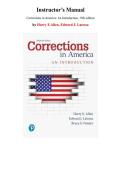
Instructor’s Manual
Corrections in America: An Introduction, 15th edition
by Harry E Allen, Edward J. Latessa
ST
U
D
YL
AB
, Table of content
PART 1: HISTORICAL PERSPECTIVES
1. Early History (2000 BC to AD 1800)
2. Prisons (1800 to the Present)
3. Correctional Ideologies: The Pendulum Swings
4. The Sentencing and Appeals Process
PART 2: ALTERNATIVES TO IMPRISONMENT
5. Probation
ST
6. Diversion and Intermediate Sanctions
PART 3: INSTITUTIONAL CORRECTIONS
7. Custody Functions
U
8. Security Threat Groups and Prison Gangs
9. Management and Treatment Functions
D
10. Jails and Detention Facilities
11. Prison Systems
YL
12. Private-Sector Systems
13. The Death Penalty
14. Parole and Reentry
AB
PART 4: CORRECTIONAL CLIENTS
15. Appeals and Offender Rights
16. Male Offenders
17. Female Offenders
18. Juvenile Offenders and Facilities
19. Special-Category Offenders
, uytrew
To the Instructor
The adoption of a textbook is always a major decision. The authors thank you for
choosing the Fifteenth edition of Corrections in America: An Introduction to use in your
course. We are confident that this revamped and improved edition will meet all your
needs in providing timely and comprehensive information in this rapidly changing sector
of the criminal justice system. In conjunction with your expertise, the text will provide
your students with a solid foundation in the exciting field of corrections.
The Instructor’s Manual has been carefully designed to assist you, the faculty, in
presenting the material contained in the text by adding new features to make classes and
lectures more interesting, effective, and “instructor friendly.” Here is a list of features:
•
ST
Suggested Course Syllabus for ten-and sixteen-week courses
• Chapter Overview
• Chapter Objectives
• Lecture Outline
• Video Suggestions
U
• Types of Guest Lecturers
• Sources of Additional Information Resources
D
• Lecture Notes
• Class Activities
• Thematic Questions
YL
• Homework
• Review Question Answers
These above-mentioned items, along with the pedagogical features contained in the main
text, can be combined to construct quizzes, midterm examinations, and comprehensive
AB
examinations. They can be mixed together in unlimited combinations by using the Test
Bank, which accompanies this book.
Thus, this Instructor’s Manual provides you with efficient and effective means for
management of your lectures (classroom or online), ensuring that key points are being
learned, and maximizing effective student interaction. The authors always welcome your
comments and recommendations for improvement of future editions.
, uytrew
Syllabi
10-WEEK SYLLABUS
University
Department of Justice Administration
Quarter, 20 -20
ST
INTRODUCTION TO CORRECTIONS
Instructor: Phone:
Office Hours: Email:
U
Section 01: Office:
Section 02:
D
INTRODUCTION
A multidisciplinary study of corrections from the early 1800's to the present.
Significant studies relating to the role of corrections and the methods of community
YL
treatment, and analysis of current model and practices. Three units.
This course focuses on the roles of corrections of offenders and society. It starts
with an historical and philosophical view of the development of corrections (post-
adjudication processing of criminal offenders) focusing on adult offenders. Later topics
include administrative and operational components of corrections, criminals in
confinement, post-adjudication procedures and problems, and community corrections.
AB
OBJECTIVES
There are six objectives of this course, representing what students can reasonable
expect to achieve, assuming active study and participation.
1. Comprehend the relationship between society and the offender.
2. Understand the philosophical bases by which offenders are treated.
3. Comprehend the broader forces at work in institutional and community
corrections.
4. Differentiate between corrections of misdemeanants and felons.
5. Understand the current correctional systems in the nation.
6. Understand the historical development of corrections in America.
Corrections in America: An Introduction, 15th edition
by Harry E Allen, Edward J. Latessa
ST
U
D
YL
AB
, Table of content
PART 1: HISTORICAL PERSPECTIVES
1. Early History (2000 BC to AD 1800)
2. Prisons (1800 to the Present)
3. Correctional Ideologies: The Pendulum Swings
4. The Sentencing and Appeals Process
PART 2: ALTERNATIVES TO IMPRISONMENT
5. Probation
ST
6. Diversion and Intermediate Sanctions
PART 3: INSTITUTIONAL CORRECTIONS
7. Custody Functions
U
8. Security Threat Groups and Prison Gangs
9. Management and Treatment Functions
D
10. Jails and Detention Facilities
11. Prison Systems
YL
12. Private-Sector Systems
13. The Death Penalty
14. Parole and Reentry
AB
PART 4: CORRECTIONAL CLIENTS
15. Appeals and Offender Rights
16. Male Offenders
17. Female Offenders
18. Juvenile Offenders and Facilities
19. Special-Category Offenders
, uytrew
To the Instructor
The adoption of a textbook is always a major decision. The authors thank you for
choosing the Fifteenth edition of Corrections in America: An Introduction to use in your
course. We are confident that this revamped and improved edition will meet all your
needs in providing timely and comprehensive information in this rapidly changing sector
of the criminal justice system. In conjunction with your expertise, the text will provide
your students with a solid foundation in the exciting field of corrections.
The Instructor’s Manual has been carefully designed to assist you, the faculty, in
presenting the material contained in the text by adding new features to make classes and
lectures more interesting, effective, and “instructor friendly.” Here is a list of features:
•
ST
Suggested Course Syllabus for ten-and sixteen-week courses
• Chapter Overview
• Chapter Objectives
• Lecture Outline
• Video Suggestions
U
• Types of Guest Lecturers
• Sources of Additional Information Resources
D
• Lecture Notes
• Class Activities
• Thematic Questions
YL
• Homework
• Review Question Answers
These above-mentioned items, along with the pedagogical features contained in the main
text, can be combined to construct quizzes, midterm examinations, and comprehensive
AB
examinations. They can be mixed together in unlimited combinations by using the Test
Bank, which accompanies this book.
Thus, this Instructor’s Manual provides you with efficient and effective means for
management of your lectures (classroom or online), ensuring that key points are being
learned, and maximizing effective student interaction. The authors always welcome your
comments and recommendations for improvement of future editions.
, uytrew
Syllabi
10-WEEK SYLLABUS
University
Department of Justice Administration
Quarter, 20 -20
ST
INTRODUCTION TO CORRECTIONS
Instructor: Phone:
Office Hours: Email:
U
Section 01: Office:
Section 02:
D
INTRODUCTION
A multidisciplinary study of corrections from the early 1800's to the present.
Significant studies relating to the role of corrections and the methods of community
YL
treatment, and analysis of current model and practices. Three units.
This course focuses on the roles of corrections of offenders and society. It starts
with an historical and philosophical view of the development of corrections (post-
adjudication processing of criminal offenders) focusing on adult offenders. Later topics
include administrative and operational components of corrections, criminals in
confinement, post-adjudication procedures and problems, and community corrections.
AB
OBJECTIVES
There are six objectives of this course, representing what students can reasonable
expect to achieve, assuming active study and participation.
1. Comprehend the relationship between society and the offender.
2. Understand the philosophical bases by which offenders are treated.
3. Comprehend the broader forces at work in institutional and community
corrections.
4. Differentiate between corrections of misdemeanants and felons.
5. Understand the current correctional systems in the nation.
6. Understand the historical development of corrections in America.

