

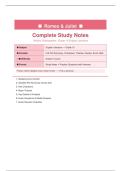
■ Romeo & Juliet ■
Complete Study Notes
William Shakespeare | Grade 10 English Literature
■ Subject English Literature — Grade 10
■ Includes Full Plot Summary, Characters, Themes, Quotes, Exam Q&A
✏■ Difficulty Grade 10 Level
■ Format Study Notes + Practice Questions with Answers
"These violent delights have violent ends." — Friar Lawrence
1. Background & Context
2. Detailed Plot Summary (Act by Act)
3. Key Characters
4. Major Themes
5. Key Quotes & Analysis
6. Exam Questions & Model Answers
7. Quick Revision Checklist
, ■■ 1. BACKGROUND & CONTEXT
Written by William Shakespeare, approximately 1594–1596.
Genre Tragic romance. It combines elements of comedy (the first half) with
tragedy (the second half).
Setting Verona and Mantua, Italy. The story takes place over just 5 days,
creating extreme urgency.
Source Based on a 1562 poem by Arthur Brooke called 'The Tragicall
Historye of Romeus and Juliet'. Shakespeare expanded the
characters and themes significantly.
Elizabethan In Shakespeare's time, girls as young as 13 were expected to marry
Context men chosen by their fathers. Women had very little independence.
Family honour was extremely important, and feuds between noble
families were taken seriously.
Fate & Stars Elizabethans believed in astrology — that the stars controlled human
destiny. When the Prologue calls them 'star-crossed lovers,' the
original audience would have taken this very literally.
The Prologue — What you need to know:
The play opens with a 14-line poem called the Prologue, spoken by the Chorus. It tells us everything
that will happen before it happens — that two lovers from feuding families will fall in love and die. This
creates dramatic irony: the audience knows the ending from line one, which makes every happy
moment feel bittersweet.
The Prologue is written as a sonnet — a form traditionally used for love poetry. Shakespeare uses
this form deliberately: a love story told in the language of love, but with a tragic outcome.
, ■ 2. DETAILED PLOT SUMMARY
Act I — The Meeting
Scene 1: The Street Fight
The play opens in Verona with servants from the Montague and Capulet households brawling
in the streets. Prince Escalus arrives and issues a warning: anyone who disturbs the peace
again will be executed. We learn that Romeo has been moping over a girl named Rosaline
who doesn't love him back. His friends Benvolio and Mercutio suggest he attend the Capulet
party to take his mind off her.
Scene 2-3: The Party Plan
Lord Capulet is arranging for his daughter Juliet (just 13 years old) to marry a nobleman
named Paris. Lady Capulet and the Nurse tell Juliet about Paris and encourage her to
consider marrying him. Juliet agrees to 'look' — she is obedient and has no strong opinion of
her own yet. The Capulets send out invitations to a feast, and Romeo's group decides to
gate-crash the party.
Scene 4-5: Love at First Sight
Romeo, Benvolio, and Mercutio arrive at the Capulet party wearing masks. Romeo spots
Juliet across the room and is instantly struck by her beauty — he completely forgets Rosaline.
Their first conversation forms a sonnet (14 lines), symbolising their perfect connection. They
kiss twice. Afterwards, both discover the shocking truth: Romeo is a Montague and Juliet is a
Capulet — they are from enemy families. Juliet says: 'My only love sprung from my only hate!'
Act II — The Secret Marriage
The Balcony Scene (Scene 2) — The Most Famous Scene
After the party, Romeo sneaks into the Capulet garden and overhears Juliet on her balcony,
talking to herself about her love for him. He reveals himself and they declare their love for
each other. Juliet proposes that if Romeo truly loves her, he should arrange for them to marry.
She says: 'What's in a name? That which we call a rose / By any other name would smell as
sweet.' She means that Romeo's family name (Montague) doesn't change who he is as a
person.
The Secret Wedding (Scenes 3-6)
Complete Study Notes
William Shakespeare | Grade 10 English Literature
■ Subject English Literature — Grade 10
■ Includes Full Plot Summary, Characters, Themes, Quotes, Exam Q&A
✏■ Difficulty Grade 10 Level
■ Format Study Notes + Practice Questions with Answers
"These violent delights have violent ends." — Friar Lawrence
1. Background & Context
2. Detailed Plot Summary (Act by Act)
3. Key Characters
4. Major Themes
5. Key Quotes & Analysis
6. Exam Questions & Model Answers
7. Quick Revision Checklist
, ■■ 1. BACKGROUND & CONTEXT
Written by William Shakespeare, approximately 1594–1596.
Genre Tragic romance. It combines elements of comedy (the first half) with
tragedy (the second half).
Setting Verona and Mantua, Italy. The story takes place over just 5 days,
creating extreme urgency.
Source Based on a 1562 poem by Arthur Brooke called 'The Tragicall
Historye of Romeus and Juliet'. Shakespeare expanded the
characters and themes significantly.
Elizabethan In Shakespeare's time, girls as young as 13 were expected to marry
Context men chosen by their fathers. Women had very little independence.
Family honour was extremely important, and feuds between noble
families were taken seriously.
Fate & Stars Elizabethans believed in astrology — that the stars controlled human
destiny. When the Prologue calls them 'star-crossed lovers,' the
original audience would have taken this very literally.
The Prologue — What you need to know:
The play opens with a 14-line poem called the Prologue, spoken by the Chorus. It tells us everything
that will happen before it happens — that two lovers from feuding families will fall in love and die. This
creates dramatic irony: the audience knows the ending from line one, which makes every happy
moment feel bittersweet.
The Prologue is written as a sonnet — a form traditionally used for love poetry. Shakespeare uses
this form deliberately: a love story told in the language of love, but with a tragic outcome.
, ■ 2. DETAILED PLOT SUMMARY
Act I — The Meeting
Scene 1: The Street Fight
The play opens in Verona with servants from the Montague and Capulet households brawling
in the streets. Prince Escalus arrives and issues a warning: anyone who disturbs the peace
again will be executed. We learn that Romeo has been moping over a girl named Rosaline
who doesn't love him back. His friends Benvolio and Mercutio suggest he attend the Capulet
party to take his mind off her.
Scene 2-3: The Party Plan
Lord Capulet is arranging for his daughter Juliet (just 13 years old) to marry a nobleman
named Paris. Lady Capulet and the Nurse tell Juliet about Paris and encourage her to
consider marrying him. Juliet agrees to 'look' — she is obedient and has no strong opinion of
her own yet. The Capulets send out invitations to a feast, and Romeo's group decides to
gate-crash the party.
Scene 4-5: Love at First Sight
Romeo, Benvolio, and Mercutio arrive at the Capulet party wearing masks. Romeo spots
Juliet across the room and is instantly struck by her beauty — he completely forgets Rosaline.
Their first conversation forms a sonnet (14 lines), symbolising their perfect connection. They
kiss twice. Afterwards, both discover the shocking truth: Romeo is a Montague and Juliet is a
Capulet — they are from enemy families. Juliet says: 'My only love sprung from my only hate!'
Act II — The Secret Marriage
The Balcony Scene (Scene 2) — The Most Famous Scene
After the party, Romeo sneaks into the Capulet garden and overhears Juliet on her balcony,
talking to herself about her love for him. He reveals himself and they declare their love for
each other. Juliet proposes that if Romeo truly loves her, he should arrange for them to marry.
She says: 'What's in a name? That which we call a rose / By any other name would smell as
sweet.' She means that Romeo's family name (Montague) doesn't change who he is as a
person.
The Secret Wedding (Scenes 3-6)

