
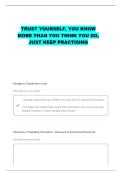
Storage by Classification Level
Give this one a try later!
• Storage requirements are different for each level of classified information.
• The higher the classification level of the information, the more secure the
storage container or open storage area must be.
Disclosure of Classified Information - Disclosure to Authorized Persons (2)
Give this one a try later!
, • Before disclosing classified information to another DOD activity, Federal
agency, foreign person, attorney, or Federal or state courts, you must have
authorization from the DOD activity or Federal agency that has
classification jurisdiction over the information in question.
• Finally, classified information must never be disclosed to the public, and
unclassified information about classified contracts may only be released to
the public in accordance with the National Industrial Security Program
Operating Manual (NISPOM).
• Although it is no longer classified, declassified information may not be
disclosed to the public, unless approved in the same manner as classified
information
GSA-approved Security Containers - Repairs
Give this one a try later!
• Repairs of storage containers must be completed by appropriately
cleared or continuously escorted personnel who are specifically trained in
approved methods of maintenance and repair of these containers.
• In order to continue to be used to protect classified information, an
approved security container must be restored to its original state of
security integrity and have a signed and dated certification stating the
method of repair used.
• All repairs must follow Fed Standard 809 (FED-STD-809), Neutralization
and Repair of GSA Approved Containers and Vault Doors.
Procedures - Reproduction Request
Give this one a try later!
, • The National Industrial Security Program Operating Manual (NISPOM)
imposes requirements on the reproduction of classified documents,
including parts of documents.
• To ensure that these requirements are met at a facility, the Facility Security
Officer (FSO), should consider requiring that authorized personnel submit a
request form prior to reproducing classified information.
• Although not a NISPOM requirement, a formal procedure for requesting
permission to reproduce materials will ensure that all proposed
reproduction is routed through the FSO.
• This process will help to avoid any unnecessary or improper reproduction
of classified materials.
• If your facility decides to use these requests, include it in your Standard
Practice Procedures (SPP), if you have one.
GSA-approved Security Containers - GSA Approved Label
Give this one a try later!
GSA Approved Label:
• Verifies that container is GSA-approved
• Color-coding:
- Black: pre-1990
- Red: post-1990 (container has a case-hardened locking drawer that
requires a different method of neutralization and repair).
Combination Locks (2)
Give this one a try later!
, • Combination padlocks may also be used to secure classified information.
• The current padlock model that meets Federal specifications is S&G
8077AD.
• To ensure that classified information inside a security container or vault is
fully protected, the combination must be protected.
• In addition, there are specific requirements and procedures for changing
combinations.
Perimeter Controls (1)
Give this one a try later!
• Perimeter controls are entry and exit inspections that deter and detect the
introduction or removal of classified information from a facility without
proper authority.
• Contractors who are authorized to store classified information are
required to establish and maintain such perimeter controls.
• Signs must be posted conspicuously informing everyone that they are
subject to inspection upon entry and exit.
Working Papers
Give this one a try later!
Give this one a try later!
• Storage requirements are different for each level of classified information.
• The higher the classification level of the information, the more secure the
storage container or open storage area must be.
Disclosure of Classified Information - Disclosure to Authorized Persons (2)
Give this one a try later!
, • Before disclosing classified information to another DOD activity, Federal
agency, foreign person, attorney, or Federal or state courts, you must have
authorization from the DOD activity or Federal agency that has
classification jurisdiction over the information in question.
• Finally, classified information must never be disclosed to the public, and
unclassified information about classified contracts may only be released to
the public in accordance with the National Industrial Security Program
Operating Manual (NISPOM).
• Although it is no longer classified, declassified information may not be
disclosed to the public, unless approved in the same manner as classified
information
GSA-approved Security Containers - Repairs
Give this one a try later!
• Repairs of storage containers must be completed by appropriately
cleared or continuously escorted personnel who are specifically trained in
approved methods of maintenance and repair of these containers.
• In order to continue to be used to protect classified information, an
approved security container must be restored to its original state of
security integrity and have a signed and dated certification stating the
method of repair used.
• All repairs must follow Fed Standard 809 (FED-STD-809), Neutralization
and Repair of GSA Approved Containers and Vault Doors.
Procedures - Reproduction Request
Give this one a try later!
, • The National Industrial Security Program Operating Manual (NISPOM)
imposes requirements on the reproduction of classified documents,
including parts of documents.
• To ensure that these requirements are met at a facility, the Facility Security
Officer (FSO), should consider requiring that authorized personnel submit a
request form prior to reproducing classified information.
• Although not a NISPOM requirement, a formal procedure for requesting
permission to reproduce materials will ensure that all proposed
reproduction is routed through the FSO.
• This process will help to avoid any unnecessary or improper reproduction
of classified materials.
• If your facility decides to use these requests, include it in your Standard
Practice Procedures (SPP), if you have one.
GSA-approved Security Containers - GSA Approved Label
Give this one a try later!
GSA Approved Label:
• Verifies that container is GSA-approved
• Color-coding:
- Black: pre-1990
- Red: post-1990 (container has a case-hardened locking drawer that
requires a different method of neutralization and repair).
Combination Locks (2)
Give this one a try later!
, • Combination padlocks may also be used to secure classified information.
• The current padlock model that meets Federal specifications is S&G
8077AD.
• To ensure that classified information inside a security container or vault is
fully protected, the combination must be protected.
• In addition, there are specific requirements and procedures for changing
combinations.
Perimeter Controls (1)
Give this one a try later!
• Perimeter controls are entry and exit inspections that deter and detect the
introduction or removal of classified information from a facility without
proper authority.
• Contractors who are authorized to store classified information are
required to establish and maintain such perimeter controls.
• Signs must be posted conspicuously informing everyone that they are
subject to inspection upon entry and exit.
Working Papers
Give this one a try later!

