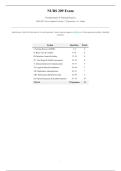
NURS 209 Exam
Fundamentals of Nursing Practice
2026/2027 New Updated Version | 75 Questions | A+ Grade
Instructions: Select the best answer for each question. Correct answers appear in bold cyan. Each question includes a detailed
rationale.
Section Questions Points
I. Nursing Process (ADPIE) 1–8 8
II. Basic Care & Comfort 9–16 8
III. Infection Control & Safety 17–24 8
IV. Vital Signs & Health Assessment 25–32 8
V. Documentation & Communication 33–37 5
VI. Legal & Ethical Foundations 38–44 7
VII. Medication Administration 45–51 7
VIII. Professional Identity & Scope 52–56 5
IX. Patient Education & Health Promotion 57–75 19
TOTAL 75 Questions 75
1
,Section I: Nursing Process (ADPIE)
1. The first step of the nursing process is:
A. Diagnosis B. Assessment
C. Planning D. Implementation
Rationale: Assessment is the foundational first step of ADPIE. It involves systematic collection of patient data (health
history, physical exam, laboratory values, observations). All subsequent steps depend on thorough, accurate assessment.
Skipping or rushing assessment leads to incorrect diagnoses and inappropriate interventions.
2. A nursing diagnosis differs from a medical diagnosis in that it:
A. Identifies the disease process
B. Focuses on the patient's response to illness or health conditions
C. Is made by a physician only
D. Does not require patient input
Rationale: A nursing diagnosis (NANDA-I) describes a human response to a health condition or life process that a nurse
is licensed to treat (e.g., Acute Pain, Risk for Falls). Medical diagnoses identify pathology (e.g., Diabetes Mellitus). The
nursing diagnosis guides independent nursing interventions.
3. During the evaluation phase of the nursing process, the nurse:
A. Sets patient goals
B. Compares patient outcomes to established goals and modifies the care plan as needed
C. Administers medications
D. Performs the initial assessment
Rationale: Evaluation measures patient progress toward established goals and determines whether interventions were
effective. If outcomes are not met, the nurse revises the diagnosis, goals, or interventions. This cyclical process ensures
responsive, individualized patient care.
4. A patient-centered goal should be:
A. Written from the nurse's perspective
B. Specific, measurable, achievable, relevant, and time-bound (SMART)
C. Vague and general
D. Based solely on physician orders
Rationale: SMART goals ensure clarity and accountability. Example: 'Patient will ambulate 50 feet with a rolling walker
by 0800 on post-op day 2.' Goals should reflect patient preferences, capabilities, and clinical needs. Vague goals (e.g.,
'patient will feel better') cannot be objectively evaluated.
5. Which type of nursing diagnosis describes a risk for a potential problem?
A. Actual diagnosis
B. Risk diagnosis
2
, C. Health promotion diagnosis
D. Syndrome diagnosis
Rationale: A risk nursing diagnosis (e.g., Risk for Impaired Skin Integrity) identifies a condition where a patient is more
vulnerable to developing a problem but does not currently exhibit signs or symptoms. It requires risk-reduction
interventions. An actual diagnosis requires defining characteristics that are currently present.
6. The implementation phase of the nursing process includes:
A. Collecting vital signs only
B. Carrying out nursing interventions and documenting care provided
C. Setting up the care plan without acting
D. Discharging the patient
Rationale: Implementation involves executing planned interventions (medication administration, wound care, patient
education, therapeutic communication) and documenting all actions in the patient record. Delegation of tasks to UAP
follows the Five Rights of Delegation and the nurse retains accountability for outcomes.
7. A nurse assesses a postoperative patient and identifies: incisional pain 7/10, guarding behavior, BP
150/90, RR 24, and refuses to deep breathe. The highest priority nursing diagnosis is:
A. Risk for infection
B. Acute Pain related to surgical incision
C. Deficient knowledge
D. Imbalanced nutrition
Rationale: Applying Maslow's hierarchy, pain is a physiological need that takes priority over knowledge deficits or
nutritional concerns. Uncontrolled pain causes tachycardia, hypertension, and shallow breathing, increasing risk of
atelectasis and DVT postoperatively. Pain management enables participation in recovery activities.
8. Subjective data in a nursing assessment includes:
A. Temperature of 38.5°C
B. Patient statement: 'I feel nauseated'
C. Heart rate of 110 bpm
D. Wound measurement of 4 cm
Rationale: Subjective data (symptoms) are information the patient reports that cannot be directly measured or observed by
the nurse (e.g., pain, nausea, dizziness, anxiety). Objective data (signs) are measurable and observable findings (e.g., vital
signs, lab results, wound appearance). Both are essential for comprehensive assessment.
Section II: Basic Care & Comfort
9. When providing oral hygiene to an unconscious patient, the nurse should:
A. Place the patient in a supine position
B. Position the patient on their side with the head turned to prevent aspiration
C. Use a firm-bristled toothbrush
D. Pour water directly into the patient's mouth
3
Fundamentals of Nursing Practice
2026/2027 New Updated Version | 75 Questions | A+ Grade
Instructions: Select the best answer for each question. Correct answers appear in bold cyan. Each question includes a detailed
rationale.
Section Questions Points
I. Nursing Process (ADPIE) 1–8 8
II. Basic Care & Comfort 9–16 8
III. Infection Control & Safety 17–24 8
IV. Vital Signs & Health Assessment 25–32 8
V. Documentation & Communication 33–37 5
VI. Legal & Ethical Foundations 38–44 7
VII. Medication Administration 45–51 7
VIII. Professional Identity & Scope 52–56 5
IX. Patient Education & Health Promotion 57–75 19
TOTAL 75 Questions 75
1
,Section I: Nursing Process (ADPIE)
1. The first step of the nursing process is:
A. Diagnosis B. Assessment
C. Planning D. Implementation
Rationale: Assessment is the foundational first step of ADPIE. It involves systematic collection of patient data (health
history, physical exam, laboratory values, observations). All subsequent steps depend on thorough, accurate assessment.
Skipping or rushing assessment leads to incorrect diagnoses and inappropriate interventions.
2. A nursing diagnosis differs from a medical diagnosis in that it:
A. Identifies the disease process
B. Focuses on the patient's response to illness or health conditions
C. Is made by a physician only
D. Does not require patient input
Rationale: A nursing diagnosis (NANDA-I) describes a human response to a health condition or life process that a nurse
is licensed to treat (e.g., Acute Pain, Risk for Falls). Medical diagnoses identify pathology (e.g., Diabetes Mellitus). The
nursing diagnosis guides independent nursing interventions.
3. During the evaluation phase of the nursing process, the nurse:
A. Sets patient goals
B. Compares patient outcomes to established goals and modifies the care plan as needed
C. Administers medications
D. Performs the initial assessment
Rationale: Evaluation measures patient progress toward established goals and determines whether interventions were
effective. If outcomes are not met, the nurse revises the diagnosis, goals, or interventions. This cyclical process ensures
responsive, individualized patient care.
4. A patient-centered goal should be:
A. Written from the nurse's perspective
B. Specific, measurable, achievable, relevant, and time-bound (SMART)
C. Vague and general
D. Based solely on physician orders
Rationale: SMART goals ensure clarity and accountability. Example: 'Patient will ambulate 50 feet with a rolling walker
by 0800 on post-op day 2.' Goals should reflect patient preferences, capabilities, and clinical needs. Vague goals (e.g.,
'patient will feel better') cannot be objectively evaluated.
5. Which type of nursing diagnosis describes a risk for a potential problem?
A. Actual diagnosis
B. Risk diagnosis
2
, C. Health promotion diagnosis
D. Syndrome diagnosis
Rationale: A risk nursing diagnosis (e.g., Risk for Impaired Skin Integrity) identifies a condition where a patient is more
vulnerable to developing a problem but does not currently exhibit signs or symptoms. It requires risk-reduction
interventions. An actual diagnosis requires defining characteristics that are currently present.
6. The implementation phase of the nursing process includes:
A. Collecting vital signs only
B. Carrying out nursing interventions and documenting care provided
C. Setting up the care plan without acting
D. Discharging the patient
Rationale: Implementation involves executing planned interventions (medication administration, wound care, patient
education, therapeutic communication) and documenting all actions in the patient record. Delegation of tasks to UAP
follows the Five Rights of Delegation and the nurse retains accountability for outcomes.
7. A nurse assesses a postoperative patient and identifies: incisional pain 7/10, guarding behavior, BP
150/90, RR 24, and refuses to deep breathe. The highest priority nursing diagnosis is:
A. Risk for infection
B. Acute Pain related to surgical incision
C. Deficient knowledge
D. Imbalanced nutrition
Rationale: Applying Maslow's hierarchy, pain is a physiological need that takes priority over knowledge deficits or
nutritional concerns. Uncontrolled pain causes tachycardia, hypertension, and shallow breathing, increasing risk of
atelectasis and DVT postoperatively. Pain management enables participation in recovery activities.
8. Subjective data in a nursing assessment includes:
A. Temperature of 38.5°C
B. Patient statement: 'I feel nauseated'
C. Heart rate of 110 bpm
D. Wound measurement of 4 cm
Rationale: Subjective data (symptoms) are information the patient reports that cannot be directly measured or observed by
the nurse (e.g., pain, nausea, dizziness, anxiety). Objective data (signs) are measurable and observable findings (e.g., vital
signs, lab results, wound appearance). Both are essential for comprehensive assessment.
Section II: Basic Care & Comfort
9. When providing oral hygiene to an unconscious patient, the nurse should:
A. Place the patient in a supine position
B. Position the patient on their side with the head turned to prevent aspiration
C. Use a firm-bristled toothbrush
D. Pour water directly into the patient's mouth
3