
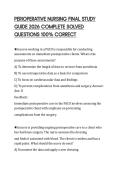
PERIOPERATIVE NURSING FINAL STUDY
GUIDE 2026 COMPLETE SOLVED
QUESTIONS 100% CORRECT
◉A nurse working in a PACU is responsible for conducting
assessments on immediate postoperative clients. What is the
purpose of these assessments?
A) To determine the length of time to recover from anesthesia
B) To use intraoperative data as a basis for comparison
C) To focus on cardiovascular data and findings
D) To prevent complications from anesthesia and surgery. Answer:
Ans: D
Feedback:
Immediate postoperative care in the PACU involves assessing the
postoperative client with emphasis on preventing
complications from the surgery.
◉A nurse is providing ongoing postoperative care to a client who
has had knee surgery. The nurse assesses the dressing
and finds it saturated with blood. The client is restless and has a
rapid pulse. What should the nurse do next?
A) Document the data and apply a new dressing.
, B) Apply a pressure dressing and report findings.
C) Reassure the family that this is a common problem.
D) Make assessments every 15 minutes for four hours.. Answer: Ans:
B
Feedback:
Hemorrhage is an excessive internal or external loss of blood.
Common indications of hemorrhage include a rapid,
thready pulse. If bleeding occurs, the nurse should apply a pressure
dressing to the site, report findings to the physician,
and be prepared to return the client to the operating room if
bleeding cannot be stopped or is massive.
◉A postoperative home care client has developed thrombophlebitis
in her right leg. What category of medications will
probably be prescribed for this cardiovascular complication?
A) Anticoagulants
B) Antibiotics
C) Antihistamines
D) Antigens. Answer: Ans: A
Feedback:
Thrombophlebitis is an inflammation of a vein associated with
thrombus formation. Thrombophlebitis from venous
stasis is most commonly seen in the legs of postoperative clients.
Nursing interventions include administering ordered
GUIDE 2026 COMPLETE SOLVED
QUESTIONS 100% CORRECT
◉A nurse working in a PACU is responsible for conducting
assessments on immediate postoperative clients. What is the
purpose of these assessments?
A) To determine the length of time to recover from anesthesia
B) To use intraoperative data as a basis for comparison
C) To focus on cardiovascular data and findings
D) To prevent complications from anesthesia and surgery. Answer:
Ans: D
Feedback:
Immediate postoperative care in the PACU involves assessing the
postoperative client with emphasis on preventing
complications from the surgery.
◉A nurse is providing ongoing postoperative care to a client who
has had knee surgery. The nurse assesses the dressing
and finds it saturated with blood. The client is restless and has a
rapid pulse. What should the nurse do next?
A) Document the data and apply a new dressing.
, B) Apply a pressure dressing and report findings.
C) Reassure the family that this is a common problem.
D) Make assessments every 15 minutes for four hours.. Answer: Ans:
B
Feedback:
Hemorrhage is an excessive internal or external loss of blood.
Common indications of hemorrhage include a rapid,
thready pulse. If bleeding occurs, the nurse should apply a pressure
dressing to the site, report findings to the physician,
and be prepared to return the client to the operating room if
bleeding cannot be stopped or is massive.
◉A postoperative home care client has developed thrombophlebitis
in her right leg. What category of medications will
probably be prescribed for this cardiovascular complication?
A) Anticoagulants
B) Antibiotics
C) Antihistamines
D) Antigens. Answer: Ans: A
Feedback:
Thrombophlebitis is an inflammation of a vein associated with
thrombus formation. Thrombophlebitis from venous
stasis is most commonly seen in the legs of postoperative clients.
Nursing interventions include administering ordered

