
Page No. 142
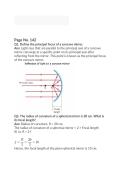
Q1. Define the principal focus of a concave mirror.
Ans: Light rays that are parallel to the principal axis of a concave
mirror converge at a specific point on its principal axis after
reflecting from the mirror. This point is known as the principal focus
of the concave mirror.
Q2. The radius of curvature of a spherical mirror is 20 cm. What is
its focal length?
Ans: Radius of curvature, R = 20 cm.
The radius of curvature of a spherical mirror = 2 × Focal length
(f) i.e. R = 2 f
Hence, the focal length of the given spherical mirror is 10 cm.
,Q3. Name the mirror that can give an erect and enlarged image of
an object.
Ans: When an object is placed between the pole and the principal
focus of a concave mirror, the image formed is virtual, erect, and
enlarged. Therefore, the mirror is concave.
Q4. Why do we prefer a convex mirror as a rear-view mirror in
vehicles?
Ans: Convex mirrors give a virtual,
erect, and diminished image of the objects placed in front of them.
They are preferred as a rear-view mirror in vehicles because they
give a wider field of view, which allows the driver to see most of the
traffic behind him.
Page No. 145
Q1. Find the focal length of a convex mirror whose radius of
curvature is 32 cm.
Ans: Radius of curvature, R = 32 cm
Radius of curvature = 2 × Focal length ( f ) i.e. R = 2 f
Hence, the focal length of the given convex mirror is 16 cm.
Q2. A concave mirror produces three times magnified (enlarged)
real image of an object placed at 10 cm in front of it. Where is the
image located?
Ans: Magnification produced by a spherical mirror is given by the
, relation,
Let the height of the object, h = h
o
Then, height of the image, h = −3h (Image formed is real)
i
∵ Object distance, u = −10 cm ⇒ v = 3 × (−10) = −30 cm
Here, the negative sign indicates that an inverted image is formed at
a distance of 30 cm in front of the given concave mirror.
Page No. 150
Q1. A ray of light travelling in the air enters obliquely into water.
Does the light ray bend towards the normal or away from the
normal? Why?
Ans: The light ray bends towards the normal. When a ray of light
travels from an optically rarer medium to an optically denser
medium, it gets bent towards the normal. Since water is optically
denser than air, a ray of light travelling from air into the water will
bend towards the normal.

