
lOMoARcPSD|27245663
Grade Nine Chemistry Study Guide
Name: Arushi Sharma
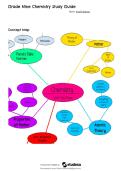
Concept Map:
Downloaded by Arushi Sharma ()
, lOMoARcPSD|27245663
Vocabulary / Terms
Term Definition
Isotope Two elements with the SAME number of protons, but different number of
Neutrons.
example/ Carbon-12 and Carbon-14
Proton Positively charged subatomic particles found in the nucleus of the atom. The
number of protons is unique to each element and is equal to the Atomic Number.
Valence Electrons The electrons found in the outermost shell of an atom. These are important
because they are the electrons that interact with other elements.
Neutrons Star dust (atomic glue) found in the nucleus- neutral charge and keeps protons
together
Electrons Found on the outside of the nucleus- negative charge. Almost 1000 times smaller
than a proton
Halogens All non-metals and extremely reactive- 17th column on the periodic table
Noble Gases They are all gases but don’t react- last column of the periodic table (18th column)
Alkali Metals Very soft and reactive- first column of periodic table
Alkali Earth Metals Harder and not as reactive as Alkali Metals- second column of the periodic table
Ionic Compound Ionic compound are pure substances made up of a metal and non- metal
Molecular Compound A molecular compound is a pure substance when non-metals chemically combine.
Covalent Bond A covalent bond is when electrons are shared in-between the atoms in a molecular
compound in order to fill in the valence shell
Atomic Theory Study of the nature of atoms and how they can combine
Compare and Contrast
Topic How are they Similar How are they Different?
Isotopes of the They have the same number of protons and They have different numbers of NEUTRONS
same element electrons
example/ Carbon-12 and Carbon-14 both Example/ Carbon-12 has 6 neutrons, Carbon-14
have 6 protons has 8 neutrons.
Downloaded by Arushi Sharma ()

