

H6 : APOPTOSIS
6.1 DEFINITION
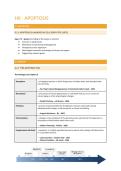
6.1.1 APOPTOSIS IS LAUNCHED AS CELL DEATH TYPE (1972)
Apo (off) + ptosis (the falling of the leaves in autumn)
● Turnover in adult tissues
● Elimination of cells during embryogenesis
● Therapeutic tumor regression
● Physiological involution and atrophy of tissues and organs
● Triggered by noxious agents
6.2 HISTORY
6.2.1 “PRE-APOPTOSIS” ERA
Terminology (see chapter 5)
Resorption = a biological process in which living tissue is broken down and absorbed back
into the body.
→ Karl Vogt noticed disappearance of notochord cells in toad - 1842
Necrobiosis = the process of tissue degeneration or cell death that occurs as a result of
natural aging or other physiological changes
→ Rudolf Virchow - cell theory - 1858
Histolysis = process characterized by the breakdown of tissue, particularly during
developmental changes, metamorphosis, or tissue remodeling
→ August Weismann - fly - 1863
Chromatolysis = changes in the cytoplasm of the granulosa cells, particularly the dispersion or
dissolution of Nissl bodies within these cells.
→ Walter Flemming - Follicle - 1882
Programmed cell death = apoptosis, is a highly regulated process by which cells undergo self-destruction
in a controlled manner
→ John Saunders - chicken limb - 1957
→ Richard Lockshin - silk moth - 1964
,6.2.2 HISTORY OF APOPTOSIS
Timeline
Research discovered
1) Mutations affecting programmed cell death in C. Elegans (Horvitz, nobelprize)
2) 1972: Kerr et al.: term “apoptosis”
3) CED-1 = SCARF1 in human (scavenger receptor class F, member 1)
4) Genetic control of programmed cell death in C. Elegans
- Genes are homologous to caspase family
,6.3 BASIC CORE MACHINERY
6.3.1 INTRODUCTION MOVIE (DIA 9)
Apoptosis → cell is broken down by proteins called caspases
→ caspasen need to be activated by 2 distinct pathways
1) Extrinsic pathway
● Initial signal from outside the cell → will initiate other cells like T-lymphocytes
● T-lymphocytes contains Fas ligand → binds to Fas receptor on target cell
● This induce intracellular pathway → FADD will bind to death domain of receptor
● In last phase → caspases are activated and will activate each other = caspase cascade
● Now apoptosis is initiated because caspases will break down cell
2) Intrinsic pathway
● Initiated by signals within cell
● Regulated by maintaining a balance between 2 sets of proteins in mitochondria membrane
○ Anti-apoptotic proteins : Bcl-2 & Bcl-x
○ Pro-apoptotic proteins : BAK & BAX
● In healthy cells → anti-apoptotic proteins bind to pro-apoptotic one = blocks action
● In damaged cells → Bcl-2 & Bcl-x are blocked → BAK & BAX free to make pores in membrane
○ This causes leakage of cytochrome c in cytoplasm
○ Cytochrome c binds to APAF-1 proteins → formation of complex that will activate
caspase cascade
6.3.2 CASPASES
3 types of proteases
1) Cysteine-dependent ASPartate-directed proteASEs = caspases
→ In animals
2) Asp-specific
→ In animals and slime mold
3) Arginine/Lysine-specific
→ In plants, fungi, and protists
, STRUCTURE OF CASPASES
2 important domains
1) Catalytic domain subunits
● Small: p10
● Large: p20
2) Recruitment domains → essential for activation/regulation
● DEDD (dead fold domain)
● CARD
➔ Caspase-3, 6, 7, 14 → don’t have recruitment domain
➔ Caspase-8, 10, FLIP → DEDD
➔ Caspase-1, 2, 4, 5, 9, 12 → CARD
Structure
● Caspase contains a dimer
○ 2x P20 + 2x P10
● P10 allows docking of the substrate
● Amount and type of AA present in substrate determines fitting in the pocket
CASPASES CUT PROTEIN - CATALYTIC MECHANISM
How do caspases cut proteins? → catalytic mechanism
● Cysteine-dependent aspartate specific protease
→ They require the amino acid cysteine for their enzymatic activity
→ They specifically cleave peptide bonds after aspartic acid residues in target proteins
Proces (not know by <3)
I. His237 attracts a proton from Cys285, thereby facilitating
nucleophilic attack of the scissile bond by Cys285
II. Electron relocalizations → release of C-terminal substrate fragment
III. His237 attracts a proton from H2O → facilitating 2nd nucleophilic
attack of the carbonyl group by H2O
IV. Electron relocalizations → release of N-terminal substrate fragment.
TYPES OF CASPASES
Specific caspases used for:
● Inflammation: casp-1/4/5
● Cell death execution: casp-3/6/7
● Cell death initiation: casp-2/8/9/10
● Differentiation: casp-14
6.1 DEFINITION
6.1.1 APOPTOSIS IS LAUNCHED AS CELL DEATH TYPE (1972)
Apo (off) + ptosis (the falling of the leaves in autumn)
● Turnover in adult tissues
● Elimination of cells during embryogenesis
● Therapeutic tumor regression
● Physiological involution and atrophy of tissues and organs
● Triggered by noxious agents
6.2 HISTORY
6.2.1 “PRE-APOPTOSIS” ERA
Terminology (see chapter 5)
Resorption = a biological process in which living tissue is broken down and absorbed back
into the body.
→ Karl Vogt noticed disappearance of notochord cells in toad - 1842
Necrobiosis = the process of tissue degeneration or cell death that occurs as a result of
natural aging or other physiological changes
→ Rudolf Virchow - cell theory - 1858
Histolysis = process characterized by the breakdown of tissue, particularly during
developmental changes, metamorphosis, or tissue remodeling
→ August Weismann - fly - 1863
Chromatolysis = changes in the cytoplasm of the granulosa cells, particularly the dispersion or
dissolution of Nissl bodies within these cells.
→ Walter Flemming - Follicle - 1882
Programmed cell death = apoptosis, is a highly regulated process by which cells undergo self-destruction
in a controlled manner
→ John Saunders - chicken limb - 1957
→ Richard Lockshin - silk moth - 1964
,6.2.2 HISTORY OF APOPTOSIS
Timeline
Research discovered
1) Mutations affecting programmed cell death in C. Elegans (Horvitz, nobelprize)
2) 1972: Kerr et al.: term “apoptosis”
3) CED-1 = SCARF1 in human (scavenger receptor class F, member 1)
4) Genetic control of programmed cell death in C. Elegans
- Genes are homologous to caspase family
,6.3 BASIC CORE MACHINERY
6.3.1 INTRODUCTION MOVIE (DIA 9)
Apoptosis → cell is broken down by proteins called caspases
→ caspasen need to be activated by 2 distinct pathways
1) Extrinsic pathway
● Initial signal from outside the cell → will initiate other cells like T-lymphocytes
● T-lymphocytes contains Fas ligand → binds to Fas receptor on target cell
● This induce intracellular pathway → FADD will bind to death domain of receptor
● In last phase → caspases are activated and will activate each other = caspase cascade
● Now apoptosis is initiated because caspases will break down cell
2) Intrinsic pathway
● Initiated by signals within cell
● Regulated by maintaining a balance between 2 sets of proteins in mitochondria membrane
○ Anti-apoptotic proteins : Bcl-2 & Bcl-x
○ Pro-apoptotic proteins : BAK & BAX
● In healthy cells → anti-apoptotic proteins bind to pro-apoptotic one = blocks action
● In damaged cells → Bcl-2 & Bcl-x are blocked → BAK & BAX free to make pores in membrane
○ This causes leakage of cytochrome c in cytoplasm
○ Cytochrome c binds to APAF-1 proteins → formation of complex that will activate
caspase cascade
6.3.2 CASPASES
3 types of proteases
1) Cysteine-dependent ASPartate-directed proteASEs = caspases
→ In animals
2) Asp-specific
→ In animals and slime mold
3) Arginine/Lysine-specific
→ In plants, fungi, and protists
, STRUCTURE OF CASPASES
2 important domains
1) Catalytic domain subunits
● Small: p10
● Large: p20
2) Recruitment domains → essential for activation/regulation
● DEDD (dead fold domain)
● CARD
➔ Caspase-3, 6, 7, 14 → don’t have recruitment domain
➔ Caspase-8, 10, FLIP → DEDD
➔ Caspase-1, 2, 4, 5, 9, 12 → CARD
Structure
● Caspase contains a dimer
○ 2x P20 + 2x P10
● P10 allows docking of the substrate
● Amount and type of AA present in substrate determines fitting in the pocket
CASPASES CUT PROTEIN - CATALYTIC MECHANISM
How do caspases cut proteins? → catalytic mechanism
● Cysteine-dependent aspartate specific protease
→ They require the amino acid cysteine for their enzymatic activity
→ They specifically cleave peptide bonds after aspartic acid residues in target proteins
Proces (not know by <3)
I. His237 attracts a proton from Cys285, thereby facilitating
nucleophilic attack of the scissile bond by Cys285
II. Electron relocalizations → release of C-terminal substrate fragment
III. His237 attracts a proton from H2O → facilitating 2nd nucleophilic
attack of the carbonyl group by H2O
IV. Electron relocalizations → release of N-terminal substrate fragment.
TYPES OF CASPASES
Specific caspases used for:
● Inflammation: casp-1/4/5
● Cell death execution: casp-3/6/7
● Cell death initiation: casp-2/8/9/10
● Differentiation: casp-14

