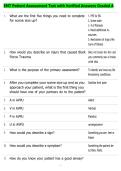
EMT Patient Assessment Test with Verified Answers Graded A
1. What are the first five things you need to complete 1. PPE for BSI
for scene size up? 2. Scene safe
3. # of Patients
4. Need additional re-
sources
5. Mechanism of Injury/Na-
ture of Illness
2. How would you describe an injury that caused Blunt Does not break the skin and
Force Trauma you commonly see a bruise
with this
3. What is the purpose of the primary assessment? To identify and treat any life
threatening conditions
4. After you complete your scene size up and as you Stabilize their spine
approach your patient, what is the first thing you
should have one of your partners do to the patient?
5. A in AVPU Alert
6. V in AVPU Verbal
7. P in AVPU Painful
8. U in AVPU unresponsive
9. How would you describe a sign? Something you see, feel or
hear
10. How would you describe a symptom? Something the patient de-
scribes; feels.
11. How do you know your patient has a good airway?
1/9
, Because they are talking to
you.
12. If you patient did not have a good airway, how could 1. open the airway
you fix it? 2. insert an airway
3. suction
13. What 3 things do you do under the breathing assess- 1. Assess their breathing;
ment? palpate and auscultate
2. give oxygen
3. treat any major chest in-
juries
14. What 3 things do you do under the circulation assess- 1. check a pulse
ment? 2. skin color and tempera-
ture
3. assess for any major
bleeding; bright red is VERY
bad
15. If you assessing someone breathing status and you High pitched sound and
hear stridor, what is it and where is it occurring in the there is a problem with the
airway? upper airway.
16. Airway patency must be continually.......... Reassessed
17. What do we reassess in our patient's at the comple- The primary assessment.
tion of the patient assessment skill?
18. How often to we reassess a stable patient? Every 15 minutes
19. How often do we reassess an unstable patient? Every 5 minutes
20.
2/9
1. What are the first five things you need to complete 1. PPE for BSI
for scene size up? 2. Scene safe
3. # of Patients
4. Need additional re-
sources
5. Mechanism of Injury/Na-
ture of Illness
2. How would you describe an injury that caused Blunt Does not break the skin and
Force Trauma you commonly see a bruise
with this
3. What is the purpose of the primary assessment? To identify and treat any life
threatening conditions
4. After you complete your scene size up and as you Stabilize their spine
approach your patient, what is the first thing you
should have one of your partners do to the patient?
5. A in AVPU Alert
6. V in AVPU Verbal
7. P in AVPU Painful
8. U in AVPU unresponsive
9. How would you describe a sign? Something you see, feel or
hear
10. How would you describe a symptom? Something the patient de-
scribes; feels.
11. How do you know your patient has a good airway?
1/9
, Because they are talking to
you.
12. If you patient did not have a good airway, how could 1. open the airway
you fix it? 2. insert an airway
3. suction
13. What 3 things do you do under the breathing assess- 1. Assess their breathing;
ment? palpate and auscultate
2. give oxygen
3. treat any major chest in-
juries
14. What 3 things do you do under the circulation assess- 1. check a pulse
ment? 2. skin color and tempera-
ture
3. assess for any major
bleeding; bright red is VERY
bad
15. If you assessing someone breathing status and you High pitched sound and
hear stridor, what is it and where is it occurring in the there is a problem with the
airway? upper airway.
16. Airway patency must be continually.......... Reassessed
17. What do we reassess in our patient's at the comple- The primary assessment.
tion of the patient assessment skill?
18. How often to we reassess a stable patient? Every 15 minutes
19. How often do we reassess an unstable patient? Every 5 minutes
20.
2/9