

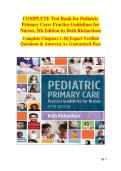
COMPLETE Test Bank for Pediatric
Primary Care: Practice Guidelines for
Nurses, 5th Edition by Beth Richardson
Complete Chapters 1-36| Expert Verified
Questions & Answers| A+ Guaranteed Pass
Ar
ch
pg. 1
Do
c
, Chapter 1: Obtaining an Initial History
MULTIPLE CHOICE
1. The nurse is seeing an adolescent and the parents in the clinic for the first time. Which should the
nurse do first?
a. Introduce him- or herself.
b. Make the family comfortable.
c. Give assurance of privacy.
d. Explain the purpose of the interview. CORRECT ANSWER: A
The first thing that nurses must do is to introduce themselves to the patient and family. Parents and
other adults should be addressed with appropriate titles unless they specify a preferred name.
Clarification of the purpose of the interview and the nurses role is the second thing that should be
done. During the initial part of the interview, the nurse should include general conversation to help
make the family feel at ease. The interview also should take place in an environment as free of
distraction as possible. In addition, the nurse should clarify which information will be shared with
other members of the health care team and any limits to the confidentiality.
2. Which is considered a block to effective communication?
a. Using silence
b. Using clichs
c. Directing the focus
d. Defining the problem CORRECT ANSWER: B
Using stereotyped comments or clichs can block effective communication. After the nurse uses
such trite phrases, parents often do not respond. Silence can be an effective interviewing tool. Silence
permits the interviewee to sort out thoughts and feelings and search for responses to questions. To be
effective, the nurse must be able to direct the focus of the interview while allowing maximum
freedom of expression. By using open-ended questions and guiding questions, the nurse can obtain
the necessary information and maintain a relationship with the family. The nurse and parent must
collaborate and define the problem that will be the focus of the nursing intervention.
3. Which is the single most important factor to consider when communicating with children?
a. Presence of the child’s parent
Ar
b. Child’s physical condition
Child’s developmental level
ch
c.
pg. 2
Do
c
, d. Child’s nonverbal behaviors CORRECT ANSWER: C
The nurse must be aware of the child’s developmental stage to engage in effective communication.
The use of both verbal and nonverbal communication should be appropriate to the developmental
level. Nonverbal behaviors vary in importance based on the child’s developmental level and physical
condition. Although the child’s physical condition is a consideration, developmental level is much
more important. The presence of parents is important when communicating with young children but
may be detrimental when speaking with adolescents.
4. Because children younger than 5 years are egocentric, the nurse should do which when
communicating with them?
a. Focus communication on the child.
b. Use easy analogies when possible.
c. Explain experiences of others to the child.
d. Assure the child that communication is private. CORRECT ANSWER: A
Because children of this age are able to see things only in terms of themselves, the best approach is to
focus communication directly on them. Children should be provided with information about what
they can do and how they will feel. With children who are egocentric, analogies, experiences, and
assurances that communication is private will not be effective because the child is not capable of
understanding.
5. The nurses approach when introducing hospital equipment to a preschooler who seems afraid
should be based on which principle?
a. The child may think the equipment is alive.
b. Explaining the equipment will only increase the child’s fear.
c. One brief explanation will be enough to reduce the child’s fear.
d. The child is too young to understand what the equipment does. CORRECT ANSWER: A
Young children attribute human characteristics to inanimate objects. They often fear that the objects
may jump, bite, cut, or pinch all by themselves without human direction. Equipment should be kept
out of sight until needed. Simple, concrete explanations about what the equipment does and how it
will feel will help alleviate the child’s fear. Preschoolers need repeated explanations as reassurance.
6. When the nurse interviews an adolescent, which is especially important?
Ar
a. Focus the discussion on the peer group.
ch
b. Allow an opportunity to express feelings.
pg. 3
Do
c
, c. Use the same type of language as the adolescent.
d. Emphasize that confidentiality will always be maintained. CORRECT ANSWER: B
Adolescents, like all children, need opportunities to express their feelings. Often they interject
feelings into their words. The nurse must be alert to the words and feelings expressed. The nurse
should maintain a professional relationship with adolescents. To avoid misunderstanding or
misinterpretation of words and phrases used, the nurse should clarify the terms used, what
information will be shared with other members of the health care team, and any limits to
confidentiality. Although the peer group is important to this age group, the interview should focus on
the adolescent.
7. The nurse is preparing to assess a 10-month-old infant. He is sitting on his father’s lap and appears
to be afraid of the nurse and of what might happen next. Which initial actions by the nurse should be
most appropriate?
a. Initiate a game of peek-a-boo.
b. Ask the infants father to place the infant on the examination table.
c. Talk softly to the infant while taking him from his father.
d. Undress the infant while he is still sitting on his father’s lap. CORRECT ANSWER: A
Peek-a-boo is an excellent means of initiating communication with infants while maintaining a safe,
nonthreatening distance. The child will most likely become upset if separated from his father. As
much of the assessment as possible should be done with the child on the fathers lap. The nurse should
have the father undress the child as needed during the examination.
8. An 8-year-old girl asks the nurse how the blood pressure apparatus works. The most appropriate
nursing action is which?
a. Ask her why she wants to know.
b. Determine why she is so anxious.
c. Explain in simple terms how it works.
d. Tell her she will see how it works as it is used. CORRECT ANSWER: C
School-age children require explanations and reasons for everything. They are interested in the
functional aspect of all procedures, objects, and activities. It is appropriate for the nurse to explain
how equipment works and what will happen to the child so that the child can then observe during the
procedure. The nurse should respond positively for requests for information about procedures and
Ar
health information. By not responding, the nurse may be limiting communication with the child. The
child is not exhibiting anxiety in asking how the blood pressure apparatus works, just requesting
ch
clarification of what will occur.
pg. 4
Do
c
Primary Care: Practice Guidelines for
Nurses, 5th Edition by Beth Richardson
Complete Chapters 1-36| Expert Verified
Questions & Answers| A+ Guaranteed Pass
Ar
ch
pg. 1
Do
c
, Chapter 1: Obtaining an Initial History
MULTIPLE CHOICE
1. The nurse is seeing an adolescent and the parents in the clinic for the first time. Which should the
nurse do first?
a. Introduce him- or herself.
b. Make the family comfortable.
c. Give assurance of privacy.
d. Explain the purpose of the interview. CORRECT ANSWER: A
The first thing that nurses must do is to introduce themselves to the patient and family. Parents and
other adults should be addressed with appropriate titles unless they specify a preferred name.
Clarification of the purpose of the interview and the nurses role is the second thing that should be
done. During the initial part of the interview, the nurse should include general conversation to help
make the family feel at ease. The interview also should take place in an environment as free of
distraction as possible. In addition, the nurse should clarify which information will be shared with
other members of the health care team and any limits to the confidentiality.
2. Which is considered a block to effective communication?
a. Using silence
b. Using clichs
c. Directing the focus
d. Defining the problem CORRECT ANSWER: B
Using stereotyped comments or clichs can block effective communication. After the nurse uses
such trite phrases, parents often do not respond. Silence can be an effective interviewing tool. Silence
permits the interviewee to sort out thoughts and feelings and search for responses to questions. To be
effective, the nurse must be able to direct the focus of the interview while allowing maximum
freedom of expression. By using open-ended questions and guiding questions, the nurse can obtain
the necessary information and maintain a relationship with the family. The nurse and parent must
collaborate and define the problem that will be the focus of the nursing intervention.
3. Which is the single most important factor to consider when communicating with children?
a. Presence of the child’s parent
Ar
b. Child’s physical condition
Child’s developmental level
ch
c.
pg. 2
Do
c
, d. Child’s nonverbal behaviors CORRECT ANSWER: C
The nurse must be aware of the child’s developmental stage to engage in effective communication.
The use of both verbal and nonverbal communication should be appropriate to the developmental
level. Nonverbal behaviors vary in importance based on the child’s developmental level and physical
condition. Although the child’s physical condition is a consideration, developmental level is much
more important. The presence of parents is important when communicating with young children but
may be detrimental when speaking with adolescents.
4. Because children younger than 5 years are egocentric, the nurse should do which when
communicating with them?
a. Focus communication on the child.
b. Use easy analogies when possible.
c. Explain experiences of others to the child.
d. Assure the child that communication is private. CORRECT ANSWER: A
Because children of this age are able to see things only in terms of themselves, the best approach is to
focus communication directly on them. Children should be provided with information about what
they can do and how they will feel. With children who are egocentric, analogies, experiences, and
assurances that communication is private will not be effective because the child is not capable of
understanding.
5. The nurses approach when introducing hospital equipment to a preschooler who seems afraid
should be based on which principle?
a. The child may think the equipment is alive.
b. Explaining the equipment will only increase the child’s fear.
c. One brief explanation will be enough to reduce the child’s fear.
d. The child is too young to understand what the equipment does. CORRECT ANSWER: A
Young children attribute human characteristics to inanimate objects. They often fear that the objects
may jump, bite, cut, or pinch all by themselves without human direction. Equipment should be kept
out of sight until needed. Simple, concrete explanations about what the equipment does and how it
will feel will help alleviate the child’s fear. Preschoolers need repeated explanations as reassurance.
6. When the nurse interviews an adolescent, which is especially important?
Ar
a. Focus the discussion on the peer group.
ch
b. Allow an opportunity to express feelings.
pg. 3
Do
c
, c. Use the same type of language as the adolescent.
d. Emphasize that confidentiality will always be maintained. CORRECT ANSWER: B
Adolescents, like all children, need opportunities to express their feelings. Often they interject
feelings into their words. The nurse must be alert to the words and feelings expressed. The nurse
should maintain a professional relationship with adolescents. To avoid misunderstanding or
misinterpretation of words and phrases used, the nurse should clarify the terms used, what
information will be shared with other members of the health care team, and any limits to
confidentiality. Although the peer group is important to this age group, the interview should focus on
the adolescent.
7. The nurse is preparing to assess a 10-month-old infant. He is sitting on his father’s lap and appears
to be afraid of the nurse and of what might happen next. Which initial actions by the nurse should be
most appropriate?
a. Initiate a game of peek-a-boo.
b. Ask the infants father to place the infant on the examination table.
c. Talk softly to the infant while taking him from his father.
d. Undress the infant while he is still sitting on his father’s lap. CORRECT ANSWER: A
Peek-a-boo is an excellent means of initiating communication with infants while maintaining a safe,
nonthreatening distance. The child will most likely become upset if separated from his father. As
much of the assessment as possible should be done with the child on the fathers lap. The nurse should
have the father undress the child as needed during the examination.
8. An 8-year-old girl asks the nurse how the blood pressure apparatus works. The most appropriate
nursing action is which?
a. Ask her why she wants to know.
b. Determine why she is so anxious.
c. Explain in simple terms how it works.
d. Tell her she will see how it works as it is used. CORRECT ANSWER: C
School-age children require explanations and reasons for everything. They are interested in the
functional aspect of all procedures, objects, and activities. It is appropriate for the nurse to explain
how equipment works and what will happen to the child so that the child can then observe during the
procedure. The nurse should respond positively for requests for information about procedures and
Ar
health information. By not responding, the nurse may be limiting communication with the child. The
child is not exhibiting anxiety in asking how the blood pressure apparatus works, just requesting
ch
clarification of what will occur.
pg. 4
Do
c

