

Comprehensive NCLEX-RN ATI Review Questions with Answers Rated A
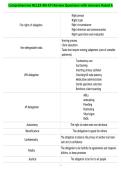
Right person
Right task
Five rights of delegation Right circumstance
Right direction and communication
Right supervision and evaluation
Nursing process
Client education
Non-delegatable tasks
Tasks that require nursing judgement (care of unstable
patients)
Tracheotomy care
Suctioning
Inserting urinary catheter
LPN delegation Checking NG tube patency
Medication administration
Sterile specimen colection
Reinforce client teaching
ADLs
Ambulating
Feeding
AP delegation
Positioning
Vital signs
I&Os
Autonomy The right to make ones own decisions
Beneficence The obligation to good for others
The obligation to observe the privacy of another and main-
Confidentiality
tain strict confidence
The obligation to be faithful to agreements and responsi-
Fidelity
bilities, to keep promises
Justice The obligation to be fair to all people
,Comprehensive NCLEX-RN ATI Review Questions with Answers Rated A
Nonmaleficence The obligation to do no harm to others
Paternalism Assuming the right to make decisions for another
Veracity The obligation to tell the truth
Ensure the provider gave the necessary information
Ensure the client understands the procedure
Nurses role of informed consent Patient must be competent to sign informed consent
Witness the clients signature
Notify the provider if clarification is needed
Abuse - vulnerable populations
Mandatory Reporting
Communicable diseases
The failure of a person with professional training to act
Malpractice in a reasonable an prudent manner within the identified
scope of practice
The omission to do something that a reasonable person
Negligence would do or something that a reasonable person would
not do
Immediate threat to life
Emergency class 1 (red tag)
Do not delay care
Major injuries that require treatment
Urgent class 2 (yellow tag)
Delay of 30 minutes to 2 hours
Minor injuries that do not require immediate attention
Non-urgent class 3 (green tag)
Delay of 2-4 hours
Expected/allowed to die
Expectant class 4 (black tag)
Prepare for morgue
Monitor serum glucose ever 4-6 hours
TPN Change dressing every 48 - 72 hours
Change IV tubing and fluid every 24 hours
, Comprehensive NCLEX-RN ATI Review Questions with Answers Rated A
If solution is temporarily unavailable, administer 10% dex-
trose in water to prevent hypoglycemia
Acetaminophen (antidote) Acetylcysteine (antidote)
Benzodiazepine (antidote) Flumazenil (antidote)
Curare (antidote) Edrophonium (antidote)
Cyanide poisoning (antidote) Methylene blue (antidote)
Digitalis: (antidote) Digoxin immune FAB (antidote)
Ethylene poisoning (antidote) Fomepizole (antidote)
Heparin and enoxaparin (antidote) Protamine sulfate (antidote)
Iron (antidote) Deferoxamine (antidote)
Lead (antidote) Succimer (antidote)
Magnesium sulfate (antidote) Calcium gluconate 10% (antidote)
Narcotics (antidote) Naloxone (antidote)
Warfarin (antidote) Phytonadione (vitamin K)(antidote)
Suflx: dipine
Causes: arterial dilation and decreased BP
For: angina and HTN, verapamil and diltazem can be used
for a-fib, a-flutter, svt
Precautions: digoxin and beta blockers
Contraindication: heart failure, heart block, of bradycar-
Calcium channel blockers dia
Side ettects: reflex tachycardia, peripheral edema, and
toxicity
Monitor: BP and HR
Do not drink grapefruit juice
Do not crush/chew
IV administration 2-3 minutes
ACE inhibitor
Right person
Right task
Five rights of delegation Right circumstance
Right direction and communication
Right supervision and evaluation
Nursing process
Client education
Non-delegatable tasks
Tasks that require nursing judgement (care of unstable
patients)
Tracheotomy care
Suctioning
Inserting urinary catheter
LPN delegation Checking NG tube patency
Medication administration
Sterile specimen colection
Reinforce client teaching
ADLs
Ambulating
Feeding
AP delegation
Positioning
Vital signs
I&Os
Autonomy The right to make ones own decisions
Beneficence The obligation to good for others
The obligation to observe the privacy of another and main-
Confidentiality
tain strict confidence
The obligation to be faithful to agreements and responsi-
Fidelity
bilities, to keep promises
Justice The obligation to be fair to all people
,Comprehensive NCLEX-RN ATI Review Questions with Answers Rated A
Nonmaleficence The obligation to do no harm to others
Paternalism Assuming the right to make decisions for another
Veracity The obligation to tell the truth
Ensure the provider gave the necessary information
Ensure the client understands the procedure
Nurses role of informed consent Patient must be competent to sign informed consent
Witness the clients signature
Notify the provider if clarification is needed
Abuse - vulnerable populations
Mandatory Reporting
Communicable diseases
The failure of a person with professional training to act
Malpractice in a reasonable an prudent manner within the identified
scope of practice
The omission to do something that a reasonable person
Negligence would do or something that a reasonable person would
not do
Immediate threat to life
Emergency class 1 (red tag)
Do not delay care
Major injuries that require treatment
Urgent class 2 (yellow tag)
Delay of 30 minutes to 2 hours
Minor injuries that do not require immediate attention
Non-urgent class 3 (green tag)
Delay of 2-4 hours
Expected/allowed to die
Expectant class 4 (black tag)
Prepare for morgue
Monitor serum glucose ever 4-6 hours
TPN Change dressing every 48 - 72 hours
Change IV tubing and fluid every 24 hours
, Comprehensive NCLEX-RN ATI Review Questions with Answers Rated A
If solution is temporarily unavailable, administer 10% dex-
trose in water to prevent hypoglycemia
Acetaminophen (antidote) Acetylcysteine (antidote)
Benzodiazepine (antidote) Flumazenil (antidote)
Curare (antidote) Edrophonium (antidote)
Cyanide poisoning (antidote) Methylene blue (antidote)
Digitalis: (antidote) Digoxin immune FAB (antidote)
Ethylene poisoning (antidote) Fomepizole (antidote)
Heparin and enoxaparin (antidote) Protamine sulfate (antidote)
Iron (antidote) Deferoxamine (antidote)
Lead (antidote) Succimer (antidote)
Magnesium sulfate (antidote) Calcium gluconate 10% (antidote)
Narcotics (antidote) Naloxone (antidote)
Warfarin (antidote) Phytonadione (vitamin K)(antidote)
Suflx: dipine
Causes: arterial dilation and decreased BP
For: angina and HTN, verapamil and diltazem can be used
for a-fib, a-flutter, svt
Precautions: digoxin and beta blockers
Contraindication: heart failure, heart block, of bradycar-
Calcium channel blockers dia
Side ettects: reflex tachycardia, peripheral edema, and
toxicity
Monitor: BP and HR
Do not drink grapefruit juice
Do not crush/chew
IV administration 2-3 minutes
ACE inhibitor

