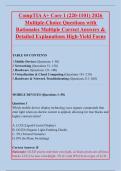
CompTIA A+ Core 1 (220-1101) 2026
Multiple-Choice Questions with
Rationales Multiple Correct Answers &
Detailed Explanations High-Yield Focus
TABLE OF CONTENTS
1.Mobile Devices (Questions 1–50)
2.Networking (Questions 51–120)
3.Hardware (Questions 121–180)
4.Virtualization & Cloud Computing (Questions 181–210)
5.Hardware & Network Troubleshooting (Questions 211–260)
MOBILE DEVICES (Questions 1–50)
Question 1
Which mobile device display technology uses organic compounds that
emit light when an electric current is applied, allowing for true blacks and
higher contrast ratios?
A. LCD (Liquid Crystal Display)
B. OLED (Organic Light-Emitting Diode)
C. TN (Twisted Nematic)
D. IPS (In-Plane Switching)
Correct Answer: B
Rationale: OLED pixels emit their own light, so black pixels are off (true
black). LCD (A) uses a backlight. TN (C) and IPS (D) are types of LCD.
,Question 2 (Select all that apply)
Which of the following are characteristics of OLED displays compared to
LCD? (Select all that apply)
A. Thinner and more flexible
B. Lower power consumption when displaying dark content
C. Better outdoor visibility
D. No backlight required
E. Longer lifespan (true for some OLEDs but not always)
Correct Answers: A, B, D
Rationale: OLEDs are thinner (A), have no backlight (D), and use less
power for dark content (B). Outdoor visibility (C) is often better on LCD.
Lifespan (E) can be shorter due to burn-in.
Question 3
What is the primary difference between an IPS LCD and a TN LCD?
A. IPS has better color accuracy and viewing angles; TN has faster
response times
B. TN has better color accuracy; IPS has faster response times
C. Both are identical
D. IPS is only used in TVs, not mobile devices
Correct Answer: A
Rationale: IPS (In-Plane Switching) offers superior color and viewing
angles. TN (Twisted Nematic) offers faster response times (gaming) but
poor viewing angles.
,Question 4
Which mobile device connector is used for both charging and data
transfer on most modern Android devices?
A. Lightning
B. USB-C
C. Micro-USB
D. Mini-USB
Correct Answer: B
Rationale: USB-C is the current standard for Android and many laptops.
Lightning (A) is Apple proprietary. Micro-USB (C) is older Android.
Question 5 (Select all that apply)
Which of the following are advantages of USB-C over older USB
connectors? (Select all that apply)
A. Reversible (can be plugged in either orientation)
B. Supports higher power delivery (fast charging)
C. Supports higher data transfer speeds (USB 3.1/3.2/4)
D. Smaller than Micro-USB
E. Supports DisplayPort alt mode (video output)
Correct Answers: A, B, C, D, E
Rationale: All are advantages of USB-C. It is reversible (A), supports
Power Delivery (B) up to 240W, high speeds (C) up to 40Gbps, is smaller
than Micro-USB (D), and supports alt modes (E) for video.
Question 6
What is the maximum data transfer speed of USB 3.2 Gen 2?
, A. 480 Mbps
B. 5 Gbps
C. 10 Gbps
D. 20 Gbps
Correct Answer: C
Rationale: USB 3.2 Gen 2 (formerly USB 3.1 Gen 2) is 10 Gbps. USB
3.2 Gen 1 (B) is 5 Gbps. USB 2.0 (A) is 480 Mbps. USB 3.2 Gen 2x2 (D)
is 20 Gbps.
Question 7
Which wireless technology is commonly used for connecting mobile
devices to peripherals like headphones, keyboards, and mice?
A. Wi-Fi
B. Bluetooth
C. NFC
D. Cellular (4G/5G)
Correct Answer: B
Rationale: Bluetooth is designed for short-range peripheral connections.
Wi-Fi (A) is for network access. NFC (C) is for very short-range
(contactless payments). Cellular (D) is for mobile data.
Question 8 (Select all that apply)
Which of the following are Bluetooth versions that introduced significant
improvements? (Select all that apply)
A. Bluetooth 2.0 + EDR (Enhanced Data Rate)
B. Bluetooth 4.0 (Low Energy – BLE)
Multiple-Choice Questions with
Rationales Multiple Correct Answers &
Detailed Explanations High-Yield Focus
TABLE OF CONTENTS
1.Mobile Devices (Questions 1–50)
2.Networking (Questions 51–120)
3.Hardware (Questions 121–180)
4.Virtualization & Cloud Computing (Questions 181–210)
5.Hardware & Network Troubleshooting (Questions 211–260)
MOBILE DEVICES (Questions 1–50)
Question 1
Which mobile device display technology uses organic compounds that
emit light when an electric current is applied, allowing for true blacks and
higher contrast ratios?
A. LCD (Liquid Crystal Display)
B. OLED (Organic Light-Emitting Diode)
C. TN (Twisted Nematic)
D. IPS (In-Plane Switching)
Correct Answer: B
Rationale: OLED pixels emit their own light, so black pixels are off (true
black). LCD (A) uses a backlight. TN (C) and IPS (D) are types of LCD.
,Question 2 (Select all that apply)
Which of the following are characteristics of OLED displays compared to
LCD? (Select all that apply)
A. Thinner and more flexible
B. Lower power consumption when displaying dark content
C. Better outdoor visibility
D. No backlight required
E. Longer lifespan (true for some OLEDs but not always)
Correct Answers: A, B, D
Rationale: OLEDs are thinner (A), have no backlight (D), and use less
power for dark content (B). Outdoor visibility (C) is often better on LCD.
Lifespan (E) can be shorter due to burn-in.
Question 3
What is the primary difference between an IPS LCD and a TN LCD?
A. IPS has better color accuracy and viewing angles; TN has faster
response times
B. TN has better color accuracy; IPS has faster response times
C. Both are identical
D. IPS is only used in TVs, not mobile devices
Correct Answer: A
Rationale: IPS (In-Plane Switching) offers superior color and viewing
angles. TN (Twisted Nematic) offers faster response times (gaming) but
poor viewing angles.
,Question 4
Which mobile device connector is used for both charging and data
transfer on most modern Android devices?
A. Lightning
B. USB-C
C. Micro-USB
D. Mini-USB
Correct Answer: B
Rationale: USB-C is the current standard for Android and many laptops.
Lightning (A) is Apple proprietary. Micro-USB (C) is older Android.
Question 5 (Select all that apply)
Which of the following are advantages of USB-C over older USB
connectors? (Select all that apply)
A. Reversible (can be plugged in either orientation)
B. Supports higher power delivery (fast charging)
C. Supports higher data transfer speeds (USB 3.1/3.2/4)
D. Smaller than Micro-USB
E. Supports DisplayPort alt mode (video output)
Correct Answers: A, B, C, D, E
Rationale: All are advantages of USB-C. It is reversible (A), supports
Power Delivery (B) up to 240W, high speeds (C) up to 40Gbps, is smaller
than Micro-USB (D), and supports alt modes (E) for video.
Question 6
What is the maximum data transfer speed of USB 3.2 Gen 2?
, A. 480 Mbps
B. 5 Gbps
C. 10 Gbps
D. 20 Gbps
Correct Answer: C
Rationale: USB 3.2 Gen 2 (formerly USB 3.1 Gen 2) is 10 Gbps. USB
3.2 Gen 1 (B) is 5 Gbps. USB 2.0 (A) is 480 Mbps. USB 3.2 Gen 2x2 (D)
is 20 Gbps.
Question 7
Which wireless technology is commonly used for connecting mobile
devices to peripherals like headphones, keyboards, and mice?
A. Wi-Fi
B. Bluetooth
C. NFC
D. Cellular (4G/5G)
Correct Answer: B
Rationale: Bluetooth is designed for short-range peripheral connections.
Wi-Fi (A) is for network access. NFC (C) is for very short-range
(contactless payments). Cellular (D) is for mobile data.
Question 8 (Select all that apply)
Which of the following are Bluetooth versions that introduced significant
improvements? (Select all that apply)
A. Bluetooth 2.0 + EDR (Enhanced Data Rate)
B. Bluetooth 4.0 (Low Energy – BLE)