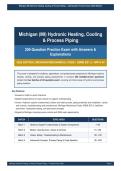
Michigan (MI) Hydronic Heating, Cooling & Process Piping — 200-Question Practice Exam (2026 Edition)
Michigan (MI) Hydronic Heating, Cooling
& Process Piping
200-Question Practice Exam with Answers &
Explanations
2026 EDITION | MICHIGAN MECHANICAL CODE | ASME B31.3 | NFPA 54
This exam is designed for students, apprentices, and professionals preparing for Michigan hydronic
heating, cooling, and process piping assessments. It contains 200 multiple-choice questions
divided into four batches of 50 questions each, covering all critical areas of hydronic and process
piping systems.
Key Features:
• Answers in bold for quick reference
• Detailed explanations for each answer to support understanding
• Covers: Hydronic system fundamentals, boilers and heat sources, piping materials and installation, valves
and controls, troubleshooting and maintenance, Michigan Mechanical Code, ASME B31.3, backflow
prevention, hydrostatic testing, and advanced concepts
• Aligned to Michigan licensing exam content and 2026 code requirements
BATCH TOPIC AREA QUESTIONS
Batch 1 Hydronic System Fundamentals & System Components 1–50
Batch 2 Boilers, Heat Sources, Valves & Controls 51–100
Batch 3 Codes, Safety, Troubleshooting & Maintenance 101–150
Batch 4 Advanced Concepts, Process Piping & Code Specifics 151–200
Michigan Hydronic Heating, Cooling & Process Piping — Practice Exam 2026 Page 1
, Michigan (MI) Hydronic Heating, Cooling & Process Piping — 200-Question Practice Exam (2026 Edition)
BATCH 1 OF Hydronic System Fundamentals & System Questions
4 Components 1–50
◆ Hydronic System Fundamentals
1. What is the primary purpose of a hydronic heating system?
A) Distribute air
B) Circulate water or another fluid for heating purposes
C) Provide ventilation
D) Cool the building
Answer: B
Hydronic systems use water or glycol-based fluids to transfer heat efficiently through pipes to radiators,
baseboards, or radiant floors.
2. What component prevents air accumulation in a closed-loop hydronic system?
A) Expansion tank
B) Air separator
C) Pressure reducing valve
D) Thermostatic valve
Answer: B
Air separators remove trapped air, reducing noise, corrosion, and flow problems.
3. What is the standard test pressure for hydronic piping before operation?
A) 25 psi
B) 50 psi
C) 100 psi
D) 1.5 × operating pressure
Answer: D
Hydronic systems are pressure-tested at 1.5 times the maximum operating pressure to ensure safety and leak-free
installation.
4. Which valve type allows flow in only one direction?
A) Ball valve
B) Check valve
C) Globe valve
D) Mixing valve
Answer: B
Check valves prevent reverse flow in the system, protecting pumps and components.
Michigan Hydronic Heating, Cooling & Process Piping — Practice Exam 2026 Page 2
, Michigan (MI) Hydronic Heating, Cooling & Process Piping — 200-Question Practice Exam (2026 Edition)
5. What is the purpose of an expansion tank in a hydronic system?
A) Circulate water
B) Absorb pressure changes due to fluid expansion
C) Filter impurities
D) Control temperature
Answer: B
As water heats, it expands; the expansion tank accommodates this increase to prevent overpressure.
6. In a closed-loop hydronic system, what happens to pressure when water temperature rises?
A) Pressure decreases
B) Pressure stays constant
C) Pressure increases
D) Pressure becomes zero
Answer: C
When water heats and expands in a closed system, pressure rises. The expansion tank absorbs excess volume to
maintain safe pressures.
7. What is the typical operating pressure range for residential hydronic heating systems?
A) 5–10 psi
B) 12–25 psi
C) 40–60 psi
D) 80–100 psi
Answer: B
Residential hydronic systems typically operate between 12 and 25 psi; higher pressures indicate a problem such
as a failed expansion tank.
8. Which component circulates water through a hydronic heating system?
A) Expansion tank
B) Zone valve
C) Circulator pump
D) Pressure relief valve
Answer: C
The circulator pump provides the mechanical energy to move heated water from the boiler through piping to heat
emitters and back.
Michigan Hydronic Heating, Cooling & Process Piping — Practice Exam 2026 Page 3
, Michigan (MI) Hydronic Heating, Cooling & Process Piping — 200-Question Practice Exam (2026 Edition)
9. What is the function of a zone valve in a hydronic system?
A) Regulate boiler pressure
B) Direct flow to specific zones on demand
C) Remove air from the system
D) Control supply water temperature
Answer: B
Zone valves open or close in response to thermostat calls, directing heated water only to zones that require
heating.
10. What does 'delta T' (∆T) refer to in hydronic system design?
A) Total pipe length
B) Difference between supply and return water temperatures
C) Pump head pressure
D) System fill pressure
Answer: B
Delta T (∆T) is the temperature difference between supply and return water. A typical design ∆T is 20°F, indicating
efficient heat transfer.
11. Which type of hydronic system uses a single pipe for both supply and return?
A) Two-pipe direct return
B) Primary-secondary
C) Series one-pipe
D) Reverse return
Answer: C
In a series one-pipe (monoflow) system, all heat emitters are connected in series on one loop. Each successive
emitter receives slightly cooler water.
12. In a two-pipe direct-return system, the return pipe routes water:
A) Directly back from each terminal unit by the shortest path
B) Through all terminal units before returning
C) Backward through the supply
D) Through a bypass valve
Answer: A
Direct-return systems send water from each terminal unit back to the boiler via the shortest return path, which can
cause unequal flow distribution without balancing valves.
Michigan Hydronic Heating, Cooling & Process Piping — Practice Exam 2026 Page 4
Michigan (MI) Hydronic Heating, Cooling
& Process Piping
200-Question Practice Exam with Answers &
Explanations
2026 EDITION | MICHIGAN MECHANICAL CODE | ASME B31.3 | NFPA 54
This exam is designed for students, apprentices, and professionals preparing for Michigan hydronic
heating, cooling, and process piping assessments. It contains 200 multiple-choice questions
divided into four batches of 50 questions each, covering all critical areas of hydronic and process
piping systems.
Key Features:
• Answers in bold for quick reference
• Detailed explanations for each answer to support understanding
• Covers: Hydronic system fundamentals, boilers and heat sources, piping materials and installation, valves
and controls, troubleshooting and maintenance, Michigan Mechanical Code, ASME B31.3, backflow
prevention, hydrostatic testing, and advanced concepts
• Aligned to Michigan licensing exam content and 2026 code requirements
BATCH TOPIC AREA QUESTIONS
Batch 1 Hydronic System Fundamentals & System Components 1–50
Batch 2 Boilers, Heat Sources, Valves & Controls 51–100
Batch 3 Codes, Safety, Troubleshooting & Maintenance 101–150
Batch 4 Advanced Concepts, Process Piping & Code Specifics 151–200
Michigan Hydronic Heating, Cooling & Process Piping — Practice Exam 2026 Page 1
, Michigan (MI) Hydronic Heating, Cooling & Process Piping — 200-Question Practice Exam (2026 Edition)
BATCH 1 OF Hydronic System Fundamentals & System Questions
4 Components 1–50
◆ Hydronic System Fundamentals
1. What is the primary purpose of a hydronic heating system?
A) Distribute air
B) Circulate water or another fluid for heating purposes
C) Provide ventilation
D) Cool the building
Answer: B
Hydronic systems use water or glycol-based fluids to transfer heat efficiently through pipes to radiators,
baseboards, or radiant floors.
2. What component prevents air accumulation in a closed-loop hydronic system?
A) Expansion tank
B) Air separator
C) Pressure reducing valve
D) Thermostatic valve
Answer: B
Air separators remove trapped air, reducing noise, corrosion, and flow problems.
3. What is the standard test pressure for hydronic piping before operation?
A) 25 psi
B) 50 psi
C) 100 psi
D) 1.5 × operating pressure
Answer: D
Hydronic systems are pressure-tested at 1.5 times the maximum operating pressure to ensure safety and leak-free
installation.
4. Which valve type allows flow in only one direction?
A) Ball valve
B) Check valve
C) Globe valve
D) Mixing valve
Answer: B
Check valves prevent reverse flow in the system, protecting pumps and components.
Michigan Hydronic Heating, Cooling & Process Piping — Practice Exam 2026 Page 2
, Michigan (MI) Hydronic Heating, Cooling & Process Piping — 200-Question Practice Exam (2026 Edition)
5. What is the purpose of an expansion tank in a hydronic system?
A) Circulate water
B) Absorb pressure changes due to fluid expansion
C) Filter impurities
D) Control temperature
Answer: B
As water heats, it expands; the expansion tank accommodates this increase to prevent overpressure.
6. In a closed-loop hydronic system, what happens to pressure when water temperature rises?
A) Pressure decreases
B) Pressure stays constant
C) Pressure increases
D) Pressure becomes zero
Answer: C
When water heats and expands in a closed system, pressure rises. The expansion tank absorbs excess volume to
maintain safe pressures.
7. What is the typical operating pressure range for residential hydronic heating systems?
A) 5–10 psi
B) 12–25 psi
C) 40–60 psi
D) 80–100 psi
Answer: B
Residential hydronic systems typically operate between 12 and 25 psi; higher pressures indicate a problem such
as a failed expansion tank.
8. Which component circulates water through a hydronic heating system?
A) Expansion tank
B) Zone valve
C) Circulator pump
D) Pressure relief valve
Answer: C
The circulator pump provides the mechanical energy to move heated water from the boiler through piping to heat
emitters and back.
Michigan Hydronic Heating, Cooling & Process Piping — Practice Exam 2026 Page 3
, Michigan (MI) Hydronic Heating, Cooling & Process Piping — 200-Question Practice Exam (2026 Edition)
9. What is the function of a zone valve in a hydronic system?
A) Regulate boiler pressure
B) Direct flow to specific zones on demand
C) Remove air from the system
D) Control supply water temperature
Answer: B
Zone valves open or close in response to thermostat calls, directing heated water only to zones that require
heating.
10. What does 'delta T' (∆T) refer to in hydronic system design?
A) Total pipe length
B) Difference between supply and return water temperatures
C) Pump head pressure
D) System fill pressure
Answer: B
Delta T (∆T) is the temperature difference between supply and return water. A typical design ∆T is 20°F, indicating
efficient heat transfer.
11. Which type of hydronic system uses a single pipe for both supply and return?
A) Two-pipe direct return
B) Primary-secondary
C) Series one-pipe
D) Reverse return
Answer: C
In a series one-pipe (monoflow) system, all heat emitters are connected in series on one loop. Each successive
emitter receives slightly cooler water.
12. In a two-pipe direct-return system, the return pipe routes water:
A) Directly back from each terminal unit by the shortest path
B) Through all terminal units before returning
C) Backward through the supply
D) Through a bypass valve
Answer: A
Direct-return systems send water from each terminal unit back to the boiler via the shortest return path, which can
cause unequal flow distribution without balancing valves.
Michigan Hydronic Heating, Cooling & Process Piping — Practice Exam 2026 Page 4