

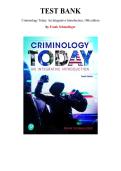
TEST BANK
Criminology Today: An Integrative Introduction, 10th edition
by Frank Schmalleger
LU
XE
LI
BR
AR
Y
, TABLE OF CONTENT
PART I: CRIME AND CRIMINOLOGY
What Is Criminology - Understanding Crime and Criminals
Where Do Theories Come From? - From Idea to Evidence
PART II: CRIME CAUSATION
Classical and Neoclassical Thought - Choice or Consequences
Early Biological Perspectives on Criminal Behavior - It’s What We Are
Biosocial and Other Contemporary Perspectives - Interaction Is Key
LU
Psychological and Psychiatric Foundations of Criminal Behavior - It’s How We Think
PART III: CRIME CAUSATION REVISITED
Social Structure Theories - It’s Where and How We Live
Theories of Social Process and Social Development - It’s What We Learn
XE
Social Conflict Theories - It’s How We Relate
PART IV: THE CRIME PICTURE
Criminal Victimization - It’s Personal
Crimes against Persons - It’s What We Fear
LI
Crimes against Property - It’s What We Lose
White-Collar and Organized Crime - Crime as a Job
Drug and Sex Crimes - Recreational Offenses
BR
Technology and Crime - It’s a Double-Edged Sword
Globalization and Terrorism - Our Small World
AR
Y
, KJHGFDSA
Test Bank
Criminology Today, 10e (Schmalleger)
Chapter 1 What Is Criminology?
1.1 Multiple Choice Questions
LU
1) The view of crime as human conduct that violates the criminal law is drawn from a
perspective.
A) political
B) sociological
C) psychological
D) legalistic
XE
Answer: C
Page Ref: 2
Objective: What is crime? What is the definition of crime that the author of this text has
chosen to use?
Level: Basic
LI
2) “Human conduct that is in violation of the criminal laws of a state, the federal government,
or a local jurisdiction that has the power to make such laws” is a definition of .
A) criminology
BR
B) crime
C) criminal
D) deviance
Answer: B
Page Ref: 3
Objective: What is crime? What is the definition of crime that the author of this text has
AR
chosen to use?
Level: Basic
3) The belief that crime is an antisocial act of such a nature that repression is necessary to
preserve the existing system of society is the basis of the perspective on crime
A) legal
Y
B) political
C) sociological
D) psychological
Answer: C
Page Ref: 3-4
Objective: What is crime? What is the definition of crime that the author of this text has
chosen to use?
Level: Basic
178
Copyright © 2021 Pearson Education, Inc.
, KJHGFDSA
4) The psychological perspective sees crime primarily as .
A) a violation of a law
B) an offense against human relationships
C) an antisocial act
D) problem behavior
Answer: D
Page Ref: 5
Objective: What is crime? What is the definition of crime that the author of this text has
chosen to use?
LU
Level: Basic
5) Which of the following statements about deviance and crime is true?
A) All deviant behavior is criminal.
B) All criminal behavior is deviant.
XE
C) Deviant behavior and criminal behavior overlap.
D) Deviant behavior and criminal behavior are mutually exclusive categories.
Answer: C
Page Ref: 5-6
Objective: What is deviance? How are crime and deviance similar? How do they differ?
LI
Level: Intermediate
6) You are running late to class and there is an exam today. To get to class on time, you drive
about 10 miles about the speed limit. This is an example of behavior that is .
BR
A) deviant but not criminal
B) criminal but not deviant
C) both deviant and criminal
D) neither deviant nor criminal
Answer: B
AR
Page Ref: 6
Objective: What is deviance? How are crime and deviance similar? How do they differ?
Level: Intermediate
7) Which of the following behaviors are criminal only when committed by a child or youth?
A) Shoplifting a candy bar
Y
B) Drinking alcohol
C) Speeding
D) Joyriding
Answer: B
Page Ref: 7
Objective: What is deviance? How are crime and deviance similar? How do they differ?
Level: Intermediate
179
Copyright © 2021 Pearson Education, Inc.
Criminology Today: An Integrative Introduction, 10th edition
by Frank Schmalleger
LU
XE
LI
BR
AR
Y
, TABLE OF CONTENT
PART I: CRIME AND CRIMINOLOGY
What Is Criminology - Understanding Crime and Criminals
Where Do Theories Come From? - From Idea to Evidence
PART II: CRIME CAUSATION
Classical and Neoclassical Thought - Choice or Consequences
Early Biological Perspectives on Criminal Behavior - It’s What We Are
Biosocial and Other Contemporary Perspectives - Interaction Is Key
LU
Psychological and Psychiatric Foundations of Criminal Behavior - It’s How We Think
PART III: CRIME CAUSATION REVISITED
Social Structure Theories - It’s Where and How We Live
Theories of Social Process and Social Development - It’s What We Learn
XE
Social Conflict Theories - It’s How We Relate
PART IV: THE CRIME PICTURE
Criminal Victimization - It’s Personal
Crimes against Persons - It’s What We Fear
LI
Crimes against Property - It’s What We Lose
White-Collar and Organized Crime - Crime as a Job
Drug and Sex Crimes - Recreational Offenses
BR
Technology and Crime - It’s a Double-Edged Sword
Globalization and Terrorism - Our Small World
AR
Y
, KJHGFDSA
Test Bank
Criminology Today, 10e (Schmalleger)
Chapter 1 What Is Criminology?
1.1 Multiple Choice Questions
LU
1) The view of crime as human conduct that violates the criminal law is drawn from a
perspective.
A) political
B) sociological
C) psychological
D) legalistic
XE
Answer: C
Page Ref: 2
Objective: What is crime? What is the definition of crime that the author of this text has
chosen to use?
Level: Basic
LI
2) “Human conduct that is in violation of the criminal laws of a state, the federal government,
or a local jurisdiction that has the power to make such laws” is a definition of .
A) criminology
BR
B) crime
C) criminal
D) deviance
Answer: B
Page Ref: 3
Objective: What is crime? What is the definition of crime that the author of this text has
AR
chosen to use?
Level: Basic
3) The belief that crime is an antisocial act of such a nature that repression is necessary to
preserve the existing system of society is the basis of the perspective on crime
A) legal
Y
B) political
C) sociological
D) psychological
Answer: C
Page Ref: 3-4
Objective: What is crime? What is the definition of crime that the author of this text has
chosen to use?
Level: Basic
178
Copyright © 2021 Pearson Education, Inc.
, KJHGFDSA
4) The psychological perspective sees crime primarily as .
A) a violation of a law
B) an offense against human relationships
C) an antisocial act
D) problem behavior
Answer: D
Page Ref: 5
Objective: What is crime? What is the definition of crime that the author of this text has
chosen to use?
LU
Level: Basic
5) Which of the following statements about deviance and crime is true?
A) All deviant behavior is criminal.
B) All criminal behavior is deviant.
XE
C) Deviant behavior and criminal behavior overlap.
D) Deviant behavior and criminal behavior are mutually exclusive categories.
Answer: C
Page Ref: 5-6
Objective: What is deviance? How are crime and deviance similar? How do they differ?
LI
Level: Intermediate
6) You are running late to class and there is an exam today. To get to class on time, you drive
about 10 miles about the speed limit. This is an example of behavior that is .
BR
A) deviant but not criminal
B) criminal but not deviant
C) both deviant and criminal
D) neither deviant nor criminal
Answer: B
AR
Page Ref: 6
Objective: What is deviance? How are crime and deviance similar? How do they differ?
Level: Intermediate
7) Which of the following behaviors are criminal only when committed by a child or youth?
A) Shoplifting a candy bar
Y
B) Drinking alcohol
C) Speeding
D) Joyriding
Answer: B
Page Ref: 7
Objective: What is deviance? How are crime and deviance similar? How do they differ?
Level: Intermediate
179
Copyright © 2021 Pearson Education, Inc.

