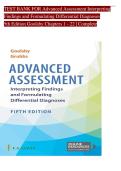
TEST BANK FOR Advanced Assessment Interpreting
Findings and Formulating Differential Diagnoses
5th Edition Goolsby Chapters 1 - 22 | Complete
, TABLE OF CONTENTS
Chapter 1. Assessment and Clinical Decision Making: An Overview
Chapter 2. Genomic Assessment: Interpreting Findings and Formulating Differential Diagnoses
Chapter 3. Skin
Chapter 4. Head, Face, and Neck
Chapter 5. The Eye
Chapter 6. Ear, Nose, Mouth, and Throat
Chapter 7. Cardiac and Peripheral Vascular Systems
Chapter 8. Respiratory System
Chapter 9. Breasts
Chapter 10. Abdomen
Chapter 11. Genitourinary System
Chapter 12. Male Reproductive System
Chapter 13. Female Reproductive System
Chapter 14. Musculoskeletal System
Chapter 15. Neurological System
Chapter 16. Nonspecific Complaints
Chapter 17. Psychiatric Mental Health
Chapter 18. Pediatric Patients
Chapter 19. Pregnant Patients
Chapter 20. Assessment of the Transgender or Gender Diverse Adult
Chapter 21. Older Patients
Chapter 22. Persons With Disabilities
, Chapter 1. Assessment and Clinical Decision Making: An Overview
Multiple Choice
Identify the choice thatKbestKcompletes the statementKorKanswers the question.
1. Which type of clinical decision-making is most reliable?
A. A. Intuitive
B. Analytical
C. Experiential
D. Augenblick
2. Which of the following is false? To obtain adequate history, health-care providers must be:
A. A. Methodical and systematic
B. Attentive to the patient‘s verbal and nonverbal langua
gtte
C. C. Able to accurately interpret the patient‘s responses
D. D. Adept at reading into the patient‘s statements
3. Essential parts of a health history include all of the following except:
A. A. Chief complaint
B. B. History of the present illness
C. C. Current vital signs
D. All of the above are essential history compone
n ts
4. Which of the following is false? While performing the physical examination, the examiner must be able to:
A. A. Differentiate between normal and abnormal findings
B. Recall knowledge of a range of conditions and their associated signs and sympt
o ms
C. C. Recognize how certain conditions affect the response to otherKconditions
D. D. Foresee unpredictable findingstt
5. The following is the least reliable source of information for diagnostic statistics:
A. A. Evidence-based investigations
B. B. Primary reports of research
C. Estimation based on a provider‘s experien
ce
, D. D. Published meta-analyses
6. The following can be used to assist in sound clinical decision-making:
A. A. AlgorithmKpublished in a pee
r-reviewed journal article
B. B. Clinical practice guidelines
C. C. Evidence-based research
D. D. All of the above
7. If a diagnostic study has high sensitivity, this indicates a:
A. High percentage of persons with the given condition will have an abnormal r
e sult
B. Low percentage of persons with the given condition will have an abnormal re
s ult
C. C. Low likelihood of normal result in persons without a given condition
D. D. None of the above
8. If a diagnostic study has high specificity, this indicates a:
A. A. Low percentage of healthy individuals will show a normal result
B. B. High percentage of healthy individuals will show a normal result
C. High percentage of individuals with a disorder will show aKnormal resul
t
D. Low percentage of individuals with a disorder will show an abnormal re
s ult
9. A- likelihood- ratio- above- 1- indicates- that- a- diagnostic- test- showing- a:
A. A.- Positive- result- is- strongly- associated- with- the- disease
B. Negative- result- is- strongly- associated- with- absence- of- the-
dise-a-se
C. C.- Positive- result- is- weakly- associated- with- the- diseasett
D. Negative- result- is- weakly- associated- with- absence- of- the-
disea-s-e
Findings and Formulating Differential Diagnoses
5th Edition Goolsby Chapters 1 - 22 | Complete
, TABLE OF CONTENTS
Chapter 1. Assessment and Clinical Decision Making: An Overview
Chapter 2. Genomic Assessment: Interpreting Findings and Formulating Differential Diagnoses
Chapter 3. Skin
Chapter 4. Head, Face, and Neck
Chapter 5. The Eye
Chapter 6. Ear, Nose, Mouth, and Throat
Chapter 7. Cardiac and Peripheral Vascular Systems
Chapter 8. Respiratory System
Chapter 9. Breasts
Chapter 10. Abdomen
Chapter 11. Genitourinary System
Chapter 12. Male Reproductive System
Chapter 13. Female Reproductive System
Chapter 14. Musculoskeletal System
Chapter 15. Neurological System
Chapter 16. Nonspecific Complaints
Chapter 17. Psychiatric Mental Health
Chapter 18. Pediatric Patients
Chapter 19. Pregnant Patients
Chapter 20. Assessment of the Transgender or Gender Diverse Adult
Chapter 21. Older Patients
Chapter 22. Persons With Disabilities
, Chapter 1. Assessment and Clinical Decision Making: An Overview
Multiple Choice
Identify the choice thatKbestKcompletes the statementKorKanswers the question.
1. Which type of clinical decision-making is most reliable?
A. A. Intuitive
B. Analytical
C. Experiential
D. Augenblick
2. Which of the following is false? To obtain adequate history, health-care providers must be:
A. A. Methodical and systematic
B. Attentive to the patient‘s verbal and nonverbal langua
gtte
C. C. Able to accurately interpret the patient‘s responses
D. D. Adept at reading into the patient‘s statements
3. Essential parts of a health history include all of the following except:
A. A. Chief complaint
B. B. History of the present illness
C. C. Current vital signs
D. All of the above are essential history compone
n ts
4. Which of the following is false? While performing the physical examination, the examiner must be able to:
A. A. Differentiate between normal and abnormal findings
B. Recall knowledge of a range of conditions and their associated signs and sympt
o ms
C. C. Recognize how certain conditions affect the response to otherKconditions
D. D. Foresee unpredictable findingstt
5. The following is the least reliable source of information for diagnostic statistics:
A. A. Evidence-based investigations
B. B. Primary reports of research
C. Estimation based on a provider‘s experien
ce
, D. D. Published meta-analyses
6. The following can be used to assist in sound clinical decision-making:
A. A. AlgorithmKpublished in a pee
r-reviewed journal article
B. B. Clinical practice guidelines
C. C. Evidence-based research
D. D. All of the above
7. If a diagnostic study has high sensitivity, this indicates a:
A. High percentage of persons with the given condition will have an abnormal r
e sult
B. Low percentage of persons with the given condition will have an abnormal re
s ult
C. C. Low likelihood of normal result in persons without a given condition
D. D. None of the above
8. If a diagnostic study has high specificity, this indicates a:
A. A. Low percentage of healthy individuals will show a normal result
B. B. High percentage of healthy individuals will show a normal result
C. High percentage of individuals with a disorder will show aKnormal resul
t
D. Low percentage of individuals with a disorder will show an abnormal re
s ult
9. A- likelihood- ratio- above- 1- indicates- that- a- diagnostic- test- showing- a:
A. A.- Positive- result- is- strongly- associated- with- the- disease
B. Negative- result- is- strongly- associated- with- absence- of- the-
dise-a-se
C. C.- Positive- result- is- weakly- associated- with- the- diseasett
D. Negative- result- is- weakly- associated- with- absence- of- the-
disea-s-e