
Memory
Multi-Store Model:
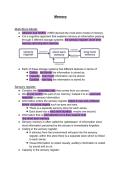
● Atkinson and Shiffrin (1968) devised the multi-store model of memory.
● It is a cognitive approach that explains memory as information passing
through 3 different storage systems: the sensory register, short term
memory and long term memory.
● Each of these storage systems has different features in terms of:
➔ Coding - the format the information is stored as.
➔ Capacity - how much information can be stored.
➔ Duration - how long the information is stored for.
Sensory register:
● Contains the immediate data that comes from our senses.
● We do not control this part of our memory, instead it is an automatic
response to sensory information.
● Information enters the sensory register coded in raw and unfiltered
format via sense organs such as eyes and ears.
➔ There is a separate sensory store for each sense.
➔ Each store has a very short duration, maybe one second.
● Information that is paid attention to is then passed onto
the short term memory.
● Sensory memory is often called the ‘gatekeeper’ of information since
most information perceived by the senses is immediately forgotten.
● Coding in the sensory register:
➔ A stimulus from the environment will pass into the sensory
register, within this store there is a separate store which is linked
to each sense.
➔ Visual information is coded visually, auditory information is coded
by sound and so on.
● Capacity in the sensory register:
, ➔ The capacity of each part of the sensory register is large, with a
constant flow of ever changing information, which is unprocessed
and highly detailed.
➔ Evidence comes from Sperling (1960) who flashed a 3 x 4 grid of
letters onto a screen for one twentieth of a second. He asked
participants to remember as many letters as they could. He found
that while they could only recall around 4 of the letters before the
grid faded from their sensory memory, they typically reported
seeing a lot more than they had time to recall.
➔ This supports the notion that capacity in the sensory register is
large as participants knew there were a lot of letters, however we
have a short duration so they could not remember them all.
● Duration in the sensory register:
➔ Each of the stores within the sensory register have a limited
duration, though the actual duration differs.
➔ In each case, it is very short.
➔ Sperling continued his work here by delaying when participants
were asked to recall the letters on the grid. He found that more
and more information was lost - only 50% was available after 0.3
sec delay and only 33% after 1 sec delay.
Short term memory:
● This is a temporary store for information where memories are either
actively processed or forgotten.
● It receives information from the sensory register and passes some of
that onto the long term memory.
● Coding in the short term memory:
➔ When information arrives in the STM it is coded (entered into the
STM) in such a way that it can be most easily dealt with, this is
usually acoustically.
➔ Baddeley (1966) tested this out. Participants were presented with
word lists. Firstly they had lists that were acoustically similar, e.g.
pat, mat, hat, cat. Then they were given words that were
semantically similar, e.g. large, big, huge, massive.
➔ Findings found that participants did a lot better at recalling words
that were semantically similar, rather than acoustically similar.
➔ Because the participants mixed up the words with similar sounds,
this shows they were encoding the words by the sound of the
word (their STM became confused with too many of the same

