💤
Stress And Stress Management
Meaning of Stress
The word ‘stress’ is derived from the Latin word ‘stringere’ meaning ‘to draw out
tight’. In 1936, Hans Selye defined it as the ‘non-specific response of the body to
any demand for change’
According to McGrath(1976), “stress is involved in an environmental situation
that is perceived as presenting a demand which threatens to exceed the
person’s capabilities and resources for meeting that demand.”
Eustress: Optimal level of stress which is considered beneficial and is required to
reach a target.
Distress: Harmful stress which results in lowered productivity and loss of creativity.
Neustress: Neutral stress that has no effect on the individual
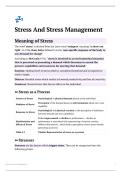
↣ Stress as a Process
Sources of Stress Psychological or physical demand placed on the individual
Perception of the demand based on self-estimation about one’s own
Mediator of Stress
capability
Psychological and physical reaction to the perception of imbalance
Response to Stress
between demand and own capabilities
Either improvement or decline in performance — decline in
Manifestation and performance is associated with experiencing of tension, worries,
Effects of Stress different diseases etc., which lead to perception of new stress thereby
generating a process
Table 4.1 Tabular Representation of stress as a process
↣ Stressors
Stressors are the factors which trigger stress. They can be categorized into the
following groups:
Stress And Stress Management 1
, 1. Physiological stressors include excessive exercise, lack of rest and sleep,
chronic pain, injury, diseases etc.
2. Environmental stressors include pollution, excessive humidity, presence of
radioactive substances, crowding or isolation, excessive noise etc.
3. Social stressors include break up of intimate relationships, lack of healthy
relationship with parents, siblings or friends, incompatible sexual relationship
Different Stress Models
↣ General Adaptation Syndrome (GAS): Hans Selye
Model
General Adaptation Syndrome (GAS) is a model developed by Hans Selye in the 1956
to describe the body’s physiological response to stress. It outlines three stages:
Stage 1: The Alarm Reaction
The alarm reaction stage of general adaptation syndrome is the body’s initial
response to stress. The sympathetic nervous system is activated by the sudden
release of hormones.
When the sympathetic nervous system is activated, it stimulates the adrenal
glands. The glands, in turn, trigger the release of certain hormones, including
adrenaline and noradrenaline.
The hormone release causes physical symptoms, such as:
Increased heart rate
Increased breathing rate
Increased blood pressure
The SAM Axis: This rapid response is governed by the Sympatho-Adreno-
Medullary (SAM) axis, which acts as the body's primary fast-acting "emergency"
circuit.
Stage 2: Resistance (Adaptation)
If the stressor continues, the body moves from a state of "panic" to a state of
sustained adaptation. This stage is dominated by the HPA Axis (Hypothalamic-
Pituitary-Adrenal axis).
Stress And Stress Management 2
Stress And Stress Management
Meaning of Stress
The word ‘stress’ is derived from the Latin word ‘stringere’ meaning ‘to draw out
tight’. In 1936, Hans Selye defined it as the ‘non-specific response of the body to
any demand for change’
According to McGrath(1976), “stress is involved in an environmental situation
that is perceived as presenting a demand which threatens to exceed the
person’s capabilities and resources for meeting that demand.”
Eustress: Optimal level of stress which is considered beneficial and is required to
reach a target.
Distress: Harmful stress which results in lowered productivity and loss of creativity.
Neustress: Neutral stress that has no effect on the individual
↣ Stress as a Process
Sources of Stress Psychological or physical demand placed on the individual
Perception of the demand based on self-estimation about one’s own
Mediator of Stress
capability
Psychological and physical reaction to the perception of imbalance
Response to Stress
between demand and own capabilities
Either improvement or decline in performance — decline in
Manifestation and performance is associated with experiencing of tension, worries,
Effects of Stress different diseases etc., which lead to perception of new stress thereby
generating a process
Table 4.1 Tabular Representation of stress as a process
↣ Stressors
Stressors are the factors which trigger stress. They can be categorized into the
following groups:
Stress And Stress Management 1
, 1. Physiological stressors include excessive exercise, lack of rest and sleep,
chronic pain, injury, diseases etc.
2. Environmental stressors include pollution, excessive humidity, presence of
radioactive substances, crowding or isolation, excessive noise etc.
3. Social stressors include break up of intimate relationships, lack of healthy
relationship with parents, siblings or friends, incompatible sexual relationship
Different Stress Models
↣ General Adaptation Syndrome (GAS): Hans Selye
Model
General Adaptation Syndrome (GAS) is a model developed by Hans Selye in the 1956
to describe the body’s physiological response to stress. It outlines three stages:
Stage 1: The Alarm Reaction
The alarm reaction stage of general adaptation syndrome is the body’s initial
response to stress. The sympathetic nervous system is activated by the sudden
release of hormones.
When the sympathetic nervous system is activated, it stimulates the adrenal
glands. The glands, in turn, trigger the release of certain hormones, including
adrenaline and noradrenaline.
The hormone release causes physical symptoms, such as:
Increased heart rate
Increased breathing rate
Increased blood pressure
The SAM Axis: This rapid response is governed by the Sympatho-Adreno-
Medullary (SAM) axis, which acts as the body's primary fast-acting "emergency"
circuit.
Stage 2: Resistance (Adaptation)
If the stressor continues, the body moves from a state of "panic" to a state of
sustained adaptation. This stage is dominated by the HPA Axis (Hypothalamic-
Pituitary-Adrenal axis).
Stress And Stress Management 2