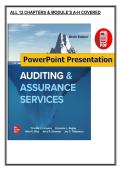
ALL 12 CHAPTERS & MODULE’S A-H COVERED
, Chapter 01
Auditing and Assurance Services
“Our system of capital formation relies upon the confidence of
millions of savers to invest in companies.
The auditor’s opinion is critical to that trust."
-- James R. Doty, Former Chairman
Public Company Accounting Oversight Board (PCAOB)
©McGraw-Hill Education 1-2
,Chapter 1 Learning Objectives
1. Define information risk and explain how the financial statement auditing process
helps to reduce this risk, thereby reducing the cost of capital for a company.
2. Define and contrast financial statement auditing, attestation, and assurance
services.
3. Describe and define the assertions that management makes about the
recognition, measurement, presentation, and disclosure of the financial
statements and explain why auditors use them as the focal point of the audit.
4. Define professional skepticism and explain its key characteristics.
5. Describe the organization of public accounting firms and identify the various
services that they offer.
6. Describe the audits and auditors in governmental, internal, and operational
auditing.
7. List and explain the requirements for becoming a certified public accountant (CPA)
and other certifications available to an accounting professional.
1-3
©McGraw-Hill Education.
, User Demand for Reliable Information
• Business risk
– The risk that an entity will fail to meet its objectives
• Today’s information
– More complex
– Demanded by remote users
– Demanded in a more timely manner
– Has far reaching consequences
• Information risk
– The probability that the information circulated by a
company will be false or misleading
– Users demand an independent third party assessment of
the information
©McGraw-Hill Education.
1-4
, Chapter 01
Auditing and Assurance Services
“Our system of capital formation relies upon the confidence of
millions of savers to invest in companies.
The auditor’s opinion is critical to that trust."
-- James R. Doty, Former Chairman
Public Company Accounting Oversight Board (PCAOB)
©McGraw-Hill Education 1-2
,Chapter 1 Learning Objectives
1. Define information risk and explain how the financial statement auditing process
helps to reduce this risk, thereby reducing the cost of capital for a company.
2. Define and contrast financial statement auditing, attestation, and assurance
services.
3. Describe and define the assertions that management makes about the
recognition, measurement, presentation, and disclosure of the financial
statements and explain why auditors use them as the focal point of the audit.
4. Define professional skepticism and explain its key characteristics.
5. Describe the organization of public accounting firms and identify the various
services that they offer.
6. Describe the audits and auditors in governmental, internal, and operational
auditing.
7. List and explain the requirements for becoming a certified public accountant (CPA)
and other certifications available to an accounting professional.
1-3
©McGraw-Hill Education.
, User Demand for Reliable Information
• Business risk
– The risk that an entity will fail to meet its objectives
• Today’s information
– More complex
– Demanded by remote users
– Demanded in a more timely manner
– Has far reaching consequences
• Information risk
– The probability that the information circulated by a
company will be false or misleading
– Users demand an independent third party assessment of
the information
©McGraw-Hill Education.
1-4