
Escrito por estudiantes que aprobaron Inmediatamente disponible después del pago Leer en línea o como PDF ¿Documento equivocado? Cámbialo gratis 4,6 TrustPilot
logo-home
Examen

Rasmussen NUR 2459 Mental Health Nursing Exam 1 2026/2027 | Modules 1-3 Complete Study Guide | 200+ Q&A with Verified Answers & Detailed Rationales | Grade A+ | NGN-Aligned

Puntuación
-
Vendido
-
Páginas
35
Grado
A+
Subido en
26-03-2026
Escrito en
2025/2026

INSTANT PDF DOWNLOAD—This comprehensive study guide is specifically designed for Rasmussen University nursing students preparing for NUR 2459 Mental and Behavioral Health Nursing Exam 1 for the 2026/2027 academic year. Based on verified exam materials covering Modules 1–3, this resource contains expertly verified practice questions and 100% correct answers with detailed rationales to help you master core mental health nursing concepts and achieve a top score (Grade A+). This comprehensive guide covers all major topics tested on NUR 2459 Exam 1 : Historical Foundations of Mental Health Care: State asylums (18th century, 600,000 residents), first school of psychiatric nursing (1882), deinstitutionalization (mass discharge from mental hospitals), and its impact (homelessness, increased incarceration, "revolving door" phenomenon). Three main reasons for deinstitutionalization: belief that hospital treatment was inhumane, hope that medications would offer a cure, and lack of funding at state/federal levels . Somatic Therapies in Early Psychiatric Nursing: Insulin therapy—insulin administered until comatose to relieve psych symptoms (could be fatal due to hypoglycemia). ECT (Electroconvulsive Therapy) —electrical stimulus to induce grand-mal seizure; now controlled with anesthesia and muscle relaxants. Used as last resort for depression, mania, schizophrenia, psychosis when medication has failed . Psychopharmacology Milestones: Phenothiazine—discovered to help control psychotic behaviors and improve/clear thinking in early psych nursing . Psychotherapy & Therapeutic Modalities: Behavioral therapy—aims to modify maladaptive behavior patterns; based on learning theory. Cognitive therapy—focuses on individual client thoughts and behaviors to solve current problems. Cognitive Behavioral Therapy (CBT) —combines cognitive and behavioral approaches for anxiety management. Family therapy—improves family functioning, understanding of mental illness, and maximizes positive interactions. Group therapy—develops more functional and satisfying reactions within group setting. Milieu therapy—creates supportive, therapeutic, safe environment to promote coping . Maslow's Hierarchy of Needs: Order from bottom to top: Physiological needs → Safety needs → Love and belonging → Self-esteem → Self-actualization. Motivation is continuous quest for self-actualization; lower level needs must be met first before advancement to higher level psychological needs . Defense Mechanisms: Always healthy: Altruism (dealing with anxiety by reaching out to others) and Sublimation (substituting acceptable forms of expression). Other mechanisms include Denial (refusing to acknowledge reality), Projection (attributing unacceptable thoughts to others), Rationalization (creating logical excuses for illogical behavior), Repression (unconsciously blocking unacceptable thoughts), Suppression (voluntarily denying stressful feelings), Regression (reverting to earlier developmental behaviors), Reaction Formation (exaggerating opposite behaviors), Splitting (inability to reconcile negative and positive attributes), and Undoing (performing an act to make up for prior behavior) . Therapeutic Nurse-Client Relationship Phases: Pre-orientation phase—preparation before first encounter; nurse obtains information, examines own feelings. Orientation phase—nurse and patient become acquainted; introductions, establish trust, identify strengths/limitations, set goals. Working phase—therapeutic work accomplished; maintain trust, problem-solving, reaching goals. Termination phase—conclusion of relationship; evaluate goal achievement, feelings of sadness/loss may occur . Therapeutic vs. Nontherapeutic Communication Techniques: Therapeutic—active listening, silence, accepting, giving recognition, offering self, broad openings, offering general leads, restating, reflecting, focusing, exploring, seeking clarification, presenting reality, voicing doubt, formulating a plan of action. Nontherapeutic—giving advice, rejecting, disapproving, disagreeing, requesting an explanation, minimizing feelings, stereotyping, using denial, interpreting, introducing an unrelated topic . Transference & Countertransference: Transference—patient unconsciously displaces feelings formed toward a person from their past onto the nurse. Countertransference—nurse's behavioral and emotional responses where nurse transfers feelings about past individuals onto the patient . Admission Types & Legal Concepts: Voluntary admission—client seeks admission and can request release. Involuntary admission—client enters against will; based on risk of harm to self/others and inability to provide self-care; lasts 60 days. Autonomy—right to self-determination. Beneficence—duty to promote good of others. Nonmaleficence—doing no harm to clients. Justice—giving fair treatment to all patients regardless of condition . Crisis Development Stages: Phase 1—exposure to precipitating stressor. Phase 2—previous coping techniques ineffective, discomfort increases. Phase 3—internal/external resources fail, anxiety increases. Phase 4—anxiety reaches panic level; cognitive functions disordered, emotions labile. Initial intervention: assess client's potential for suicide or homicide . Cultural Concepts & Spirituality: Ethnocentrism—belief one's own culture is superior, comparing others to own culture. Cultural syndromes—Ghost Sickness (Navajo—"out of one's mind"). Spirituality—connection one has to world around them; source of peace; does not necessarily mean religion. Cultural barriers to mental health services include language, stigma, mistrust, and lack of culturally competent providers . Inpatient vs. Outpatient Care: Only reason client admitted to inpatient care: danger to self or others, or unable to care for self due to mental illness. Clients with suicidal thoughts but no plan can be treated outpatient; clients with suicide plan and ability need inpatient care. Outpatient settings: day programs, half-way houses, patient-centered medical homes, homeless shelters, assisted living, transitional care units . Sample Questions Include : "What are some psychiatric historical events that occurred in the early psychiatric era?" → 18th century state asylums created, 600,000 residents, first school of psychiatric nursing (1882), deinstitutionalization, shift from custodial to professional care "What was the early use of phenothiazine for in psychiatric nursing?" → Helped control psychotic behaviors and improve/clear thinking "Which two defense mechanisms are always healthy?" → Altruism and sublimation "What is the correct order of Maslow's hierarchy of needs from bottom to top?" → Physiological needs → Safety needs → Love and belonging → Self-esteem → Self-actualization "What is the initial intervention when giving interventions to someone in a crisis situation?" → Assess the client's potential for suicide or homicide "What is the only reason a client is admitted to inpatient care?" → At danger to self or others, or unable to care for self due to mental illness All questions include complete rationales based on current evidence-based practice, mental health nursing standards, and Rasmussen University curriculum requirements . DOCUMENT ACCESS: This study guide is available as an instant digital download (PDF) immediately upon purchase. Fully text-searchable, printable, and accessible anytime through your user account. 100% satisfaction guarantee. Trusted by thousands of Rasmussen nursing students for NUR 2459 exam preparation and mastering mental health nursing competencies .

Mostrar más Leer menos
Institución
Grado

Vista previa del contenido

1|Page


NUR 2459 Module 1 Exam 2026/2027 Rasmussen Mental

Health Nursing Actual Exam Verified Answers with Detailed

Rationales Study Guide Grade A


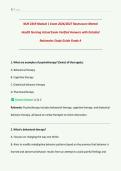
1. What are examples of psychotherapy? (Select all that apply.)

A. Behavioral therapy

B. Cognitive therapy

C. Dialectical behavior therapy

D. Pharmacotherapy

Correct Answer: A, B, C

Rationale: Psychotherapy includes behavioral therapy, cognitive therapy, and dialectical

behavior therapy, all based on verbal therapist-to-client interaction.


2. What is behavioral therapy?

A. Focuses on changing the way one thinks

B. Aims to modify maladaptive behavior patterns based on the premise that behavior is

learned and abnormal behavior results from an attempt to avoid painful feelings and

,2|Page


reduce anxiety

C. Uses both cognitive and behavioral approaches to assist with anxiety management

D. Focuses on family dynamics

Correct Answer: B

Rationale: Behavioral therapy aims to modify maladaptive behavior patterns based on

the understanding that behavior is learned and abnormal behavior results from

attempts to avoid painful feelings and reduce anxiety.


3. What is cognitive therapy?

A. Aims to modify maladaptive behavior patterns

B. Focuses on individual client thoughts and behaviors to solve current problems; based

on changing the way one thinks

C. Uses both cognitive and behavioral approaches

D. Focuses on family dynamics

Correct Answer: B

Rationale: Cognitive therapy focuses on individual client thoughts and behaviors to

solve current problems, based on changing the way one thinks.

,3|Page


4. What is cognitive behavioral therapy (CBT)?

A. Aims to modify maladaptive behavior patterns

B. Focuses on individual client thoughts

C. Uses both cognitive and behavioral approaches to assist a client with anxiety

management

D. Creates an environment that is supportive and therapeutic

Correct Answer: C

Rationale: CBT uses both cognitive and behavioral approaches to assist a client with

anxiety management.


5. What is family therapy?

A. Therapy focused on helping individuals develop more functional reactions within a

group setting

B. Creates an environment that is supportive and therapeutic

C. Therapy based on family dynamics and improving family functioning by learning ways

for dealing with mental illness in the family

D. Focuses on individual client thoughts

Correct Answer: C

, 4|Page


Rationale: Family therapy is based on family dynamics and improving family functioning

by learning ways to deal with mental illness within the family.


6. What is milieu therapy?

A. Therapy based on family dynamics

B. Creates an environment that is supportive, therapeutic, and safe to benefit clients

and promote coping within a safe place

C. Focuses on individual client thoughts

D. Uses both cognitive and behavioral approaches

Correct Answer: B

Rationale: Milieu therapy creates a supportive, therapeutic, and safe environment to

benefit clients and promote coping.


7. What is group therapy?

A. Creates an environment that is supportive and therapeutic

B. Therapy based on family dynamics

C. Therapy focused on helping individuals develop more functional and satisfying

reactions within a group setting with common feelings, experiences, and thoughts that

lead to positive behavior changes from interaction and feedback

Escuela, estudio y materia

Institución
Grado

Información del documento

Subido en
26 de marzo de 2026
Número de páginas
35
Escrito en
2025/2026
Tipo
Examen
Contiene
Preguntas y respuestas

Temas

$12.49
Accede al documento completo:

¿Documento equivocado? Cámbialo gratis Dentro de los 14 días posteriores a la compra y antes de descargarlo, puedes elegir otro documento. Puedes gastar el importe de nuevo.
Escrito por estudiantes que aprobaron
Inmediatamente disponible después del pago
Leer en línea o como PDF

Conoce al vendedor

Seller avatar
Los indicadores de reputación están sujetos a la cantidad de artículos vendidos por una tarifa y las reseñas que ha recibido por esos documentos. Hay tres niveles: Bronce, Plata y Oro. Cuanto mayor reputación, más podrás confiar en la calidad del trabajo del vendedor.
ExamitorMagnus Massachusetts Institute Of Technology
Seguir Necesitas iniciar sesión para seguir a otros usuarios o asignaturas
Vendido
117
Miembro desde
2 año
Número de seguidores
7
Documentos
1756
Última venta
1 semana hace
Top Score

I am a professional writer with knowledge across diverse academic fields. I provide quality work and I guarantee superb, timely and original content. I know the pain of getting a shoddy work, and I would never wish this on any client! I guarantee a topnotch paper, with a fast High-score turnaround. I provide quality work guaranteed to give you an exemplary grade. Furthermore, I am a tutor of Research paper, Dissertation, proposal, management studies, economics, educational studies, sociology and psychology, marketing, Geography, History, Management, English, Literature, Education. Medical studies, Health Care studies and Nursing, Biology, Economics among other subjects.

Lee mas Leer menos
3.5

22 reseñas

5
8
4
3
3
6
2
2
1
3

Por qué los estudiantes eligen Stuvia

Creado por compañeros estudiantes, verificado por reseñas

Calidad en la que puedes confiar: escrito por estudiantes que aprobaron y evaluado por otros que han usado estos resúmenes.

¿No estás satisfecho? Elige otro documento

¡No te preocupes! Puedes elegir directamente otro documento que se ajuste mejor a lo que buscas.

Paga como quieras, empieza a estudiar al instante

Sin suscripción, sin compromisos. Paga como estés acostumbrado con tarjeta de crédito y descarga tu documento PDF inmediatamente.

Student with book image

“Comprado, descargado y aprobado. Así de fácil puede ser.”

Alisha Student

Preguntas frecuentes
