
Gr 9 Natural Science Term 1
Point by Point summaries
Life and Living: Cells as basic units
• Cells
- 1. Membrane
- 2. Cytoplasm
- 3. Nucleus
- 4. Organelles
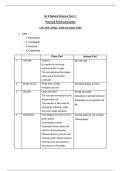
Plant Cell Animal Cell
1 Cell wall Present No cell wall
It consists of non-living
cellulose which is rigid.
The cell wall gives the shape
of the cell and provides
protection
2 Shape of cell Fixed form / shape No fixed shape or form
Inflexible and firm
3 Vacuole Large vacuoles Small vacuoles
The vacuole contributes to the Vacuoles in animal cells are
shape of the cell temporary or not present at
The vacuole is also used as
all
storage for nutrients, water
and even waste products
4 Cholroplast Chloroplasts are only found in Animal cells do not contain
green plants chloroplasts
Chloroplasts contain
chlorophyll which allows the
plant to photosynthesise
Photosynthesis is the process
whereby green plants produce
food (glucose and starch) in
the presence of sunlight
, Cell Function
Stem cells These cells have the ability to divide and develop into
different types of cells
Muscle cells These cells contract and relax to enable movement
Nerve cells Nerve cells transfer electrical impulses in the nerves and
the spinal cord
Red blood cells The red blood cells transport oxygen throughout the body
Epithelial cells Covers the surface of the body and protects it
• Cells
A group of cells that function together for the same purpose – forms tissue
A group of tissues that function together forms an organ
A group of organs that function together forms a system
A group of systems that function together forms an organism
, Life and Living: Systems in the human body
• Digestive tract
- Mouth
- Oesophagus
- Stomach
- Liver
- Pancreas
- Small intestine
- Colon
- Rectum
- Anus
• The mouth consists of:
- Lips and teeth
- Jaws and teeth
- Tongue
- Soft palate
- Salivary glands
• The oesophagus is the tube which connects the throat and the stomach
• Peristalsis is the process of involuntary muscle contractions causing the bolus
to move down the oesophagus
• The stomach:
- Mechanical digestion
- Chemical digestion
• The liver: just below the diaphragm and partly covers the stomach
- Produces bile
- Produces glycogen
- Stores vitamins
- Stores blood and iron
• Gall bladder is attached to the bottom of the liver and stores the bile
• Functions of bile:
- Breaks up fats so that they can be digested more easily
- Promotes peristalsis in the intestines
- It neutralises chyme which comes out of the stomach
, - It is an antiseptic and prevents the intestine from rotting
• Pancreas: tongue-shaped glad located under the stomach
- Secretes pancreatic juice which helps to break down starch, fats and
proteins
- Pancreatic juice neutralises chyme as soon as it enters the intestines
- Secretes the hormones which help control blood sugar levels
• Small intestine is the tube between the stomach and the colon
- Chemical digestion: main part where enzymes are added to food
- Most of the digestion takes place here
- Contains villi to maximise absorption
- Most nutrients are absorbed here
• Functions of the colon:
- Absorb water, bile, salts, mineral sats and vitamins
- Temporary storage of waste products before excretion
- Waste products are excreted through the anus
• Nutrition is the process whereby living organisms consume food and use it for
energy to allow life functions such as growth, movement, reproduction and
recovery to occur
• Nutrition is important for energy, growth, health and recovery
• Important nutrients:
Nutrient Source Function Health risk when
there is a
deficiency
Carbohydrates Bread, pasta, Source of energy so 1.Unhealthy
potatoes, rice, bodily functions can weight loss
milk occur
Fats Butter, cheese, Reserve source of 1.Kidney failure
milk, oil, eggs, energy; insulate the 2.Stunted growth
meat, nuts body against cold
Proteins Meat, fish, Building material for 1.Kwashiorkor
chicken, nuts, growth and repair 2.Low resistance
eggs, beans,

