
Context: Further notes:
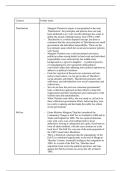
Thatcherism - Margaret Thatcher's impact is encapsulated in the term
'Thatcherism': her principles and policies have not only
been attributed to an '-ism', but this ideology also came to
define the period of British history from 1979 to 1987.
- Thatcherism is a widely disputed concept, but there is
consensus that the core principles of Thatcherism are small
government and individual responsibility. These are the
key elements upon which her social and economic policies
were based.
- Margaret Thatcher was a self-proclaimed conviction
politician whose strong beliefs in hard work and individual
responsibility were motivated by her middle-class
background as a 'grocer's daughter'. - A political practice
of campaigning for one's genuinely-held political
convictions rather than adjusting one's political opinions to
adhere to a political consensus
- From her rejection of the post-war consensus and one-
nation conservatism, we can get an idea of Thatcher's
social attitudes and beliefs. Thatcherism promotes self-
sufficiency and individualism over social cooperation and
collectivism.
- We can see how the post-war consensus governments'
took a collectivist approach in their efforts to keep full
employment and their introduction and continuance of the
welfare state and nationalisation.
- When Thatcher took office, she was ready to cut back on
these collectivist government efforts, believing they were
too costly to upkeep and had made the public too reliant
on the government:
Poll tax - Prime Minister Margaret Thatcher introduced the
Community Charge or Poll Tax in Scotland in 1989 and in
Wales and England in 1990. The tax replaced domestic
rates with a new way of providing funds to local
authorities: levying a compulsory per capita, fixed-rate tax
from all adult residents, with the exact amount set at the
local level. The Poll Tax was one of the main proposals of
the 1987 Conservative Manifesto.
- There is historical consensus that the unpopularity of the
Poll Tax contributed significantly to the end of Margaret
Thatcher’s tenure, eventually leading to her resignation in
1990. As a result of the Poll Tax, Thatcher faced
opposition from across the political spectrum, and riots
against the Poll Tax broke out across the UK in March
1990.
Thatcherism - Margaret Thatcher's impact is encapsulated in the term
'Thatcherism': her principles and policies have not only
been attributed to an '-ism', but this ideology also came to
define the period of British history from 1979 to 1987.
- Thatcherism is a widely disputed concept, but there is
consensus that the core principles of Thatcherism are small
government and individual responsibility. These are the
key elements upon which her social and economic policies
were based.
- Margaret Thatcher was a self-proclaimed conviction
politician whose strong beliefs in hard work and individual
responsibility were motivated by her middle-class
background as a 'grocer's daughter'. - A political practice
of campaigning for one's genuinely-held political
convictions rather than adjusting one's political opinions to
adhere to a political consensus
- From her rejection of the post-war consensus and one-
nation conservatism, we can get an idea of Thatcher's
social attitudes and beliefs. Thatcherism promotes self-
sufficiency and individualism over social cooperation and
collectivism.
- We can see how the post-war consensus governments'
took a collectivist approach in their efforts to keep full
employment and their introduction and continuance of the
welfare state and nationalisation.
- When Thatcher took office, she was ready to cut back on
these collectivist government efforts, believing they were
too costly to upkeep and had made the public too reliant
on the government:
Poll tax - Prime Minister Margaret Thatcher introduced the
Community Charge or Poll Tax in Scotland in 1989 and in
Wales and England in 1990. The tax replaced domestic
rates with a new way of providing funds to local
authorities: levying a compulsory per capita, fixed-rate tax
from all adult residents, with the exact amount set at the
local level. The Poll Tax was one of the main proposals of
the 1987 Conservative Manifesto.
- There is historical consensus that the unpopularity of the
Poll Tax contributed significantly to the end of Margaret
Thatcher’s tenure, eventually leading to her resignation in
1990. As a result of the Poll Tax, Thatcher faced
opposition from across the political spectrum, and riots
against the Poll Tax broke out across the UK in March
1990.

