

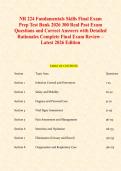
NR 224 Fundamentals Skills Final Exam
Prep Test Bank 2026 300 Real Past Exam
Questions and Correct Answers with Detailed
Rationales Complete Final Exam Review –
Latest 2026 Edition
TABLE OF CONTENTS
Section Topic Area Questions
Section 1 Infection Control and Prevention 1-25
Section 2 Safety and Mobility 26-50
Section 3 Hygiene and Personal Care 51-70
Section 4 Vital Signs Assessment 71-95
Section 5 Pain Assessment and Management 96-115
Section 6 Nutrition and Hydration 116-135
Section 7 Elimination (Urinary and Bowel) 136-155
Section 8 Oxygenation and Respiratory Care 156-175
,Section Topic Area Questions
Section 9 Wound Care and Pressure Injuries 176-195
Section 10 Fluid, Electrolyte, and Acid-Base Balance 196-215
Section 11 Medication Administration 216-235
Section 12 Perioperative Nursing 236-250
Section 13 Nursing Process and Documentation 251-265
Section 14 Communication and Client Education 266-280
Section 15 Legal and Ethical Issues 281-295
Section 16 End-of-Life Care 296-300
SECTION 1: INFECTION CONTROL AND PREVENTION
QUESTION 1
A nurse is preparing to perform hand hygiene before caring for a client.
Which of the following actions indicates proper hand hygiene technique?
A. Using hot water to open pores
B. Holding fingertips downward during washing
C. Keeping hands lower than elbows
D. Using friction for at least 20 seconds
Answer: D. Using friction for at least 20 seconds
,Rationale: Proper hand hygiene requires using friction on all surfaces
of the hands for at least 20 seconds. Hands should be held below the
elbows to allow water to flow from cleanest area (forearms) to least
clean (hands). Water temperature should be warm, not hot, to prevent
skin damage. Fingertips should be pointed downward to prevent
water from flowing onto forearms.
QUESTION 2
A nurse is caring for a client with a methicillin-resistant Staphylococcus
aureus (MRSA) infection. Which type of precautions should the nurse
implement?
A. Contact precautions
B. Droplet precautions
C. Airborne precautions
D. Protective precautions
Answer: A. Contact precautions
Rationale: MRSA is transmitted through direct contact with the
infected wound or contaminated items. Contact precautions require a
private room, gloves and gown for all contact with the patient or
environment, and dedicated or disposable patient care equipment.
QUESTION 3
The nurse is teaching a client about the chain of infection. Which link in the
chain describes the organism that causes the infection?
A. Reservoir
B. Portal of exit
C. Infectious agent
D. Portal of entry
, Answer: C. Infectious agent
Rationale: The infectious agent is the pathogen (bacteria, virus,
fungus, parasite) that causes the infection. The reservoir is where the
organism lives and multiplies. Portal of exit is how it leaves the
reservoir. Portal of entry is how it enters a new host.
QUESTION 4
A nurse is donning personal protective equipment (PPE) to care for a client
on contact precautions. Which sequence should the nurse follow?
A. Gown, mask, gloves, eyewear
B. Mask, gown, eyewear, gloves
C. Gown, mask, eyewear, gloves
D. Gloves, gown, mask, eyewear
Answer: C. Gown, mask, eyewear, gloves
Rationale: The correct order for donning PPE is: gown, then mask or
respirator, then eyewear, then gloves. This sequence ensures that all
items are properly secured and that gloves cover the gown cuffs.
Removing PPE follows a different sequence to prevent contamination.
QUESTION 5
A nurse is removing PPE after caring for a client on contact precautions.
Which item should be removed first?
A. Gloves
B. Gown
C. Mask
D. Eyewear
Answer: A. Gloves
Prep Test Bank 2026 300 Real Past Exam
Questions and Correct Answers with Detailed
Rationales Complete Final Exam Review –
Latest 2026 Edition
TABLE OF CONTENTS
Section Topic Area Questions
Section 1 Infection Control and Prevention 1-25
Section 2 Safety and Mobility 26-50
Section 3 Hygiene and Personal Care 51-70
Section 4 Vital Signs Assessment 71-95
Section 5 Pain Assessment and Management 96-115
Section 6 Nutrition and Hydration 116-135
Section 7 Elimination (Urinary and Bowel) 136-155
Section 8 Oxygenation and Respiratory Care 156-175
,Section Topic Area Questions
Section 9 Wound Care and Pressure Injuries 176-195
Section 10 Fluid, Electrolyte, and Acid-Base Balance 196-215
Section 11 Medication Administration 216-235
Section 12 Perioperative Nursing 236-250
Section 13 Nursing Process and Documentation 251-265
Section 14 Communication and Client Education 266-280
Section 15 Legal and Ethical Issues 281-295
Section 16 End-of-Life Care 296-300
SECTION 1: INFECTION CONTROL AND PREVENTION
QUESTION 1
A nurse is preparing to perform hand hygiene before caring for a client.
Which of the following actions indicates proper hand hygiene technique?
A. Using hot water to open pores
B. Holding fingertips downward during washing
C. Keeping hands lower than elbows
D. Using friction for at least 20 seconds
Answer: D. Using friction for at least 20 seconds
,Rationale: Proper hand hygiene requires using friction on all surfaces
of the hands for at least 20 seconds. Hands should be held below the
elbows to allow water to flow from cleanest area (forearms) to least
clean (hands). Water temperature should be warm, not hot, to prevent
skin damage. Fingertips should be pointed downward to prevent
water from flowing onto forearms.
QUESTION 2
A nurse is caring for a client with a methicillin-resistant Staphylococcus
aureus (MRSA) infection. Which type of precautions should the nurse
implement?
A. Contact precautions
B. Droplet precautions
C. Airborne precautions
D. Protective precautions
Answer: A. Contact precautions
Rationale: MRSA is transmitted through direct contact with the
infected wound or contaminated items. Contact precautions require a
private room, gloves and gown for all contact with the patient or
environment, and dedicated or disposable patient care equipment.
QUESTION 3
The nurse is teaching a client about the chain of infection. Which link in the
chain describes the organism that causes the infection?
A. Reservoir
B. Portal of exit
C. Infectious agent
D. Portal of entry
, Answer: C. Infectious agent
Rationale: The infectious agent is the pathogen (bacteria, virus,
fungus, parasite) that causes the infection. The reservoir is where the
organism lives and multiplies. Portal of exit is how it leaves the
reservoir. Portal of entry is how it enters a new host.
QUESTION 4
A nurse is donning personal protective equipment (PPE) to care for a client
on contact precautions. Which sequence should the nurse follow?
A. Gown, mask, gloves, eyewear
B. Mask, gown, eyewear, gloves
C. Gown, mask, eyewear, gloves
D. Gloves, gown, mask, eyewear
Answer: C. Gown, mask, eyewear, gloves
Rationale: The correct order for donning PPE is: gown, then mask or
respirator, then eyewear, then gloves. This sequence ensures that all
items are properly secured and that gloves cover the gown cuffs.
Removing PPE follows a different sequence to prevent contamination.
QUESTION 5
A nurse is removing PPE after caring for a client on contact precautions.
Which item should be removed first?
A. Gloves
B. Gown
C. Mask
D. Eyewear
Answer: A. Gloves

