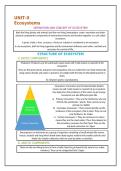
UNIT-II
Ecosystems
DEFINATION AND CONCEPT OF ECOSYSTEM
Both the living (plants and animals) and the non-living (atmosphere, water, mountains and other
physical components) components of environment interact and function together as a unit called
ecosystem.
A pond, a lake, a river, an ocean, a forest or a desert is considered as an ecosystem.
In any ecosystem, both he living organisms and its environment influence each other, and both are
necessary for survival of life.
STRUCTURE OF ECOSYSTEM
1) BIOTIC COMPONENTS
Producers: Producers are the autotrophs (auto means self, troph means to nourish) of the
ecosystem.
They are the green plants and green microorganisms who can make their own food material by
using carbon dioxide and water in presence of sunlight with the help of chlorophyll present in
them.
Ex: All green plants, Cyanobacteria.
Ter Consumers: Consumers are the heterotrophs (hetero
tiar means not self, troph means to nourish) of an ecosystem.
y Hey depend on the producers of the nature to get energy.
Co Consumers are also different types like
ns
um a) Primary Consumers = They are the herbivores who eat
ers directly the autotrophs / plants. They cannot eat any
animals. Ex. Rabbit
Secondary b) Secondary Consumers = They cannot directly eat the
Consumers
producers of the ecosystem, that is plant. They can eat
only herbivore. Ex. Snake
c) Tertiary Consumers = They are carnivores in nature
means they are the meat eaters. Thus, they depend on
Primary Consumers the secondary consumer for their food. They are the
top-level carnivores. Ex. Tigers
Decomposers or detrivores are a group of organisms consisting of small animals like worms,
insects, bacteria and fungi which break down dead organic material into smaller particles and
finally into simpler substances that are used by plants as nutrition.
2) ABIOTIC COMPONENTS
These are the non-living factors in form of solid, liquid or gas found in the nature (ice, water,
moisture). They can be categorized into 2 types
, a) Climate Factors which include the climate regime and physical factors of the environment
like Light, Temperature, Humidity, Rain, etc.
b) Edaphic Factors which are related to the structure and composition of soil including its
physical and chemical properties like Soil, Organic and Inorganic components of the soil,
Substratum, etc.
c) Inorganic substances like water, carbon, sulphur, nitrogen, phosphorus and so on.
d) Organic substances like proteins, lipids, carbohydrates, humic substances, etc.
FUNCTIONS OF ECOSYSTEM
We observe a cyclical functioning of an ecosystem as we see various elements get circulated
in the environment. Elements like oxygen, hydrogen and carbon dioxide are moving in and
out of organisms and constitute nutrient cycle.
Food chain is another aspect of functioning ecosystem.
ENERGY FOR THE LIFE BEGINS FROM THE SUN
Solar energy enters the plants and is transformed into usable energy (by photosynthesis) for
plant’s growth and is stored form in plants. The plant are producers.
When the plants are eaten by primary consumers that are called herbivore, the energy
stored in the plants enters their body.
When the herbivore are eaten by carnivore (animals), energy gets transformed into the
body. These carnivore use energy for work and growth; some of the energy is lost through
respiration.
The transfer process continues along the entire food chain.
FOOD CHAIN
A series of organisms in which each creature eats the one below it in the series and becomes
a source of food for the organisms above it.
FOOD WEB
Through Food Web are very complex in nature.
It plays a significant role in the balance and
stability of an Ecosystem. If deer will be
eliminated from the nature, then number of
grasses will increase, and it will invade to the
croplands. In turn are of the croplands will be
reduced resulting related products. Similarly,
the upper trophic level animals like tigers will
not get their food and will die ultimately.
BIOGEOCHEMICAL PROCESSES
Besides energy flows, the other important functional
attribute of an ecosystem is nutrient cycling.
Ecosystems
DEFINATION AND CONCEPT OF ECOSYSTEM
Both the living (plants and animals) and the non-living (atmosphere, water, mountains and other
physical components) components of environment interact and function together as a unit called
ecosystem.
A pond, a lake, a river, an ocean, a forest or a desert is considered as an ecosystem.
In any ecosystem, both he living organisms and its environment influence each other, and both are
necessary for survival of life.
STRUCTURE OF ECOSYSTEM
1) BIOTIC COMPONENTS
Producers: Producers are the autotrophs (auto means self, troph means to nourish) of the
ecosystem.
They are the green plants and green microorganisms who can make their own food material by
using carbon dioxide and water in presence of sunlight with the help of chlorophyll present in
them.
Ex: All green plants, Cyanobacteria.
Ter Consumers: Consumers are the heterotrophs (hetero
tiar means not self, troph means to nourish) of an ecosystem.
y Hey depend on the producers of the nature to get energy.
Co Consumers are also different types like
ns
um a) Primary Consumers = They are the herbivores who eat
ers directly the autotrophs / plants. They cannot eat any
animals. Ex. Rabbit
Secondary b) Secondary Consumers = They cannot directly eat the
Consumers
producers of the ecosystem, that is plant. They can eat
only herbivore. Ex. Snake
c) Tertiary Consumers = They are carnivores in nature
means they are the meat eaters. Thus, they depend on
Primary Consumers the secondary consumer for their food. They are the
top-level carnivores. Ex. Tigers
Decomposers or detrivores are a group of organisms consisting of small animals like worms,
insects, bacteria and fungi which break down dead organic material into smaller particles and
finally into simpler substances that are used by plants as nutrition.
2) ABIOTIC COMPONENTS
These are the non-living factors in form of solid, liquid or gas found in the nature (ice, water,
moisture). They can be categorized into 2 types
, a) Climate Factors which include the climate regime and physical factors of the environment
like Light, Temperature, Humidity, Rain, etc.
b) Edaphic Factors which are related to the structure and composition of soil including its
physical and chemical properties like Soil, Organic and Inorganic components of the soil,
Substratum, etc.
c) Inorganic substances like water, carbon, sulphur, nitrogen, phosphorus and so on.
d) Organic substances like proteins, lipids, carbohydrates, humic substances, etc.
FUNCTIONS OF ECOSYSTEM
We observe a cyclical functioning of an ecosystem as we see various elements get circulated
in the environment. Elements like oxygen, hydrogen and carbon dioxide are moving in and
out of organisms and constitute nutrient cycle.
Food chain is another aspect of functioning ecosystem.
ENERGY FOR THE LIFE BEGINS FROM THE SUN
Solar energy enters the plants and is transformed into usable energy (by photosynthesis) for
plant’s growth and is stored form in plants. The plant are producers.
When the plants are eaten by primary consumers that are called herbivore, the energy
stored in the plants enters their body.
When the herbivore are eaten by carnivore (animals), energy gets transformed into the
body. These carnivore use energy for work and growth; some of the energy is lost through
respiration.
The transfer process continues along the entire food chain.
FOOD CHAIN
A series of organisms in which each creature eats the one below it in the series and becomes
a source of food for the organisms above it.
FOOD WEB
Through Food Web are very complex in nature.
It plays a significant role in the balance and
stability of an Ecosystem. If deer will be
eliminated from the nature, then number of
grasses will increase, and it will invade to the
croplands. In turn are of the croplands will be
reduced resulting related products. Similarly,
the upper trophic level animals like tigers will
not get their food and will die ultimately.
BIOGEOCHEMICAL PROCESSES
Besides energy flows, the other important functional
attribute of an ecosystem is nutrient cycling.