

Grade 9 Study Guide: The French Revolution
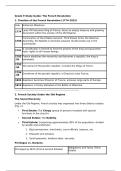
1. Timeline of the French Revolution (1774–1815)
Year Historical Milestone
Louis XVI becomes King of France; faces an empty treasury and growing
1774
discontent within the society of the Old Regime.
Convocation of the Estates General; Third Estate forms the National
1789 Assembly; the Bastille is stormed; peasant revolts break out in the
countryside.
A constitution is framed to limit the powers of the king and guarantee
1791
basic rights to all human beings.
1792 France abolishes the monarchy and becomes a republic; the king is
–93 beheaded.
1793
The period of the Jacobin republic; includes the Reign of Terror.
–94
1794
Overthrow of the Jacobin republic; a Directory rules France.
–99
1804 Napoleon becomes Emperor of France; annexes large parts of Europe.
1815 Napoleon is finally defeated at the Battle of Waterloo.
--------------------------------------------------------------------------------
2. French Society Under the Old Regime
The Social Hierarchy
Under the Old Regime, French society was organized into three distinct estates
(Fig. 2):
First Estate: The Clergy (group of persons invested with special
functions in the church).
Second Estate: The Nobility.
Third Estate: Comprising approximately 90% of the population, divided
by wealth and profession:
1. Big businessmen, merchants, court officials, lawyers, etc.
2. Peasants and artisans.
3. Small peasants, landless labor, servants.
Privileges vs. Burdens
Obligations and Taxes (Third
Privileges by Birth (First & Second Estates)
Estate)
, Tithes: A tax levied by the
Tax Exemption: Clergy and Nobility were
church, comprising one-tenth of
exempt from paying taxes to the state.
the agricultural produce.
Feudal Privileges: Nobles extracted feudal Taille: A direct tax paid by the
dues from the peasants. Third Estate to the state.
Feudal Services: Peasants were obliged to Indirect Taxes: Levied on
work in the lord's house and fields, serve in articles of everyday consumption
the army, or participate in road building. like salt or tobacco.
The Struggle for Survival: The Subsistence Crisis
A "subsistence crisis" refers to an extreme situation where basic means of
livelihood are endangered.
Population Growth: The population rose from 23 million in 1715 to 28
million in 1789, creating rapid demand for foodgrains.
Production Lag: Grain production could not keep pace with demand,
causing bread prices (the staple diet) to rise rapidly.
The Wage Gap: Laborers’ wages were fixed by owners and did not keep
pace with rising prices, widening the gap between the rich and the poor.
The Final Blow: Drought or hail frequently reduced the harvest, leading
to scarcity of grain, rising food prices, food riots, weaker bodies,
and an increased number of deaths.
--------------------------------------------------------------------------------
3. The Intellectual Catalyst: Role of Philosophers
The Revolution was fueled by the ideas of the Enlightenment, which challenged
the system of birth-based privileges.
John Locke: In his work Two Treatises of Government, he sought to
refute the doctrine of the divine and absolute right of the monarch.
Jean Jacques Rousseau: In The Social Contract, he proposed a form of
government based on a social contract between people and their
representatives.
Montesquieu: In The Spirit of the Laws, he proposed a division of
power within the government between the legislative, the executive, and
the judiciary. This model was famously put into force in the USA after its
independence.
--------------------------------------------------------------------------------
4. The Outbreak of Revolution (1789)
1. The Estates General: On 5 May 1789, Louis XVI called a meeting to pass
new taxes. The Third Estate demanded that each member have one vote
(as proposed by Rousseau), rather than the traditional "one estate, one
vote."
1. Timeline of the French Revolution (1774–1815)
Year Historical Milestone
Louis XVI becomes King of France; faces an empty treasury and growing
1774
discontent within the society of the Old Regime.
Convocation of the Estates General; Third Estate forms the National
1789 Assembly; the Bastille is stormed; peasant revolts break out in the
countryside.
A constitution is framed to limit the powers of the king and guarantee
1791
basic rights to all human beings.
1792 France abolishes the monarchy and becomes a republic; the king is
–93 beheaded.
1793
The period of the Jacobin republic; includes the Reign of Terror.
–94
1794
Overthrow of the Jacobin republic; a Directory rules France.
–99
1804 Napoleon becomes Emperor of France; annexes large parts of Europe.
1815 Napoleon is finally defeated at the Battle of Waterloo.
--------------------------------------------------------------------------------
2. French Society Under the Old Regime
The Social Hierarchy
Under the Old Regime, French society was organized into three distinct estates
(Fig. 2):
First Estate: The Clergy (group of persons invested with special
functions in the church).
Second Estate: The Nobility.
Third Estate: Comprising approximately 90% of the population, divided
by wealth and profession:
1. Big businessmen, merchants, court officials, lawyers, etc.
2. Peasants and artisans.
3. Small peasants, landless labor, servants.
Privileges vs. Burdens
Obligations and Taxes (Third
Privileges by Birth (First & Second Estates)
Estate)
, Tithes: A tax levied by the
Tax Exemption: Clergy and Nobility were
church, comprising one-tenth of
exempt from paying taxes to the state.
the agricultural produce.
Feudal Privileges: Nobles extracted feudal Taille: A direct tax paid by the
dues from the peasants. Third Estate to the state.
Feudal Services: Peasants were obliged to Indirect Taxes: Levied on
work in the lord's house and fields, serve in articles of everyday consumption
the army, or participate in road building. like salt or tobacco.
The Struggle for Survival: The Subsistence Crisis
A "subsistence crisis" refers to an extreme situation where basic means of
livelihood are endangered.
Population Growth: The population rose from 23 million in 1715 to 28
million in 1789, creating rapid demand for foodgrains.
Production Lag: Grain production could not keep pace with demand,
causing bread prices (the staple diet) to rise rapidly.
The Wage Gap: Laborers’ wages were fixed by owners and did not keep
pace with rising prices, widening the gap between the rich and the poor.
The Final Blow: Drought or hail frequently reduced the harvest, leading
to scarcity of grain, rising food prices, food riots, weaker bodies,
and an increased number of deaths.
--------------------------------------------------------------------------------
3. The Intellectual Catalyst: Role of Philosophers
The Revolution was fueled by the ideas of the Enlightenment, which challenged
the system of birth-based privileges.
John Locke: In his work Two Treatises of Government, he sought to
refute the doctrine of the divine and absolute right of the monarch.
Jean Jacques Rousseau: In The Social Contract, he proposed a form of
government based on a social contract between people and their
representatives.
Montesquieu: In The Spirit of the Laws, he proposed a division of
power within the government between the legislative, the executive, and
the judiciary. This model was famously put into force in the USA after its
independence.
--------------------------------------------------------------------------------
4. The Outbreak of Revolution (1789)
1. The Estates General: On 5 May 1789, Louis XVI called a meeting to pass
new taxes. The Third Estate demanded that each member have one vote
(as proposed by Rousseau), rather than the traditional "one estate, one
vote."

