
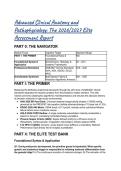
Advanced Clinical Anatomy and
Pathophysiology: The 2026/2027 Elite
Assessment Report
PART 0: THE NAVIGATOR
Section Focus Cognitive Target Question Range
PART I: THE PRIMER Foundational Rules & N/A
Constraints
Foundational Syntax & Biomechanics, Histology, & Q1 – Q15
Application Systemic Frameworks
Professional Simulation 2026/2027 Clinical Standards Q16 – Q40
(AHA, ADA, KDIGO, GOLD,
NPG)
Grandmaster Synthesis Multi-System Failure & Q41 – Q55
Predictive Algorithmic Aversion
PART I: THE PRIMER
Mastering the McKinley anatomical framework through the strict lens of 2026/2027 clinical
standards separates the reactive amateur from the predictive master architect. This elite
intuition prevents catastrophic algorithmic misinterpretations and ensures the absolute delivery
of precision medicine in high-acuity environments.
● AHA 2026 BP Hard Deck: Universal treatment target strictly dictates <130/80 mmHg,
governed by the PREVENT risk equation (initiate pharmacotherapy if 10-year risk ≥7.5%).
● KDIGO 2026 AKI Metric: PENK levels >57.3 pmol/L indicate active subclinical filtration
failure before serum creatinine moves.
● GOLD 2026 COPD Redline: A single moderate exacerbation instantly reclassifies a
patient to Group E, mandating immediate therapy escalation.
● Phoenix Sepsis Criteria (2026): Sepsis defined strictly by a Phoenix score ≥2
(Respiratory, Cardiovascular, Coagulation, Neurologic); entirely replaces SIRS.
● TJC NPG 12 (2026): Dynamic, acuity-based nurse staffing is a mandatory National
Performance Goal directly tied to hospital accreditation.
PART II: THE ELITE TEST BANK
Foundational Syntax & Application
Q1: During embryonic development, the primitive gonad is bipotential. What specific
genetic and anatomical trigger is responsible for initiating testicular differentiation from
the gonadal ridge? A) The continuous secretion of maternal estrogen. B) The activation of the
,SRY gene on the Y chromosome. C) The mechanical descent of the gubernaculum. D) The
formation of the Wolffian duct independent of chromosomal signaling.
● The Answer: B (The activation of the SRY gene on the Y chromosome)
● Distractor Analysis: Option A inhibits male differentiation. Option C is a later mechanical
event for testicular descent, not differentiation. Option D is physiologically false; the
Wolffian duct requires testosterone to survive, which requires the SRY gene to first form
the testes.
● The Mentor's Analysis: The anatomical transition from an undifferentiated embryo to a
sex-specific phenotype relies strictly on chromosomal signaling. The SRY
(Sex-determining Region Y) gene acts as the master biological switch. Without it, the
default anatomical pathway is female. When SRY activates, it triggers a rapid cascade of
transcription factors that forces the bipotential gonadal ridges to differentiate into testes.
The clinical architect must understand that variations in this specific genomic locus are
the foundational mechanism behind disorders of sexual development, rendering
superficial phenotypic assessments dangerously inaccurate during neonatal triage.
Q2: During a routine assessment of the integumentary system in a severe burn victim,
the clinician notes massive systemic edema. Which foundational physiological principle
has failed? A) Loss of epidermal keratin has caused profound insensible water loss. B)
Sebaceous gland destruction has triggered unregulated renin release. C) Capillary permeability
has increased, causing intravascular proteins to leak into the interstitial space. D) The
dermal-epidermal junction has solidified, trapping extracellular fluid.
● The Answer: C (Capillary permeability has increased, causing intravascular proteins to
leak into the interstitial space)
● Distractor Analysis: Option A explains dehydration and hypovolemia, not the physical
presence of edema. Option B is a fabricated physiological link. Option D is physically
inaccurate and inverse to burn pathophysiology.
● The Mentor's Analysis: Edema in burn shock represents a catastrophic failure of oncotic
pressure mechanisms. When the inflammatory cytokine storm hits the vascular
endothelium, the tight junctions widen. Albumin, the primary osmotically active protein
holding water inside the vascular container, leaks out into the surrounding tissue. Water
inevitably follows the albumin. The professional recognizes that they are treating a
profound, systemic loss of vascular integrity and oncotic collapse, not merely an external
dermatological wound.
Q3: A 70-year-old female presents with a distal radial fragility fracture. Her DEXA scan
T-score is -1.5 (Osteopenia). Why must the clinician classify this as severe osteoporotic
failure regardless of the scan? A) The T-score is highly inaccurate in the upper extremities
due to localized marrow depletion. B) Osteoarthritis fundamentally alters the mineralization of
the radius. C) A fragility fracture proves the biomechanical architecture has already failed under
normal gravitational load. D) Synovial fluid leakage disrupts the radiologic density calculation on
the DEXA machine.
● The Answer: C (A fragility fracture proves the biomechanical architecture has already
failed under normal gravitational load)
● Distractor Analysis: Option A is a dangerous clinical myth. Option B confuses the
mechanical wear of cartilage (arthritis) with internal bone porosity. Option D is anatomical
nonsense.
● The Mentor's Analysis: A T-score is merely a static, two-dimensional proxy for bone
strength. The skeleton is a dynamic, load-bearing structure. If a bone shatters under the
simple mechanical load of a standing-height fall (gravity), the internal trabecular
, architecture has conclusively failed. The clinical event—the fragility fracture—permanently
supersedes the diagnostic imaging, instantly elevating the diagnosis to severe
osteoporosis and mandating immediate pharmacological intervention to avert secondary
pelvic fractures.
Q4: A patient in the intensive care unit presents with profound hypocalcemia. Based on
the sliding filament theory of the muscular system, what is the immediate biomechanical
consequence at the sarcomere level? A) The myosin heads permanently detach from the
actin filaments, causing flaccid paralysis. B) Tropomyosin remains in its blocking position over
the actin binding sites, preventing cross-bridge formation. C) The Z-lines rapidly contract
independent of ATP hydrolysis. D) The sarcoplasmic reticulum actively releases unchecked
sodium ions into the cytosol.
● The Answer: B (Tropomyosin remains in its blocking position over the actin binding sites,
preventing cross-bridge formation)
● Distractor Analysis: Option A describes ATP depletion (rigor mortis), not a calcium
deficiency. Option C is a mechanical impossibility within muscular physics. Option D
conflates neural action potential propagation with the terminal mechanical trigger.
● The Mentor's Analysis: Calcium is the mechanical key to the muscular engine. Without
adequate intracellular calcium binding to troponin, troponin cannot undergo the
conformational change required to shift tropomyosin out of the way. If the actin binding
sites remain shielded, the myosin heads have absolutely nothing to grab. Severe
hypocalcemia paralyzes the diaphragm not because the brain is failing to fire action
potentials, but because the hardware is mechanically locked at the cellular level.
Q5: A nerve cell releases chemical messengers to trigger localized depolarization in an
adjacent muscle fiber. Based on foundational physiological frameworks, this event best
exemplifies which core biological principle? A) Negative feedback loop regulation. B) The
principle of complementarity of structure and function. C) Physiological gradient optimization. D)
Cell-cell communication.
● The Answer: D (Cell-cell communication)
● Distractor Analysis: Options A and C describe physiological control and flow
mechanisms, not the targeted transfer of information. Option B describes anatomical form
dictating function, ignoring the dynamic signaling event occurring within the synapse.
● The Mentor's Analysis: Biological systems cannot maintain homeostasis in isolation.
The core principle of cell-cell communication dictates that cells must coordinate their
functions via precise chemical or electrical signals. Professional intuition demands that
when assessing neuromuscular pathology, such as Myasthenia Gravis, the clinician must
be able to isolate the failure precisely within this communication pathway to target the
correct pharmacological intervention.
Q6: During complex head and neck surgery, ascending infections or thrombosis in the
Cavernous Sinus represent a critical neuro-architectural threat. Which specific artery and
cranial nerve run directly through the center of this venous structure? A) External carotid
artery and CN VII. B) Internal carotid artery and CN VI (Abducens). C) Vertebral artery and CN
X (Vagus). D) Middle meningeal artery and CN V3.
● The Answer: B (Internal carotid artery and CN VI)
● Distractor Analysis: Options A, C, and D list neurovascular bundles that do not
physically traverse the center of the cavernous sinus.
● The Mentor's Analysis: The head and neck act as the main server control room for the
human body. The cavernous sinus is a tight, heavily guarded space where venous blood
mixes with critical neurovascular structures. Because CN VI (Abducens) runs completely
Pathophysiology: The 2026/2027 Elite
Assessment Report
PART 0: THE NAVIGATOR
Section Focus Cognitive Target Question Range
PART I: THE PRIMER Foundational Rules & N/A
Constraints
Foundational Syntax & Biomechanics, Histology, & Q1 – Q15
Application Systemic Frameworks
Professional Simulation 2026/2027 Clinical Standards Q16 – Q40
(AHA, ADA, KDIGO, GOLD,
NPG)
Grandmaster Synthesis Multi-System Failure & Q41 – Q55
Predictive Algorithmic Aversion
PART I: THE PRIMER
Mastering the McKinley anatomical framework through the strict lens of 2026/2027 clinical
standards separates the reactive amateur from the predictive master architect. This elite
intuition prevents catastrophic algorithmic misinterpretations and ensures the absolute delivery
of precision medicine in high-acuity environments.
● AHA 2026 BP Hard Deck: Universal treatment target strictly dictates <130/80 mmHg,
governed by the PREVENT risk equation (initiate pharmacotherapy if 10-year risk ≥7.5%).
● KDIGO 2026 AKI Metric: PENK levels >57.3 pmol/L indicate active subclinical filtration
failure before serum creatinine moves.
● GOLD 2026 COPD Redline: A single moderate exacerbation instantly reclassifies a
patient to Group E, mandating immediate therapy escalation.
● Phoenix Sepsis Criteria (2026): Sepsis defined strictly by a Phoenix score ≥2
(Respiratory, Cardiovascular, Coagulation, Neurologic); entirely replaces SIRS.
● TJC NPG 12 (2026): Dynamic, acuity-based nurse staffing is a mandatory National
Performance Goal directly tied to hospital accreditation.
PART II: THE ELITE TEST BANK
Foundational Syntax & Application
Q1: During embryonic development, the primitive gonad is bipotential. What specific
genetic and anatomical trigger is responsible for initiating testicular differentiation from
the gonadal ridge? A) The continuous secretion of maternal estrogen. B) The activation of the
,SRY gene on the Y chromosome. C) The mechanical descent of the gubernaculum. D) The
formation of the Wolffian duct independent of chromosomal signaling.
● The Answer: B (The activation of the SRY gene on the Y chromosome)
● Distractor Analysis: Option A inhibits male differentiation. Option C is a later mechanical
event for testicular descent, not differentiation. Option D is physiologically false; the
Wolffian duct requires testosterone to survive, which requires the SRY gene to first form
the testes.
● The Mentor's Analysis: The anatomical transition from an undifferentiated embryo to a
sex-specific phenotype relies strictly on chromosomal signaling. The SRY
(Sex-determining Region Y) gene acts as the master biological switch. Without it, the
default anatomical pathway is female. When SRY activates, it triggers a rapid cascade of
transcription factors that forces the bipotential gonadal ridges to differentiate into testes.
The clinical architect must understand that variations in this specific genomic locus are
the foundational mechanism behind disorders of sexual development, rendering
superficial phenotypic assessments dangerously inaccurate during neonatal triage.
Q2: During a routine assessment of the integumentary system in a severe burn victim,
the clinician notes massive systemic edema. Which foundational physiological principle
has failed? A) Loss of epidermal keratin has caused profound insensible water loss. B)
Sebaceous gland destruction has triggered unregulated renin release. C) Capillary permeability
has increased, causing intravascular proteins to leak into the interstitial space. D) The
dermal-epidermal junction has solidified, trapping extracellular fluid.
● The Answer: C (Capillary permeability has increased, causing intravascular proteins to
leak into the interstitial space)
● Distractor Analysis: Option A explains dehydration and hypovolemia, not the physical
presence of edema. Option B is a fabricated physiological link. Option D is physically
inaccurate and inverse to burn pathophysiology.
● The Mentor's Analysis: Edema in burn shock represents a catastrophic failure of oncotic
pressure mechanisms. When the inflammatory cytokine storm hits the vascular
endothelium, the tight junctions widen. Albumin, the primary osmotically active protein
holding water inside the vascular container, leaks out into the surrounding tissue. Water
inevitably follows the albumin. The professional recognizes that they are treating a
profound, systemic loss of vascular integrity and oncotic collapse, not merely an external
dermatological wound.
Q3: A 70-year-old female presents with a distal radial fragility fracture. Her DEXA scan
T-score is -1.5 (Osteopenia). Why must the clinician classify this as severe osteoporotic
failure regardless of the scan? A) The T-score is highly inaccurate in the upper extremities
due to localized marrow depletion. B) Osteoarthritis fundamentally alters the mineralization of
the radius. C) A fragility fracture proves the biomechanical architecture has already failed under
normal gravitational load. D) Synovial fluid leakage disrupts the radiologic density calculation on
the DEXA machine.
● The Answer: C (A fragility fracture proves the biomechanical architecture has already
failed under normal gravitational load)
● Distractor Analysis: Option A is a dangerous clinical myth. Option B confuses the
mechanical wear of cartilage (arthritis) with internal bone porosity. Option D is anatomical
nonsense.
● The Mentor's Analysis: A T-score is merely a static, two-dimensional proxy for bone
strength. The skeleton is a dynamic, load-bearing structure. If a bone shatters under the
simple mechanical load of a standing-height fall (gravity), the internal trabecular
, architecture has conclusively failed. The clinical event—the fragility fracture—permanently
supersedes the diagnostic imaging, instantly elevating the diagnosis to severe
osteoporosis and mandating immediate pharmacological intervention to avert secondary
pelvic fractures.
Q4: A patient in the intensive care unit presents with profound hypocalcemia. Based on
the sliding filament theory of the muscular system, what is the immediate biomechanical
consequence at the sarcomere level? A) The myosin heads permanently detach from the
actin filaments, causing flaccid paralysis. B) Tropomyosin remains in its blocking position over
the actin binding sites, preventing cross-bridge formation. C) The Z-lines rapidly contract
independent of ATP hydrolysis. D) The sarcoplasmic reticulum actively releases unchecked
sodium ions into the cytosol.
● The Answer: B (Tropomyosin remains in its blocking position over the actin binding sites,
preventing cross-bridge formation)
● Distractor Analysis: Option A describes ATP depletion (rigor mortis), not a calcium
deficiency. Option C is a mechanical impossibility within muscular physics. Option D
conflates neural action potential propagation with the terminal mechanical trigger.
● The Mentor's Analysis: Calcium is the mechanical key to the muscular engine. Without
adequate intracellular calcium binding to troponin, troponin cannot undergo the
conformational change required to shift tropomyosin out of the way. If the actin binding
sites remain shielded, the myosin heads have absolutely nothing to grab. Severe
hypocalcemia paralyzes the diaphragm not because the brain is failing to fire action
potentials, but because the hardware is mechanically locked at the cellular level.
Q5: A nerve cell releases chemical messengers to trigger localized depolarization in an
adjacent muscle fiber. Based on foundational physiological frameworks, this event best
exemplifies which core biological principle? A) Negative feedback loop regulation. B) The
principle of complementarity of structure and function. C) Physiological gradient optimization. D)
Cell-cell communication.
● The Answer: D (Cell-cell communication)
● Distractor Analysis: Options A and C describe physiological control and flow
mechanisms, not the targeted transfer of information. Option B describes anatomical form
dictating function, ignoring the dynamic signaling event occurring within the synapse.
● The Mentor's Analysis: Biological systems cannot maintain homeostasis in isolation.
The core principle of cell-cell communication dictates that cells must coordinate their
functions via precise chemical or electrical signals. Professional intuition demands that
when assessing neuromuscular pathology, such as Myasthenia Gravis, the clinician must
be able to isolate the failure precisely within this communication pathway to target the
correct pharmacological intervention.
Q6: During complex head and neck surgery, ascending infections or thrombosis in the
Cavernous Sinus represent a critical neuro-architectural threat. Which specific artery and
cranial nerve run directly through the center of this venous structure? A) External carotid
artery and CN VII. B) Internal carotid artery and CN VI (Abducens). C) Vertebral artery and CN
X (Vagus). D) Middle meningeal artery and CN V3.
● The Answer: B (Internal carotid artery and CN VI)
● Distractor Analysis: Options A, C, and D list neurovascular bundles that do not
physically traverse the center of the cavernous sinus.
● The Mentor's Analysis: The head and neck act as the main server control room for the
human body. The cavernous sinus is a tight, heavily guarded space where venous blood
mixes with critical neurovascular structures. Because CN VI (Abducens) runs completely

